The Jewish Section of the M.O.I.
BEFORE THE WAR: A DYNAMIC NETWORK OF NONPROFIT ORGANIZATIONS
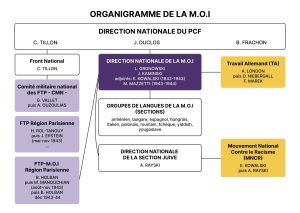
The organization M.O.I. was founded by the Communist Party in 1932; language groups were created to promote the integration in France of workers who were still not fluent in French.
Many Yiddish-speaking Jews who had immigrated from Eastern Europe—driven from their countries by fascism and anti-Semitism—joined the Jewish section of the M.O.I. ( Yiddish-speaking).
The Jewish organizations affiliated with the Jewish section of the M.O.I. are very active and diverse: social and medical services, political information, sports activities, the women’s movement, the youth movement, community centers, a writers’ group, a community choir, and a theater group.
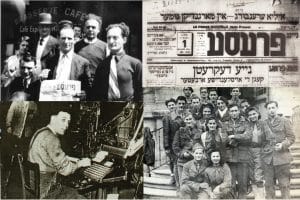
The Yiddish-speaking communists and sympathizers in the Jewish section have a daily Yiddish-language newspaper, the Naïe Presse (The New Press), which published its first issue in January 1934. This newspaper was widely circulated among the prewar Jewish immigrant community. One of its primary objectives was the fight against fascism.
THE JEWISH SECTION DURING THE OCCUPATION: THE ESTABLISHMENT OF THE UNDERGROUND MOVEMENT
From the very beginning of the Occupation, activists from the Jewish section organized a large-scale neighborhood mutual aid effort.
Very early on, in September 1940, acting outside the law, the leaders of the Jewish section founded the organization“Solidarité.” Initially an organization dedicated to mutual aid and information, “Solidarité” quickly became a Resistance organization. Social action was never separated from political action within the organization.
The Jewish section of the M.O.I.—which has gone underground—is also very active in disseminating information.
Naïe Presse reappears clandestinely, at fairly regular intervals, under the title Unzer Vort beginning on September 29, 1940.
*Unzer Vort* and *Notre Voix* or *Notre Parole* (the French-language edition) continued to be published without interruption until the Liberation.
Organizations affiliated with the Jewish section of the M.O.I., such as the Jewish Communist Youth (JCJ) andthe Union of Jewish Women (UFJ), play a specific role in “Solidarity.”
THE EARLY ROLE OF THE JEWISH SECTION IN THE RESISTANCE
As early as 1940 and 1941, Jews who were communist activists took part in armed actions within the groups of the Organisation Spéciale (OS) and the Communist Party’s Youth Battalions.
In April 1942, two Jewish Resistance fighters were killed by an explosive device they were testing. Members of the Jewish section of the M.O.I. were executed.
Very quickly, in May 1942, highly effective armed groups of Francs-tireurs and M.O.I. partisansbegan to form in Paris. Many of them came from the Jewish section. Others would follow in the provinces.
Not all Jewish communists, immigrants from Eastern Europe, and members of the Resistance are affiliated with the Yiddish-speaking Jewish section. Some belong to other language groups within the MO.I., but all are fighting Nazism.
The Jewish section’s civil Resistance took many forms: sabotage, graffiti on walls, finding hideouts for the FTP-MOI, finding families to take in hidden children, clandestine printing operations, forging documents, clandestine intelligence gathering, fundraising, and liaison agents….
The Jewish section of the M.O.I. is, operating underground, on the front lines of the political struggle and the Resistance.
The National Movement contre le Racisme(MNCR) was founded in the summer of 1942 at the initiative of the Jewish section of the M.O.I. They carried out joint actions to rescue Jewish children.
THE NEED FOR UNITY: THE FOUNDING OF THE UJRE
In the spring of 1943, the Jewish sections of the Northern and Southern zones merged to form a single organization:the Union of Jews for Resistance and Mutual Aid (UJRE). It replaced “Solidarité.”
At the same time, the Jewish section of the M.O.I. foundedthe Union of Jewish Youth (UJJ).
In the south, combat groups took the name “UJRE combat groups,” one-tenth of which would join the FTP-M.O.I.
DEVASTATION OF THE JEWISH QUARTER…
In Paris, from March to June 1943, the Special Brigades of the General Intelligence Service led three devastating manhunts.
The human, political, and military organization of the Jewish section of the M.O.I. has been devastated.
In 1944, the unification of Jewish movements—including the UJRE—led to the creation of the Representative Council of French Jews (CRIF).
Jews of all faiths aspire, above all, to liberation and the restoration of the Republic.
THE JEWISH COMMUNITY AFTER THE WAR. RECONSTRUCTION. MEMORY AND HISTORY
After the war, many Jews who survived became active in the UJRE, which was very influential at the time.
The CCE, the Commission Centrale de l’Enfance under the UJRE, founded in 1945, took in Jewish orphans whose parents had been exterminated. The CCE would leave its mark on the postwar period
The history of Jewish Resistance is often overlooked or lost amid the broader memory of persecution. As time goes by, survivors—with the support of their organizations—are raising awareness of their role in the Resistance.
To date, they have all disappeared.
The commitment of the Resistance fighters from the Jewish section of the M.O.I. to the Liberation of France is now part of the work on history and remembrance undertaken by MRJ-M.O.I. through its online museum.