The enactment of decree-laws that led to a discriminatory Jewish Statute and, subsequently, to the systematic extermination of Jews prompted the Jewish population of France to resist through organizations stemming from the Jewish section of the M.O.I., such as the UJCJ.
As early as the summer of 1940, the Jewish section of the M.O.I. decided to organize young immigrants on a specifically Jewish basis. The clandestine group of young Jewish communists, the Union of Jewish Communist Youth, was quickly formed. The UJCJ joined the clandestine organization “Solidarité,” created in September 1940. Many young Jews—active in the French Communist Youth or enrolled in progressive Jewish educational institutions, such as youth centers or sports clubs like the YASC—joined the ranks of the UJCJ. They understood that they had to fight alongside the entire Jewish population, which was in mortal danger from Nazism, and that they had a better chance of survival in hiding.
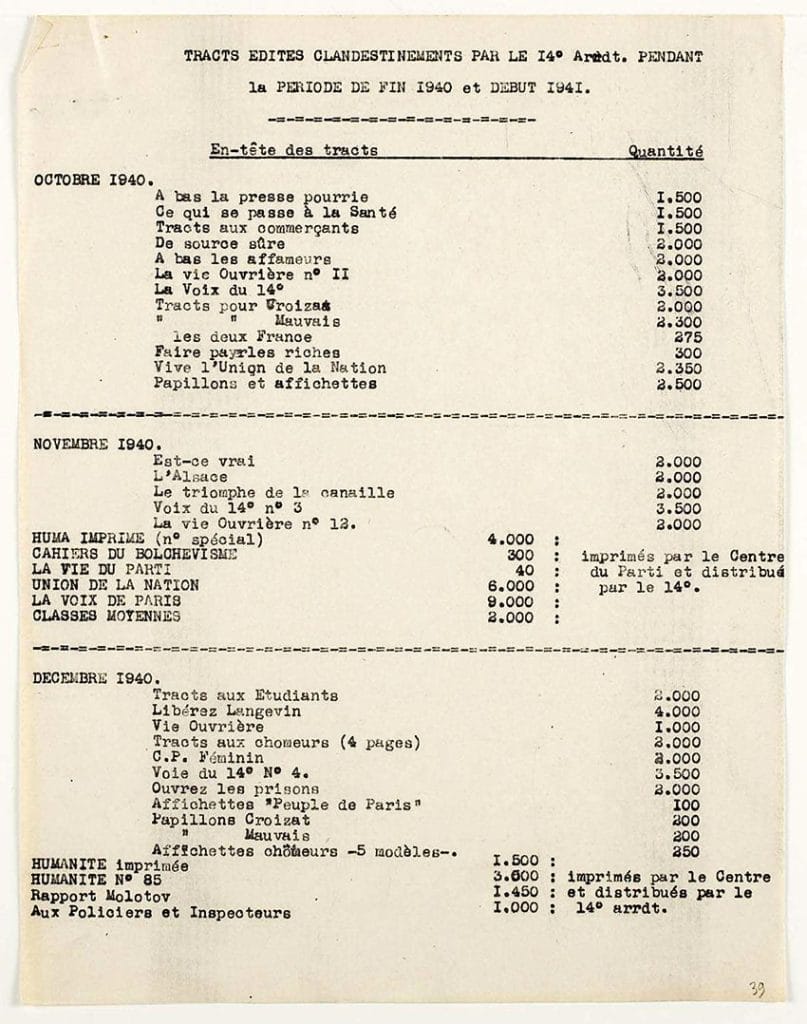
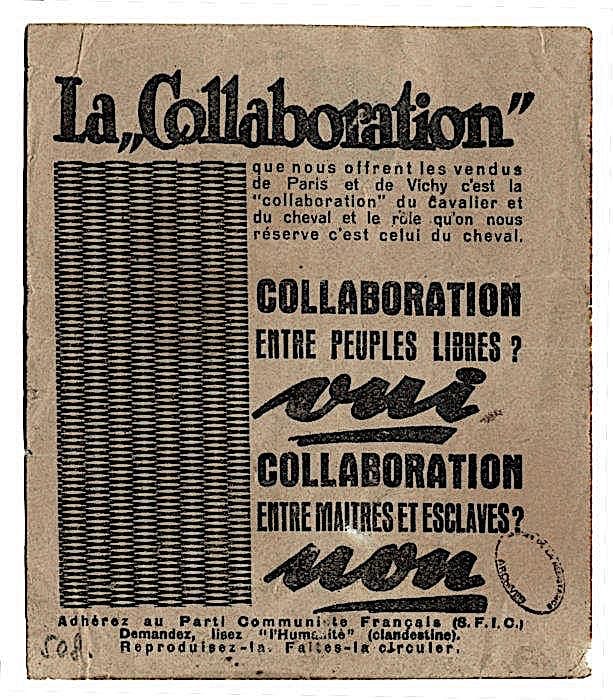
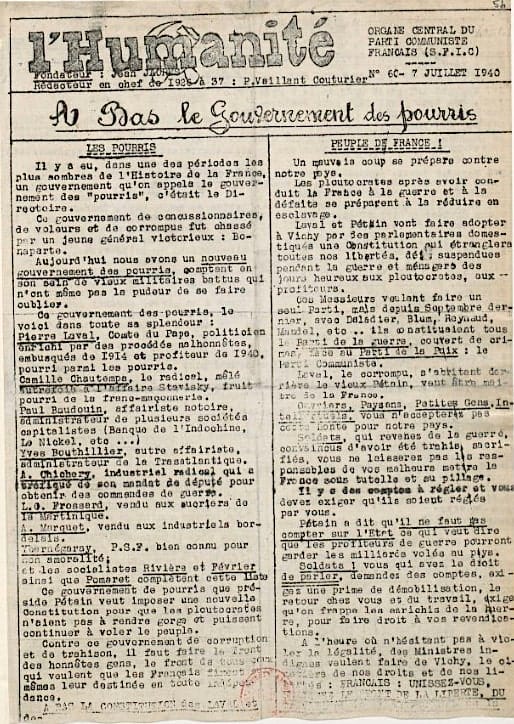
Young people posted “flyers” on walls, distributed leaflets and calls to fight against the Occupier, and warned the Jews of Paris of an impending mass roundup (the Vél’ d’Hiv’ roundup, in July 1942), and help hide children…
As the repression intensified, more young people joined the Jewish Communist Youth, often to avenge their deported parents. Ten percent of them were assigned to the FTP-M.O.I. All these resistance fighters thus combined solidarity with a population doomed to extermination with participation in the national Resistance.
On March 23, 1943, following a lengthy surveillance operation conducted by the Paris Special Brigades, 57 young Jewish Communists were arrested and deported. Only 7 of them would return from Auschwitz.
Reference:
Ravine, Jacques, 1973, *The Organized Jewish Resistance in France (1940–1944)*. Julliard