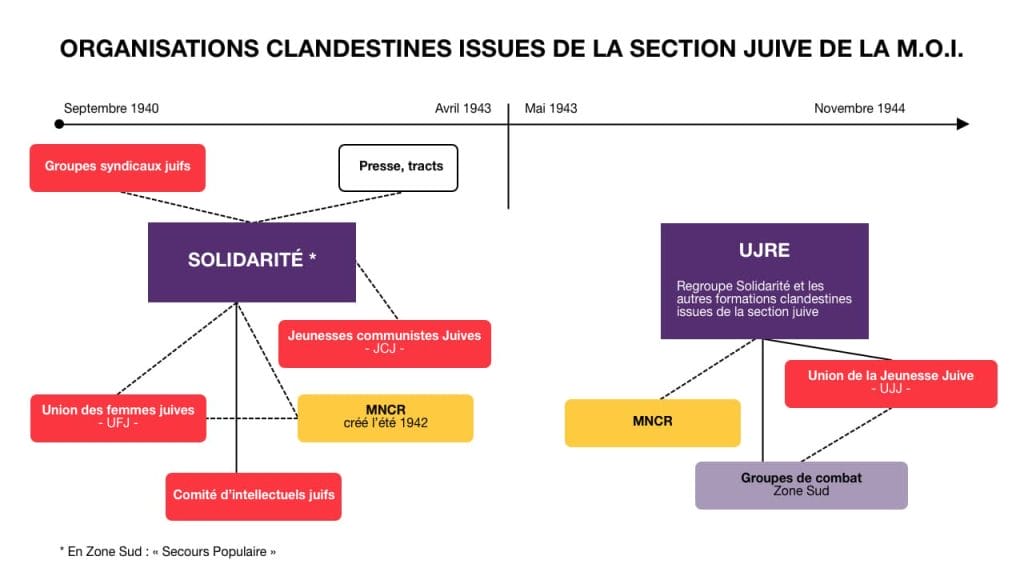
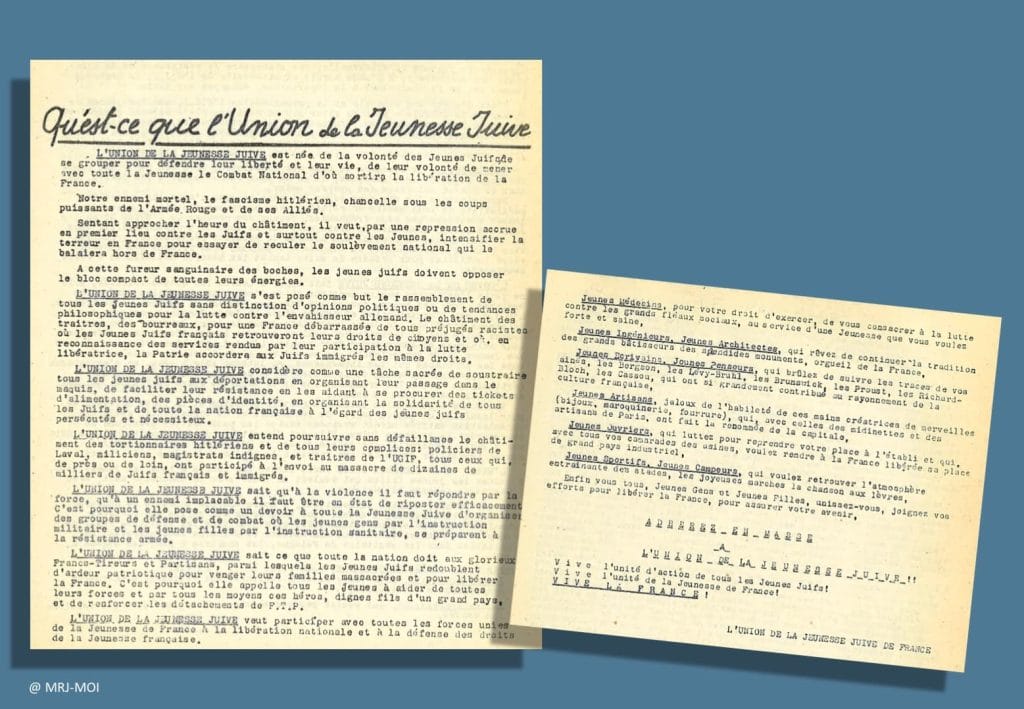
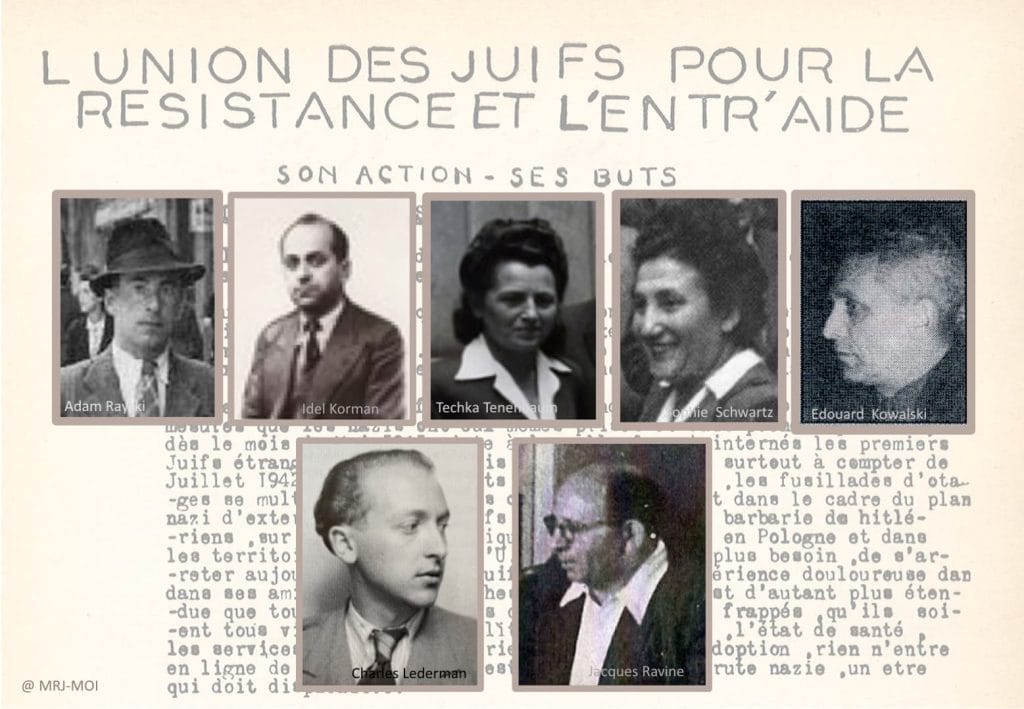
Just as the French domestic Resistance was unifying under the leadership of General de Gaulle, the Jewish section of the M.O.I. redefined its policy and opened its doors to all Jews—immigrants or French citizens, communists or not—and on May 27, 1943, created the “Union of Jews for Resistance and Mutual Aid” (UJRE). The UJRE and the Union of Jewish Youth (UJJ), founded at the same time, organized “combat groups” in southern France.
Founded on May 27, 1943, the Union of Jews for Resistance and Mutual Aid (UJRE) now brought together all the organizations that had emerged from the Jewish section of the M.O.I. At the same time, the youth wing of the UJRE (JCJ) adopted the name “Union of Jewish Youth” (UJJ). After the national leadership of the Jewish section was transferred to Lyon in the southern zone, the UJRE and the UJJ organized “combat groups” in the fall of 1943.
Unlike the fighters of the FTP-M.O.I. groups (formed in 1942)—who operated entirely underground when not engaged in operations and were paid as “full-time members” by the Resistance—the members of the “combat groups” continued to lead normal civilian lives, with families and jobs. Their highly risky actions ranged from putting up posters, distributing leaflets, writing slogans on walls, and making public speeches, to acts of sabotage and armed operations in which they served as reinforcements for the FTP-M.O.I. (which remained very active in the north and south). The most seasoned members may subsequently be transferred to the FTP-M.O.I.; the “combat groups” thus served as a breeding ground for the armed Resistance proper.
They are organized into three detachments for adults and four for youth. For safety reasons, a “triangular” structure is used: each group consists of three teams of three members each. Similarly, at the next higher level, each detachment consists of three groups.
Based on this diagram, we can estimate the size of the UJRE’s “combat groups” at about eighty people (“Denis,” the person in charge of membership, mentions 70 to 80 people). Similarly, the UJJ groups comprise about one hundred young people in total.
In 1944, these “groups” took part in the fighting during the Liberation, particularly in the Villeurbanne uprising.
The UJRE led a Resistance movement that was both specifically Jewish and fully integrated into the broader Resistance. As a member of the National Front for the Liberation and Independence of France (one of the organizations of the CNR), the UJRE, through its “combat groups,” actively contributed, alongside the UJJ, to the fight against Nazism and the liberation of France.
References:
— Collin, Claude, 1998, *Jeune Combat: The Young Jews of the M.O.I. in the Resistance*. Presses universitaires de Grenoble, “Résistances” (PUG)
— Stéphane Courtois, Denis Peschanski, Adam Rayski, 1989, *Le Sang de l’étranger: Les immigrés de la M.O.I. dans la Résistance*. Fayard