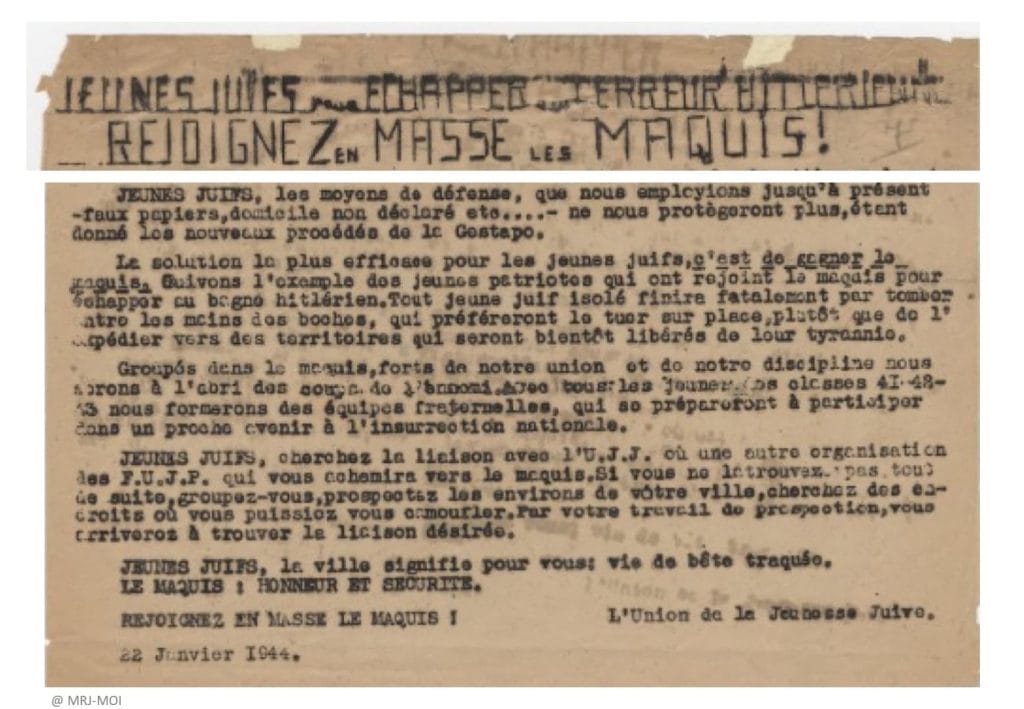
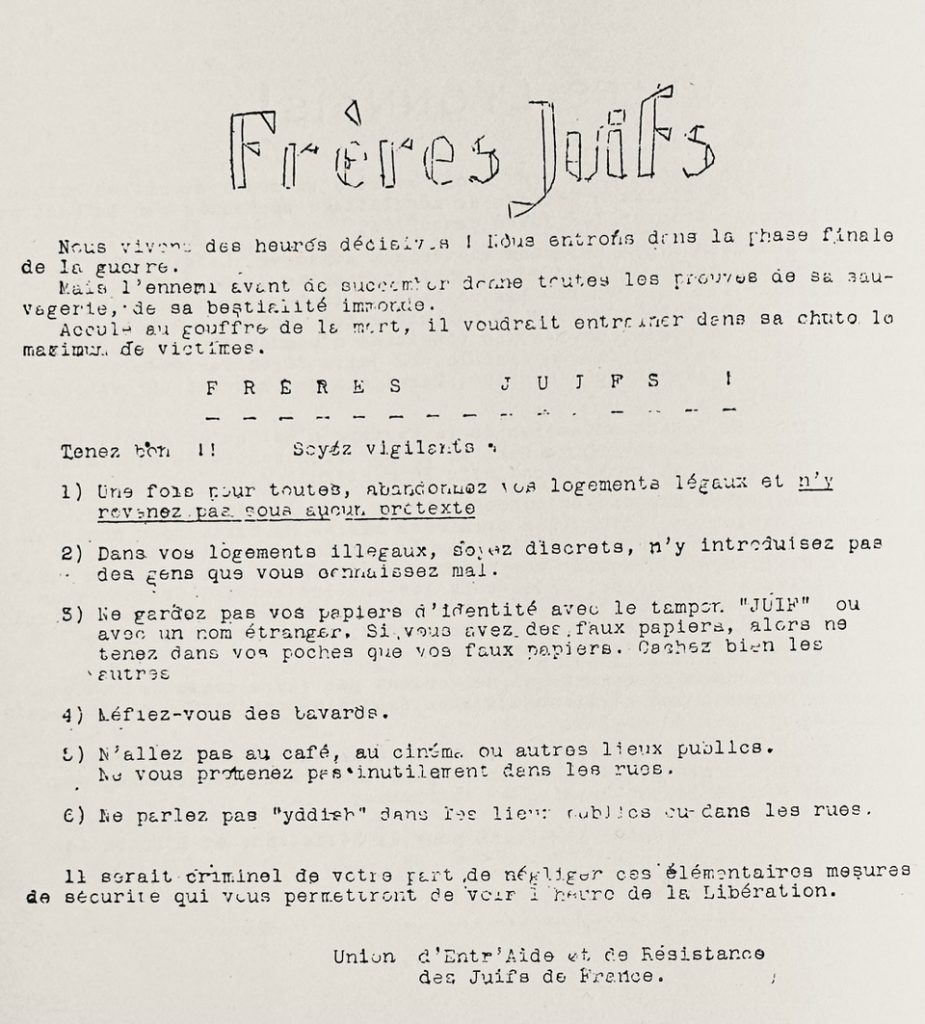
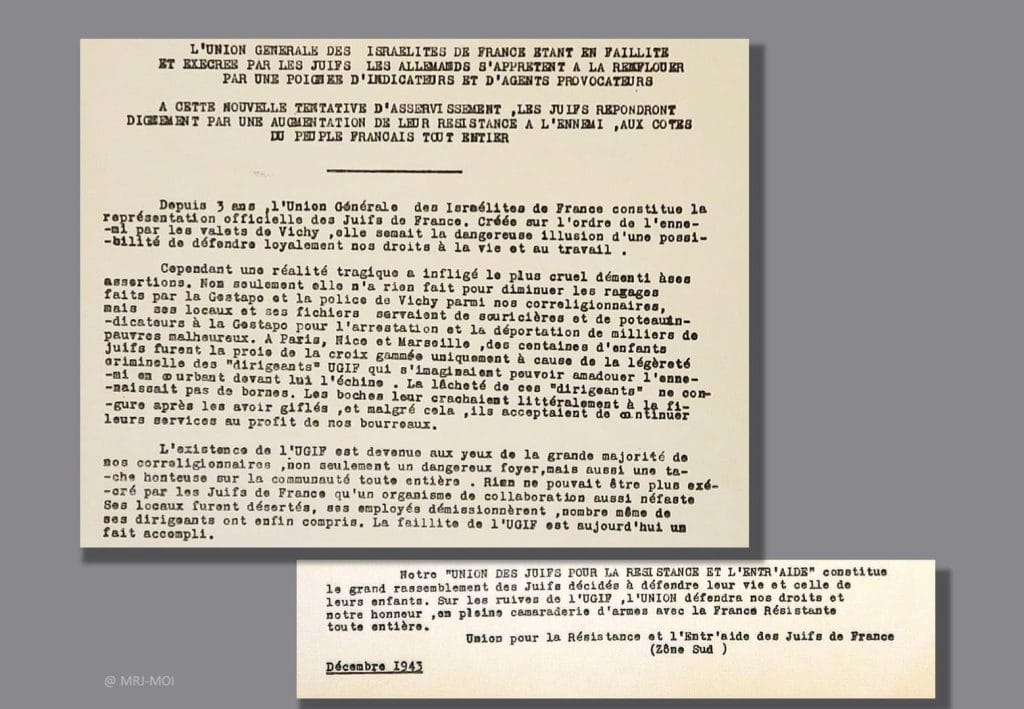
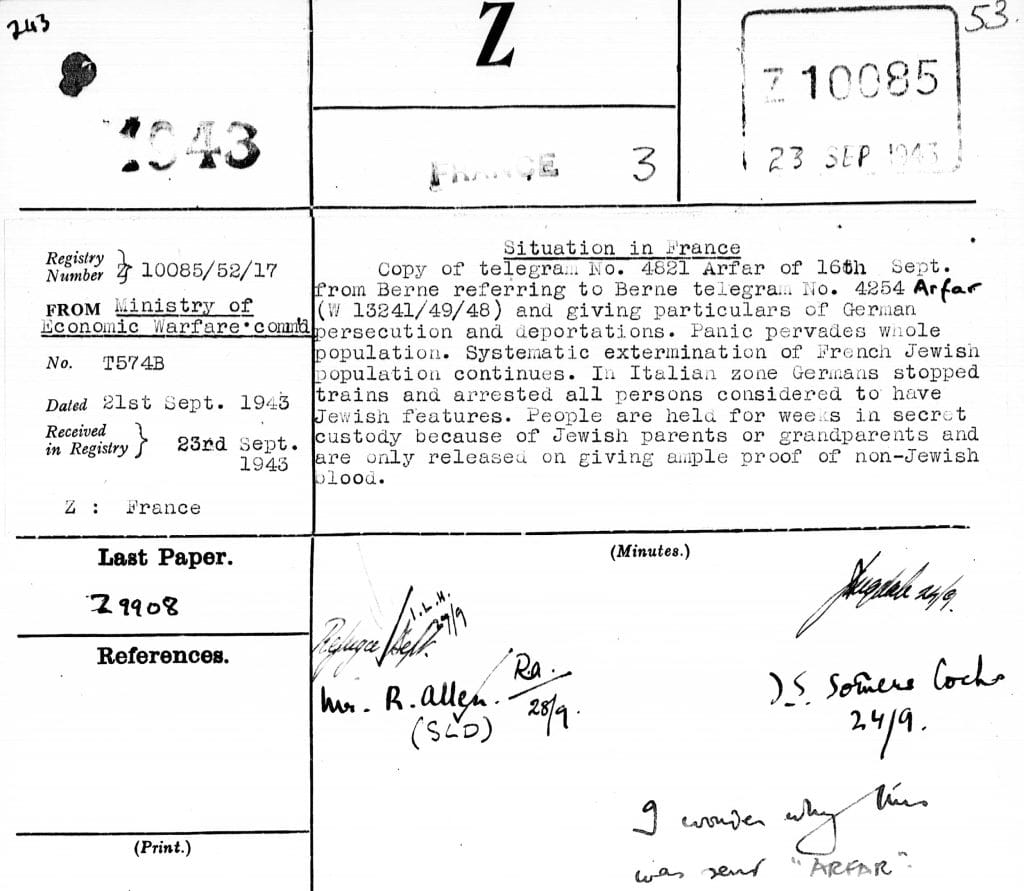
In 1943, the unification of Jewish movements of various persuasions led to the clandestine creation of the Representative Council of French Jews (CRIF). In 1944, the Council drafted a republican charter guaranteeing Jews in France the same rights as other citizens.
In 1943, the Representative Council of French Jews brought together Jewish movements of various persuasions to confront persecution. The term “Israélite,” which fell out of use after 1945, refers to Jews with French citizenship. The awareness of a shared destiny gradually brought them closer to Jewish immigrants. As early as 1943, the clandestine creation of the General Committee for the Defense of the Jews (CGD) marked the first step toward unification. With the Consistoire joining the effort, the CGD led to the founding—bringing together all factions—of the Representative Council of French Jews (CRIF).
Originally, the CRIF consisted only of the Central Consistory (a religious body), the Federation of Jewish Societies (providing material, moral, or legal assistance), the Bund (socialists), and the UJRE (communists). All of them yearned for peace in the wake of the Nazi atrocity. Until the end of the war, they managed to set aside their ideological differences without, however, refraining from expressing them in their respective publications.
In 1944, *Droit et Liberté*, for example—a publication of the Union of Jews for the Resistance and Mutual Aid (UJRE), composed of Resistance fighters from the Jewish section of the M.O.I.—affirmed its communist positions.
In 1944, the Representative Council of French Jews drafted a charter guaranteeing Jews, within the legal framework of the French Republic, equal political, economic, social, and religious treatment with other citizens. The charter also called for the restitution of their property, which had been confiscated by the Nazis with the complicity of the Vichy regime. For the first time in Jewish history, the CRIF emerged as a single representative body whose foundations were not religious.
While retaining the same acronym, CRIF became, after the war, the Representative Council of Jewish Institutions in France.
In 2009, the UJRE suspended its participation in the Council. It condemned the CRIF’s lack of pluralistic and progressive representation, which it saw as contrary to its original humanist values.
Reference:
Thomas Vescovi, 2020, “The Jews of France and Israel,” *Le Monde diplomatique*.