The Naïe Presse, which had been banned during the war, reappeared clandestinely under the title Unzer Wort (or Unzer Vort ), and later as Notre Parole and Notre Voix in the French version. The publication of the Jewish section of the M.O.I. informed readers about the crimes of the Nazis and the Vichy regime and called for Resistance.
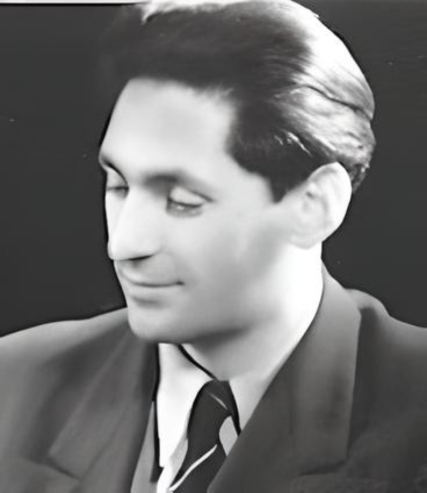
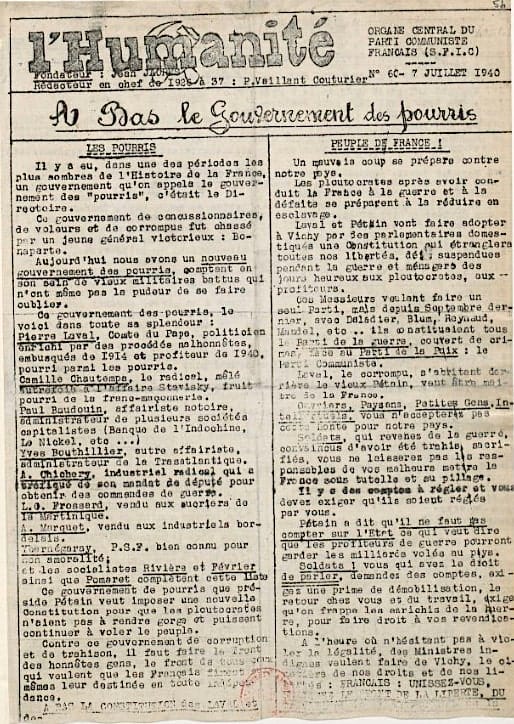
L’Humanité had been banned by the Daladier government since August 26, 1939, but La Naïe Presse continued to be published until the end of September before it, too, was banned. Adam Rayski, the former editor-in-chief of La Naïe Presse, who was deeply committed to the cause, decided to distribute an underground publication as soon as possible. The first issue, in Yiddish and titled *Unzer Wort* ( or *Unzer Vort*), was published on July 15, 1940.
Unzer Wort began reappearing at fairly regular intervals starting on September 29, 1940. Subsequently, the French-language edition, published in the northern zone, was titled *Notre Parole*—the voice of progressive Jews opposing fascism and anti-Semitism.As the main mouthpiece of the Jewish Resistance during the Occupation, the newspaper denounced (in Yiddish and French) the mass internments of foreign Jews and the discriminatory measures taken against Jews, and issued calls to join the Resistance.
In late March 1941, the first arrests of Jewish communists took place in Paris. Eight activists were apprehended, including Isidore Fuhrer, at whose home authorities discovered a typewriter with Hebrew characters (used in Yiddish) and a stencil intended for *Unzer Wort*.
As early as August 8, 1941, an issue of *Unzer Wort* urged “the Jewish masses” to stand “as always, hand in hand with the French people in the struggle against fascism, for a free France,” where Jews would be “free citizens.”
On August 24, 1941, Jewish intellectuals and artists from the USSR revealed on Radio Moscow the mass killings of Jews in the East and called on Jews around the world to intensify their fight against Nazism. The appeal was published on September 1, 1941, in France in a special issue of*Unzer Wort* printed by Rudolf Zeiler.
In June 1942, in Lyon, the Southern Zone edition of *Unzer Wort* and its French version, *Notre Voix*, were published.
90 issues of *Unzer Wort* were published, in both Yiddish and French, between 1940 and 1944.
Jews were executed for spreading communist and anti-Nazi ideas.
Leaders of the Jewish underground press were specifically targeted: about thirty of them were shot or deported.
Reference:
Cukier, Simon; Decèze, Dominique; Diamant, David; Grojnowski, Michel, 1987, Revolutionary Jews. Messidor/Éditions sociales