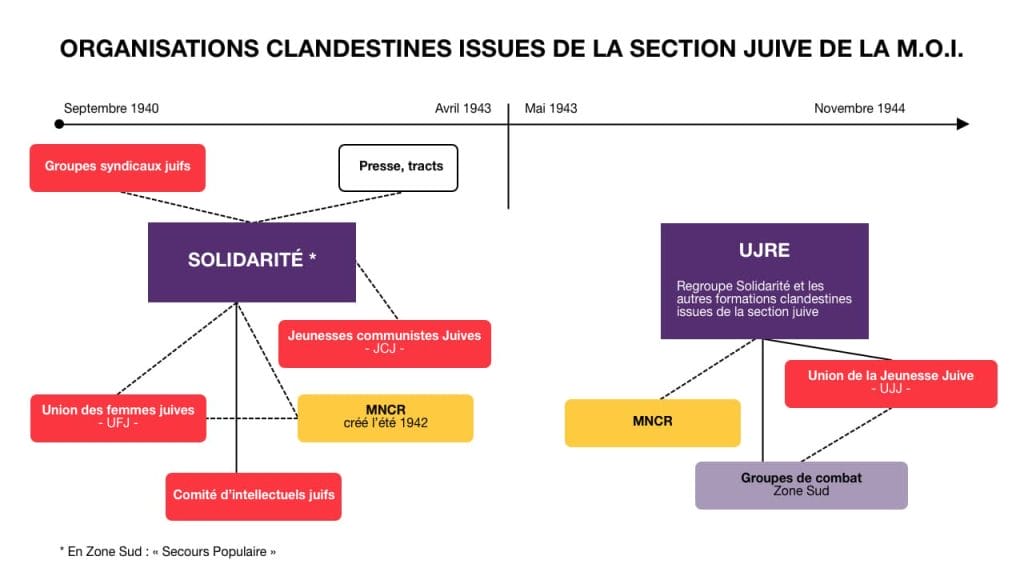
In the early months of the Occupation, young Jewish communists were organized within the French Communist Youth (JC). In 1942, it was decided—primarily for security reasons—to separate young Jewish Communists from their non-Jewish comrades and place themunder the authority of the Jewish section of the M.O.I.
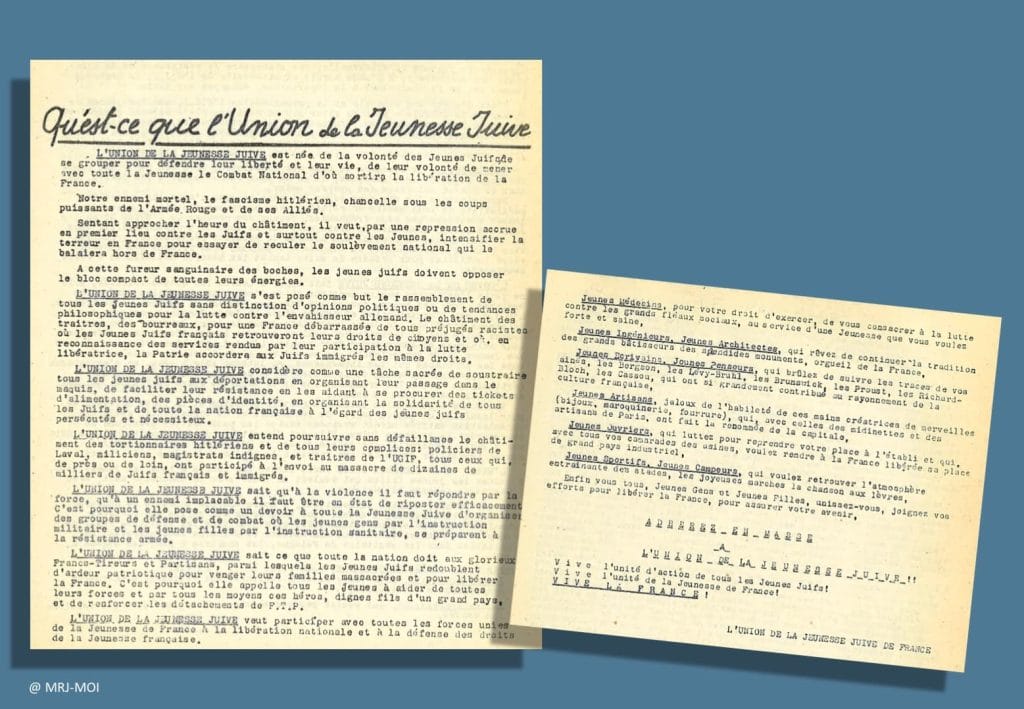
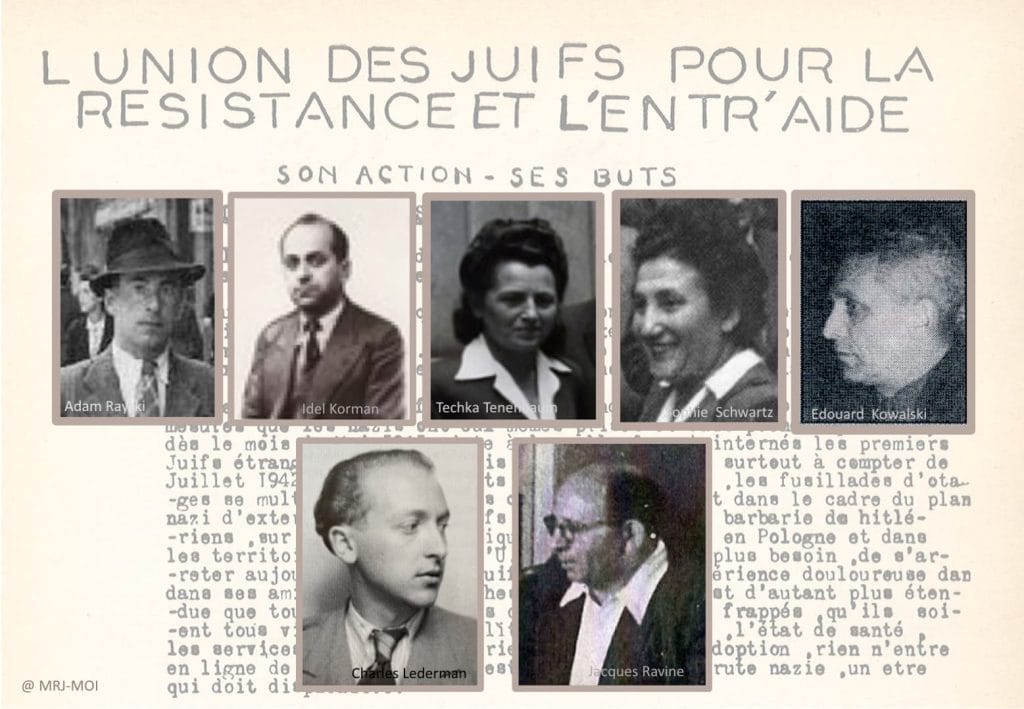
In early 1943, the Jewish section decided to consolidate its forces and created the Union of Jews for Resistance and Mutual Aid (UJRE), for adults, and the Union of Jewish Youth (UJJ), for young people.
In 1943, the national leadership of the Jewish section of the M.O.I., having suffered numerous arrests, retreated to Lyon, where it settled permanently. The UJJ would grow primarily in the southern zone.
It seeks to distinguish itself from the Jewish Communist Youth but remains closely tied to it and, above all, serves as a gathering of supporters, regardless of their political views.
The JC/UJJ is composed of 65% boys and 35% girls, and is notable for its large number of very young activists. Almost all of them are of Ashkenazi Jewish descent from Central and Eastern Europe, primarily of Polish origin. They come from families of artisans or workers employed in small garment workshops. Eighty percent of them lived in Paris or the Paris region before the war.
Many of them knew each other before arriving in Lyon, Grenoble, or Toulouse. These young people are largely integrated into French society, but they still maintain ties to their culture of origin.
In January 1944, the Jewish JC in the southern zone had 165 members. At the same time, the UJJ had 194 members. Four months later, their membership had nearly doubled. From the very beginning, the young people in the Jewish section of the M.O.I. served as a pool of recruits for the FTP-M.O.I. Furthermore, the UJJ, like the UJRE, began organizing “combat groups” as early as late 1943 Armed with revolvers, these groups seized food ration tickets from town halls, sabotaged road signs, and attacked the storefronts of shopkeepers known to be collaborators… They even occasionally disarmed police officers or seized weapons from German soldiers.
Over the course of the months, their actions became increasingly coordinated with those of the UJRE’s “adult” combat groups and, in the weeks leading up to the Liberation, even with those of the FTP-M.O.I. Young members of the UJJ, organized into three units, actively participated in the Villeurbanne uprising from August 24 to 26, 1944, alongside fighters from the FTP-M.O.I. “Carmagnole” group.
Reference:
Personal note by Claude Collin, a historian specializing in the Resistance in the southern zone.