In the spring of 1943, the leaders of organizations affiliated with the Jewish section of the M.O.I. decided to unite the forces of all progressive Jews fighting against the Nazi occupiers and created a new underground organization: the Union of Jews for Resistance and Mutual Aid (UJRE).
The Allied landing in North Africa in November 1942 and, above all, the Soviet victory at Stalingrad marked a turning point in the war. By the end of 1942, the French Communist Party had reactivated the National Front for the Liberation and Independence of France, founded in 1941, which was open to all French people opposed to the Occupiers and Nazi collaborators. The creation of the UJRE was part of this same effort to broaden its base.
After the Germans entered the southern zone and the mass deportations began, it became clear that Jews—whether immigrants or French citizens—shared a common fate.
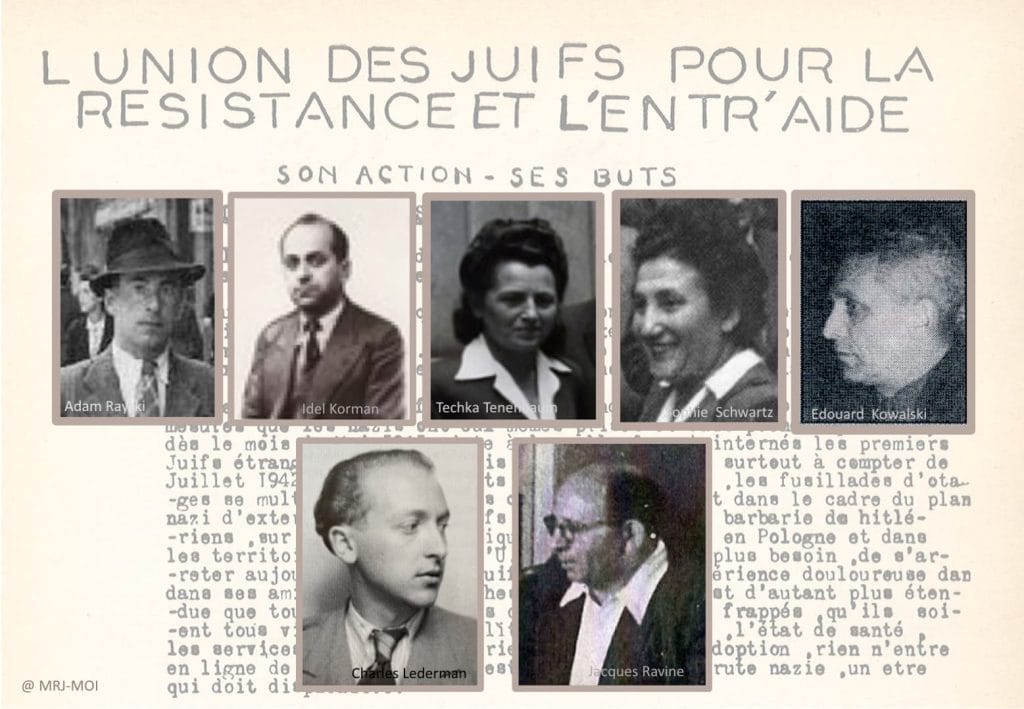
It was against this backdrop that, in the spring of 1943, a clandestine conference was held attended by seven leaders of Resistance centers in the Northern and Southern Zones affiliated with the Jewish section of the M.O.I.: Idel Korman, Edouard Kowalski, Adam Rayski, Sophie Schwartz, and Thérèse Tennenbaum from the Paris leadership, and Charles Lederman and Jacques Ravine from the Southern Zone leadership.
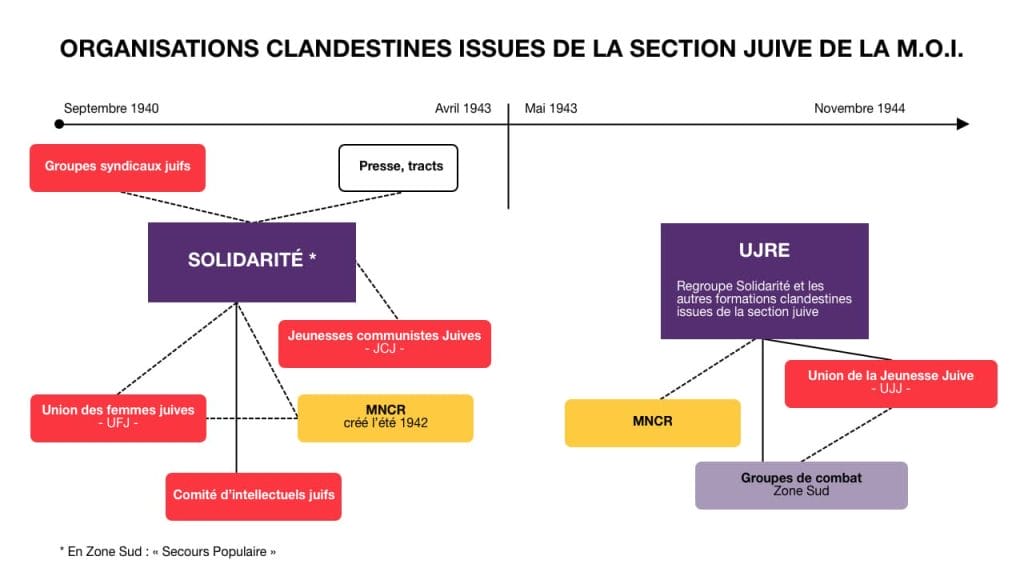
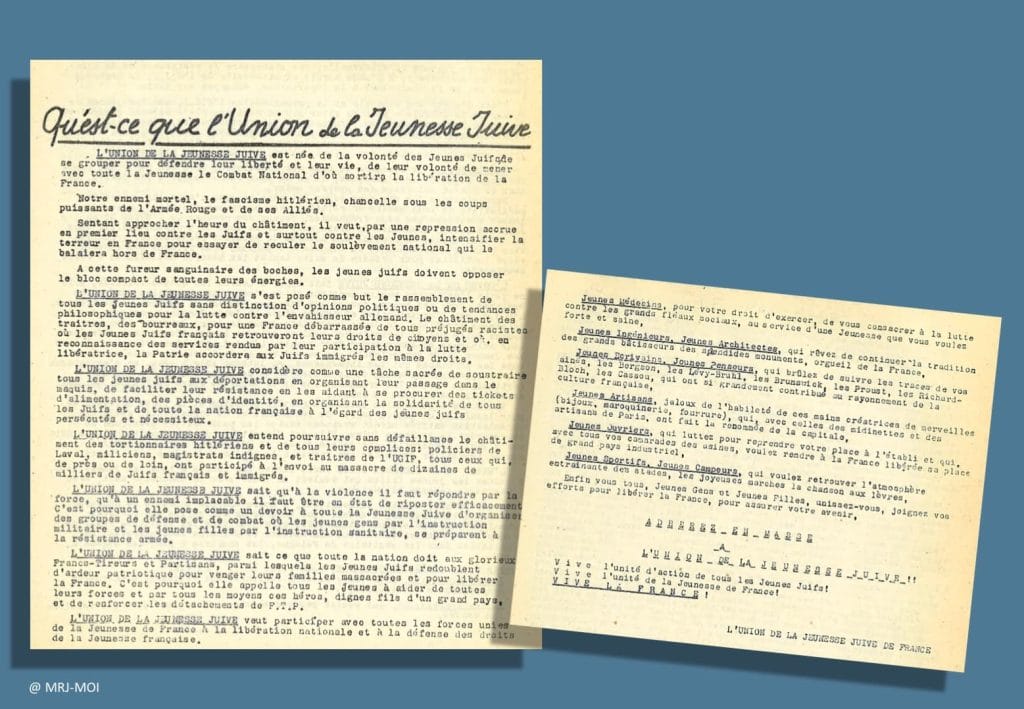
They decided to create a central clandestine coordinating body, the Union of Jews for Resistance and Mutual Aid (UJRE), which brought together other clandestine organizations: “Solidarité” from both zones, the Union of Jewish Youth (UJJ), the Union of Jewish Women (UFJ), the Jewish Popular Relief Committees, the Jewish Inter-Union Commission, and the Jewish armed groups of the FTP-M.O.I.
*Notre Parole*, *Droit et Liberté* have become the official publications of the UJRE in French. *Unzer Wort* is published in Yiddish.
The UJRE aimed to be open to all Jews. It also spearheaded the partial unification of the Jewish Resistance under a General Defense Committee, leading to the creation in 1944 of the CRIF, the Representative Council of French Jews.
Combat groups already exist under the auspices of “Solidarité.” They are known as “UJRE combat groups” and have expanded significantly. Unlike the FTP-M.O.I., their members continued to hold civilian jobs. They operated either in support of the FTP-M.O.I. or independently. These groups played a prominent role in the battles of the Liberation.
Thanks to its multifaceted activities, the UJRE’s influence among the progressive Jewish immigrant community was considerable at the time of the Liberation.
References:
— Ravine Jacques, 1973, *The Organized Resistance of the Jews in France*, Julliard.
— Diamant, David, 1971, *The Jews in the French Resistance*, Le Pavillon.
— Simon Cukier, Dominique Decèze, David Diamant, Michel Grojnowki, 1987 , *Revolutionary Jews*, Messidor/Éditions sociales.