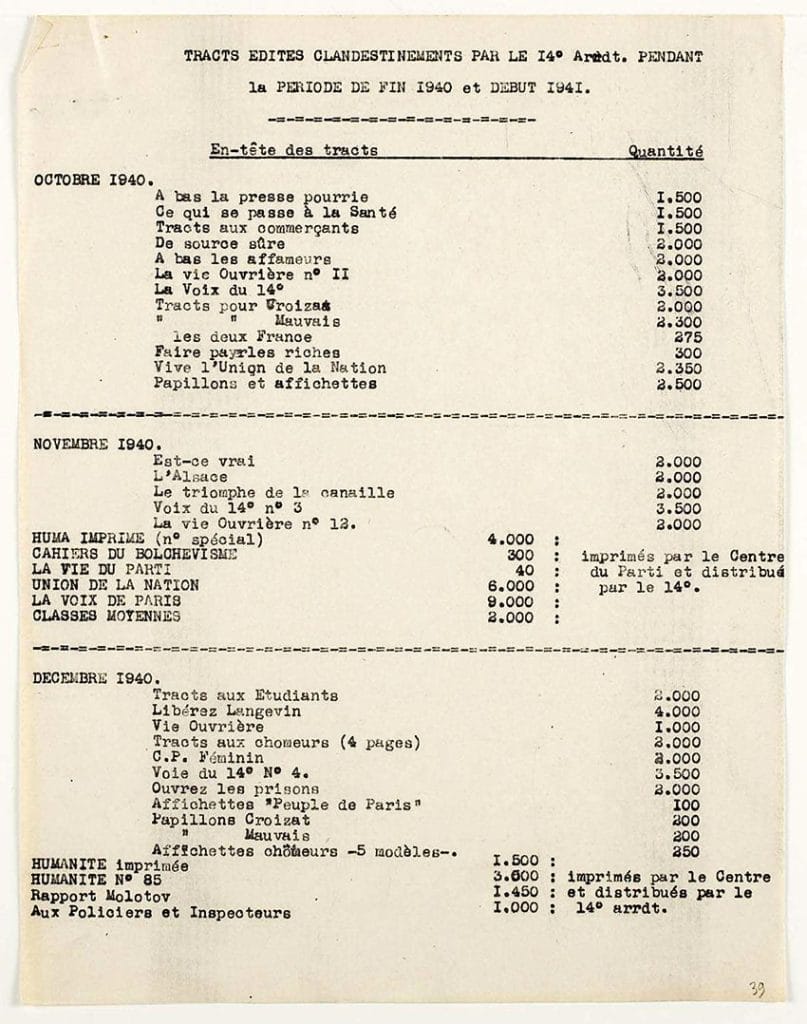
The Party is undertaking a reorganization. The attempt to resume legal publication of*L’Humanité*, negotiated with the Germans, is quickly abandoned and condemned by the leadership in exile in the USSR.
The enemy being denounced is, above all, the Vichy government, which hunts down and arrests activists.
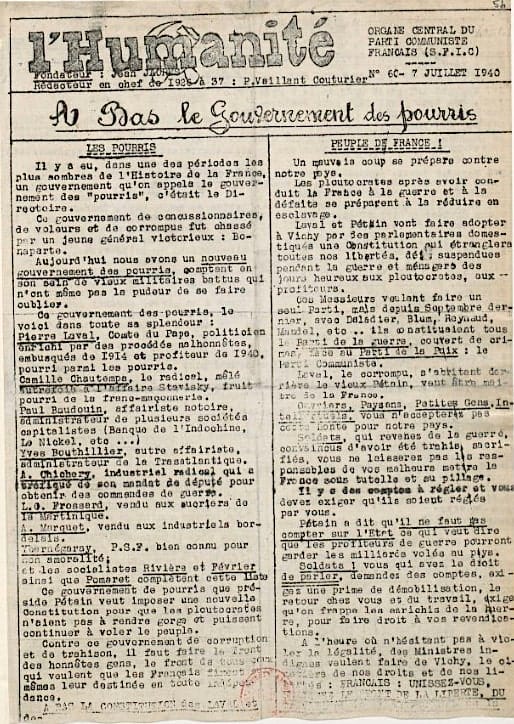
In fact, as early as June and early July, several documents drafted by Party leaders emphasized national independence. This was the case with the appeal issued by Charles Tillon* in Bordeaux. The declaration, signed in Moscow between June 17 and 19, 1940, by Maurice Thorez* and André Marty*, states that “from now on, what is at stake is the very existence of our people as a sovereign nation, and of France as an ‘independent state.’” A few weeks later, just as both chambers in Vichy were voting to grant Pétain full powers, the PCF adopted an Appeal to the Peuple de France, which would come to be known after the war as the Appeal of July 10, 1940, signed by Jacques Duclos* and Maurice Thorez*. The appeal does not name the occupier but targets above all “the traitors of Vichy,” denounces “the humiliation of the Occupation,” and repeatedly invokes the “right to independence.” With relatively limited circulation, this text was not even mentioned bythe undergroundedition of *L’Humanité*, which instead focused on the plight of widows and orphans, the disappearance of one and a half million prisoners, and the shortages caused by the Occupation’s requisitions.
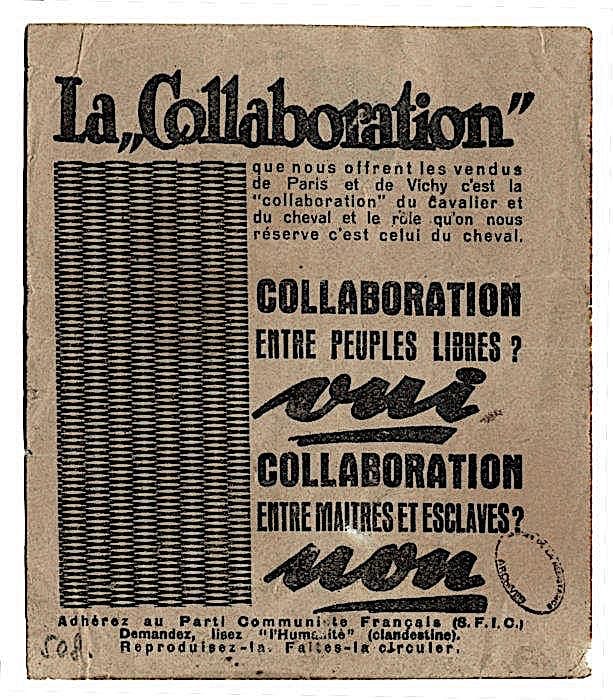
At first, the fight against the Nazis was not the main focus of communist activity. In 1940, the primary adversary was Philippe Pétain, the “German puppet.”
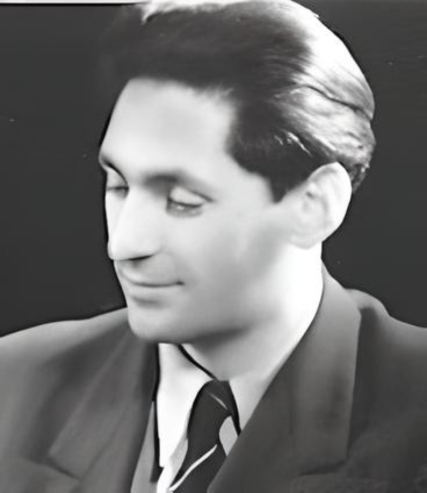
*Leaders of the French Communist Party*
Reference:
Martelli, Roger; Vigreux, Jean; Wolikow, Serge, 2020. The Red Party: A History of the PCF, 1920–2020. Armand Colin