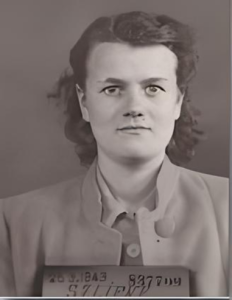
, née Szlifke (or Sliwka)
Paulette Szlifke was born in Paris in 1924 into a Yiddish-speaking Polish Jewish family. Her father, a communist, was active in the CGT Leather and Hides Workers’ Union and in the Yiddish-language group of the M.O.I., which had been founded by the Communist Party. Paulette attended youth centers affiliated with the Jewish section of the M.O.I., participated in their activist efforts, and learned about the plight of Jews under the Nazi regime.
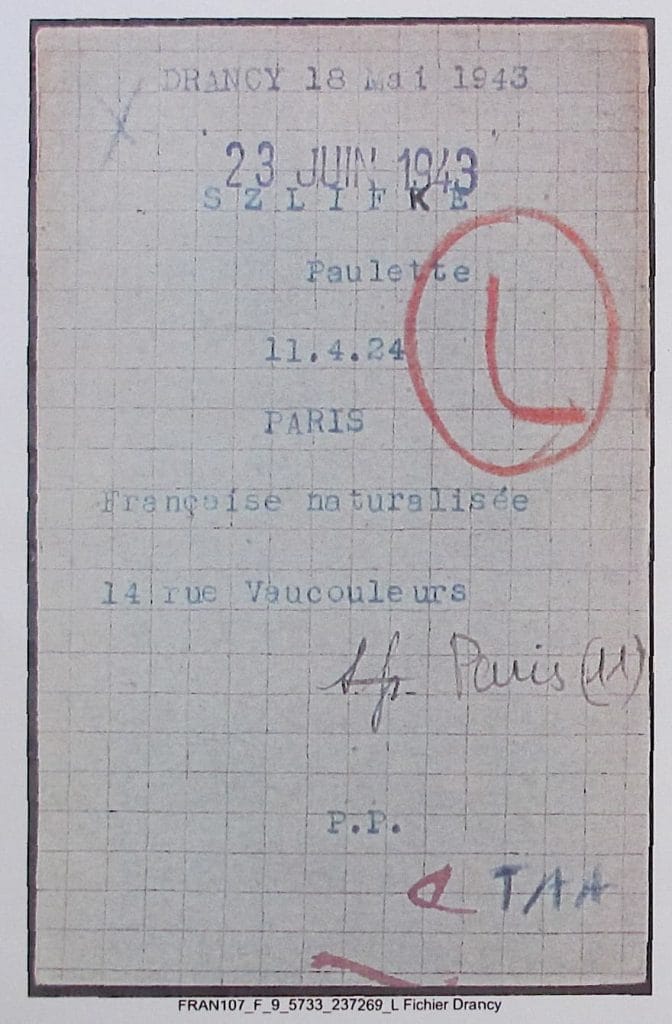
As a member of the Jewish Communist Youth, she became involved very early on in the struggle against the Vichy regime and Hitler’s barbarism. Together with her friends from the youth club, she plastered the walls of Paris with small posters and distributed leaflets at markets, in neighborhood movie theaters, in factories, and in the metro. Together, they set fire to road signs intended for the German army and organized demonstrations with the Young Communists of Paris. Before the Vél’ d’Hiv’ roundup, having been tipped off by the “Solidarité” organization, they warned many Jews to seek safe havens. In 1943, these young people were arrested by the Special Brigades, sent to Drancy, and deported to Auschwitz-Birkenau in 1943. Paulette was 19 years old.
Upon arriving at the camp after a three-day journey in sealed freight cars, the men and women were separated, and the majority were gassed immediately. Paulette and several of her fellow prisoners were assigned to work details. A witness to the daily horrors, she would later recount, in particular, the hanging of the four young women involved in theSonderkommando revoltthat destroyed two of the four crematoria in September 1944.
Paulette owes her survival to the camp’s internal Resistance, organized by the clandestine International Committee, which provided ongoing support to the deportees. Her main contact there was Marie-Claude Vaillant-Couturier, a leader in the PCF.
After a “death march” that took them to Ravensbrück and Neustadt, the surviving female deportees were liberated by the Soviets in early May 1945.
Back in France, Paulette devoted herself to the children of those who had been deported and shot, and became an activist with the CCE (Commission Centrale de l’Enfance) as part of the UJRE, to which she felt a deep personal attachment.
Throughout her life, she bore witness to honor the vow she made upon her arrival at Auschwitz: “[…] if any of us survives, she must tell the story so that the world will know… I kept my word: I told the story, spoke out, and bore witness throughout my life…”
In 2015, *Paula, Survivor Against All Odds* was published—the story of a Jewish woman, a communist, and a member of the Resistance.
Paulette Szlifke, better known as Paulette Sarcey, died in Montreuil on May 4, 2020.
References:
— Sarcey Paulette with Karen Taïeb, 2015, *Paula: Surviving with Determination*. Tallandier.
— Jean-Patrick Lebel: 1986, *La cité de la Muette* (film)
— Photo: © Paris Police Prefecture