Titled “The Army of Crime,” the “Red Poster” features medallion-style portraits of 10 FTP-M.O.I. members accused of terrorism and sentenced to death during the trial of the “23” on February 19, 1944. It would become a symbol of the commitment of foreigners to the Resistance in France.
The urban guerrilla warfare successfully waged in Paris by the FTP-M.O.I. instilled a sense of insecurity among the occupying forces and boosted the morale of the population. Beginning in 1942, the Special Brigades of the Prefecture of Police (BS), in collaboration with German security services, targeted the M.O.I.’s political and military Resistance organizations.
The third BS surveillance operation (July–November 1943) led to 68 arrests. These 68 Resistance fighters were handed over by French police to the Occupation authorities. Forty-five were deported to Germany. For the remaining 23, the Germans decided to stage a high-profile trial.
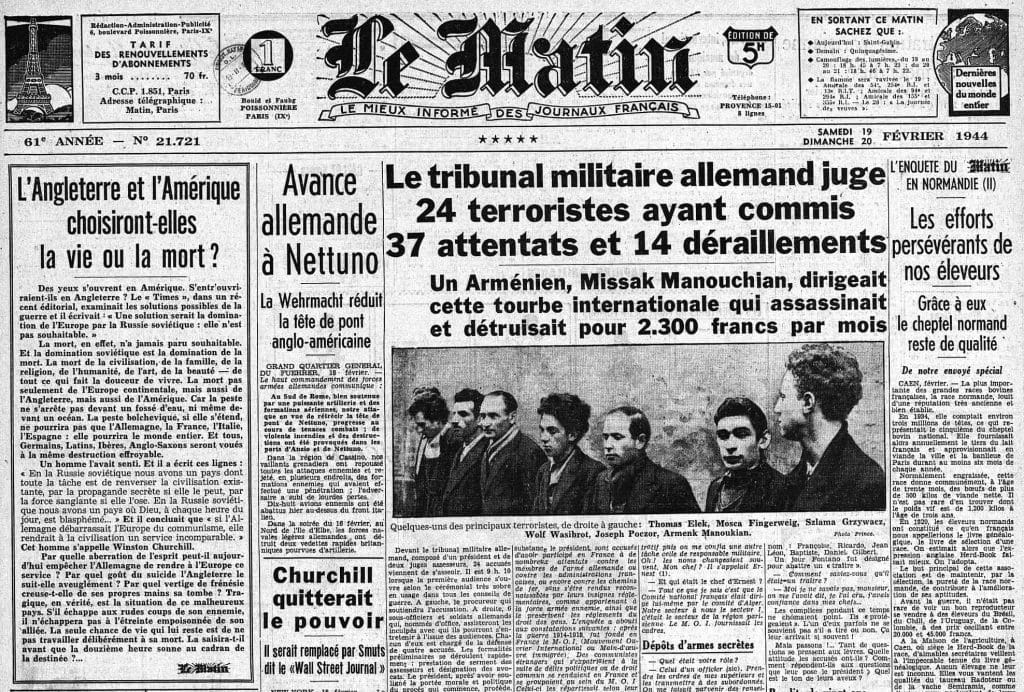
The downfall of the FTP-M.O.I. also extended to the FTPF. Forty French Resistance fighters were arrested in December 1943. Their trial was separated from that of the M.O.I. in order to mount a xenophobic and anti-Semitic campaign centered on the “Red Poster.” The press announced the trial of “23 Jews and foreign terrorists” at the Continental Hotel. This trial lasted only one day (a single hearing) on February 19, 1944, but lengthy reports were published for four consecutive days through Tuesday, February 23—two days after the condemned were executed.
The Propagandastaffel (the German propaganda office), in collaboration with the Vichy authorities, wants to give the impression that a genuine, lengthy trial is taking place, during which all the defendants have the opportunity to speak.
The German military court sentences the “23” to death. A red poster is plastered on every wall in France’s major cities. Distributed as leaflets and brochures, it is intended to discredit the Resistance, which is portrayed as an army of “Jews and immigrants who are terrorists and are in the pay of England and the Russian Bolsheviks.” Of the 23 resistance fighters, half are Jews and identified as such; photos of seven of them appear on the poster, which becomes a symbol of the foreign Resistance to Nazism: Grywacz, a Polish Jew; Elek, a Hungarian Jew; Wasjbrot, a Polish Jew; Witchitz, a Hungarian Jew; Fingerweig, a Polish Jew; Boczov, a Hungarian Jew; Rajman, a Polish Jew.
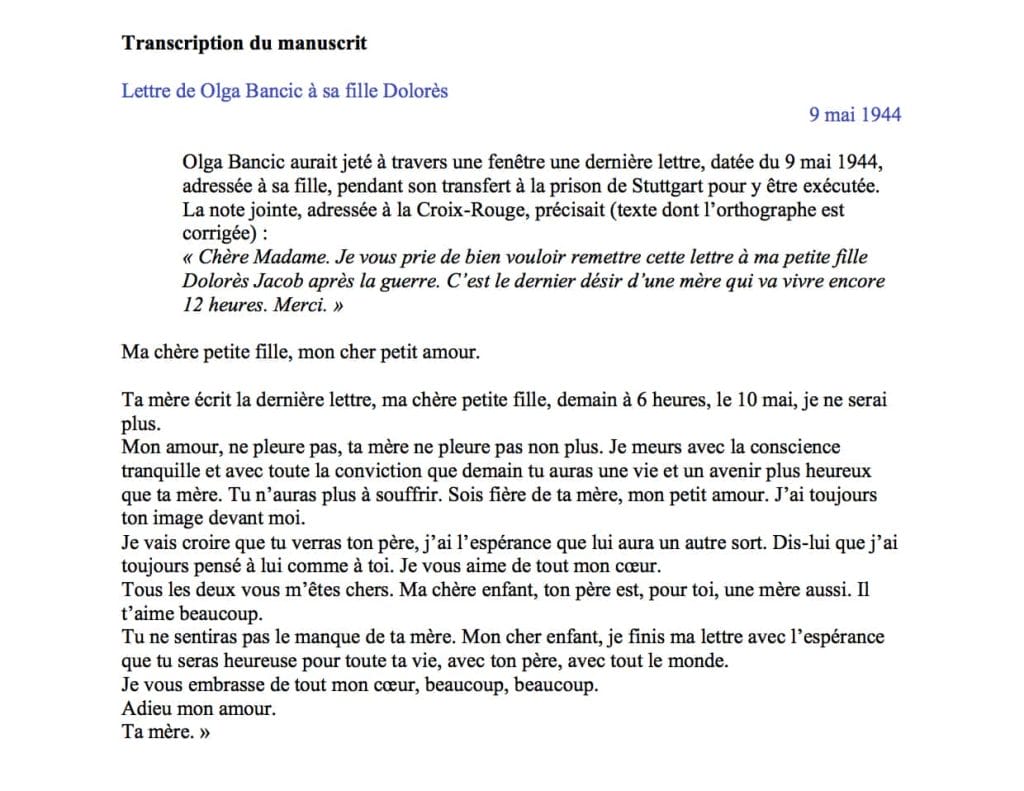
The 23 men were executed by firing squad on February 21, 1944, at Mont-Valérien. Golda (Olga) Bancic, the only woman, was transferred to Stuttgart, where she was beheaded on May 10, her 32nd birthday.
In 1955, a street named “Rue du Groupe Manouchian” was inaugurated in Paris’s 20th arrondissement, named after the (Armenian) military leader of the FTP-M.O.I. in Paris, whose portrait appears on the “Affiche rouge.”
The poet Louis Aragon wrote “Strophes pour se souvenir,” which was published on the front page of *L’Humanité* on March 6 , 1955. The poem ends with these lines:
23 foreigners—and yet our brothers
23 People Who Love Life to Death
23 who were shouting, “France is falling!”
The 23
They were inducted into the Panthéon (along with Joseph Epstein) alongside Mélinée and Missak Manouchian on February 21, 2024. A plaque commemorates the names of these 23 companions of Manouchian.
Celestino Alfonso, Spanish
Olga Bancic, a Romanian Jew
Joseph Boczov, a Hungarian Jew
Georges Cloarec, French
Rino Della Negra, French
Thomas Elek, a Hungarian Jew
Maurice Fingercwajg, a Polish Jew
Spartaco Fontanot, Italian
Jonas Geduldig, a Polish Jew
Emeric Glasz, a Hungarian Jew
Léon Goldberg, a Polish Jew
Szlama Grzywacz, a Polish Jew
Stanislas Kubacki, a Polish Jew
Cesare Luccarini, Italian
Missak Manouchian, Armenian
Armenak Arpen Manoukian, Armenian,
Marcel Rajman, a Polish Jew
Roger Rouxel, French
Antoine Salvadori, Italian
Willy Schapiro, a Polish Jew
Amedeo Usseglio, Italian
Wolf Wajsbrot, a Polish Jew
Robert Witchitz, French
Reference:
Rayski Adam, 2009,“L’Affiche Rouge.” Published by the City of Paris.