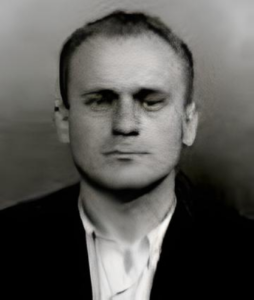
, known as Colonel Gilles; Joseph André (or Andrej); André Duffau
Born in Zamość, Poland, on October 16, 1911, Joseph Epstein came from a well-to-do family with a Yiddish cultural background. From a very young age, he joined the ranks of the Communist Party of Poland and took part in the struggle against the dictatorial government of Józef Piłsudski. He studied law at the University of Warsaw.
He was arrested while giving a speech in front of a factory; after being released on bail, he left Poland for Czechoslovakia.
He was immediately expelled, moved to France in 1931, and earned his law degree in Bordeaux.
In 1936, when the Spanish Civil War broke out, he was one of the first volunteers. He fought alongside the Spanish Republicans in the International Brigades and was seriously wounded on the Irun front. While recovering, he took part in France in the efforts of the shipping company “France Navigation,” which was responsible for transporting weapons to Republican Spain.
He took part in the Battle of the Ebro under the pseudonym Joseph André and was mentioned in the Army’s orders of the day; he was promoted to captain. After the fall of the Spanish Republic in 1939, he returned to France and was interned at the Gurs camp. He was released in July 1939.
Joseph Epstein, who had enlisted in the Foreign Legion, was taken prisoner in May 1940. He was sent to a stalag in Germany, from which he escaped in December 1940 and joined the underground resistance in France with the Francs-tireurs et Partisans (FTPF, or simply FTP).
Initially serving as the chief leader, in 1942, of the sabotage and destruction groups (GSD) created by the CGT unions within companies forced to work for the Occupying forces, he became the military commander of the FTP in the Paris region in February 1943, under the alias Colonel Gilles. Instead of the groups of three Resistance fighters—the standard in the underground organization—he came up with the idea of forming units of ten to fifteen fighters capable of carrying out a number of spectacular operations. This organizational structure ensured the protection of bombers and grenadiers who carried out their attacks one after another in rapid succession. Epstein thus established a “urban guerrilla” tactic that was implemented by the FTP and the FTP-M.O.I. Blowing up trains and railroad tracks, destroying power poles and bridges, and sabotaging factories—these guerrilla tactics were the ones he had learned during the Spanish Civil War.
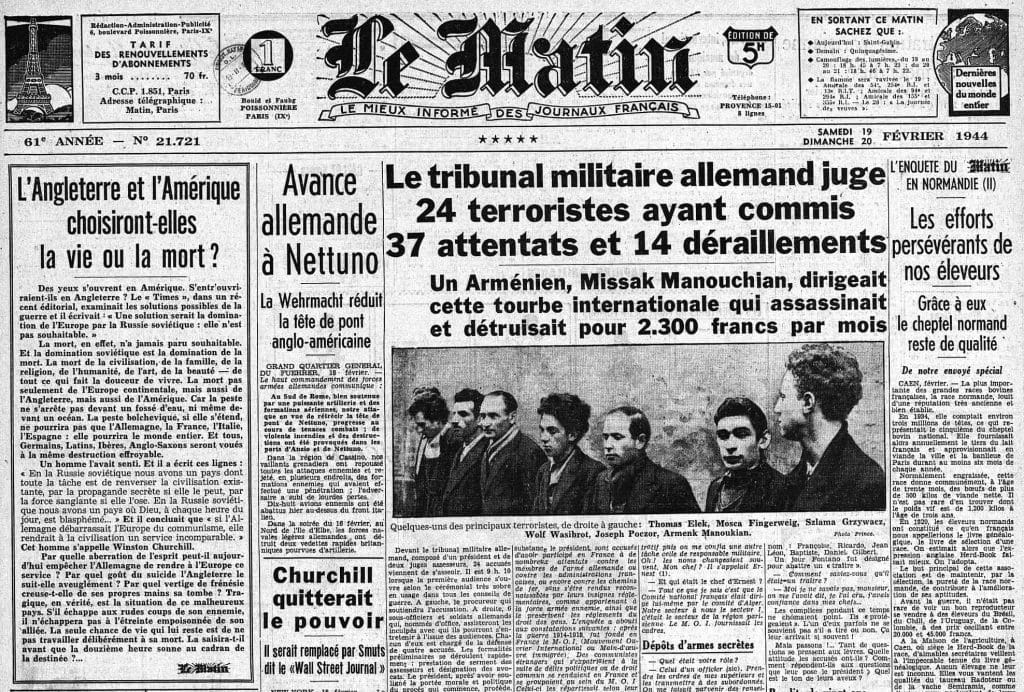
After being denounced, Joseph Epstein was arrested at the Évry Petit-Bourg train station on November 16, 1943, while meeting with Missak Manouchian of the FTP-M.O.I.
Despite being brutally tortured by inspectors from the Special Brigades, he did not reveal any names.
Joseph Epstein was executed by firing squad—under the name Joseph André—at Fort Mont-Valérien along with 28 other Resistance fighters on April 11, 1944.
On the day of his execution, he helped a fellow prisoner escape from the truck that was taking them to the firing squad.
In 2004, a square in Paris’s 20th arrondissement was named after him.
References:
— Convert Pascal, 2007, Joseph Epstein: Good for the Legend. Published by Séguier.
— Le Maitron Online Dictionary. 2020. Jean Maitron and Claude Pennetier.
— Photo: Pascal Convert – France 2008 documentary (DR)