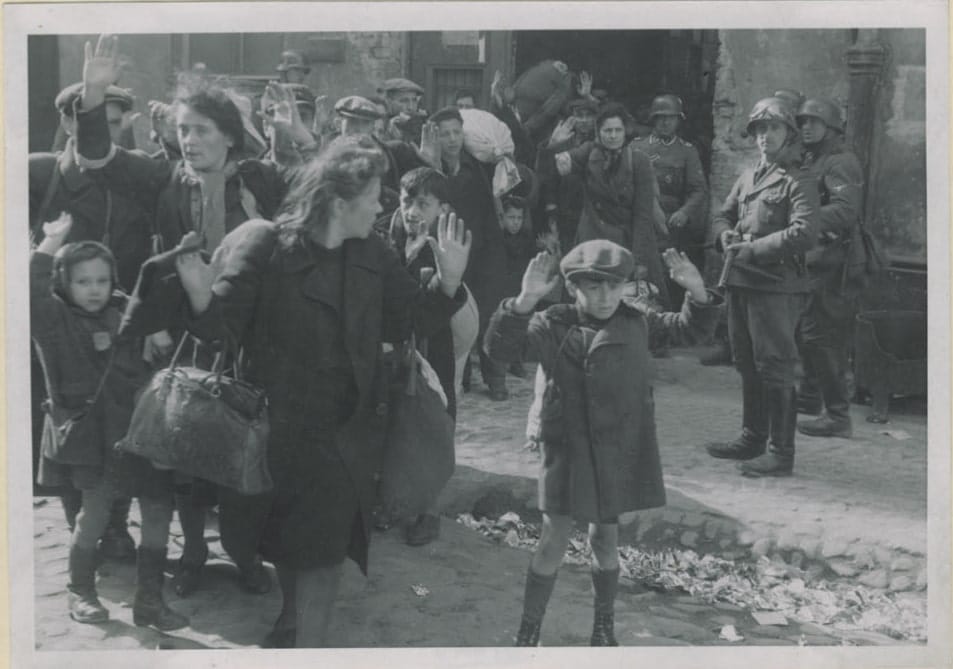
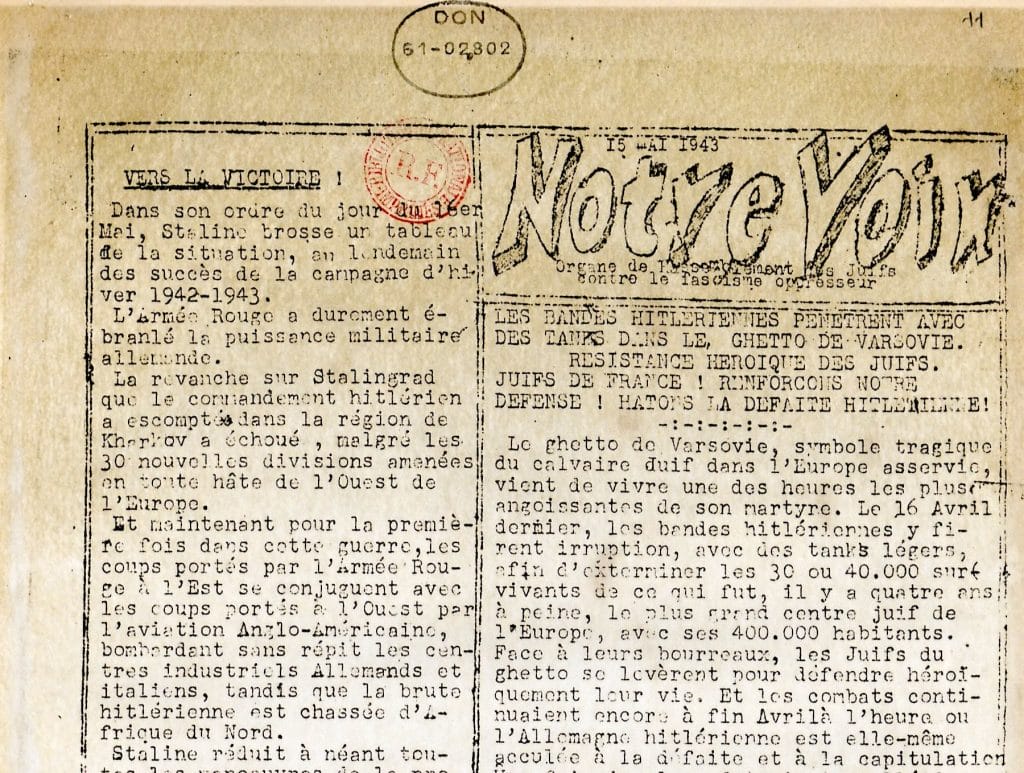
Marceau Vilner, a Jewish communist activist with the M.O.I. and founder of the weekly *La Presse nouvelle* (PNH), states:
“In September 1943, two thousand Jewish deportees from France, Belgium, the Netherlands, and Greece were transported from Auschwitz to Warsaw. I was part of the convoy. When we got off the train at a station on the edge of the ghetto at dawn, a horrific sight met our eyes. Of all the houses, strangely torn apart, only the outer walls remained standing. Beds, bricks, and scrap metal lay scattered across the street. Each house—emptied and consumed by fire—presented a different sight […] Some of the rubble was still smoldering.
We were herded into a concentration camp in the heart of the ghetto. Our job was to demolish these ruins one by one, clean the bricks, and salvage the scrap metal. These tens of millions of bricks and hundreds of thousands of beams were to be shipped to Germany as war booty.
The moment we laid eyes on those ruins, we knew that there were still survivors in the cleverly concealed underground structures. A special SD brigade had been tasked with locating the shelters and shooting the survivors, so as to leave no trace and no witnesses.
On the third day, a fellow prisoner had made a discovery without the SS guards’ knowledge […] I managed to get assigned to work at the ruins he had pointed out […].
As I moved forward, I came face to face with a woman brandishing a revolver. Two men lay motionless beside her, dying.
A week later, the neighborhood was blown up with dynamite, burying alive everyone who was still there.
Several months later, I went down into the sewers one day with a friend. All along the way lay a row of corpses that had suffocated, each clutching a suitcase or a bag. They were all in an advanced state of decomposition. It was easy to piece together what had happened. When the ghetto burned and the fighting was drawing to a close, a number of people tried to reach the “Aryan” side through the underground tunnels. The Germans, having learned of this, blocked the sewer entrances and attacked the fugitives with gas.
Another day, a friend found a diary that a young girl had kept day by day for three months: April, May, and June 1943. The diary ended in the middle of a sentence, one day in June… ”[…].
References:
— Excerpt from the booklet “The Song of the Warsaw Ghetto,” a supplement to issue No. 138 of the weekly *La Presse Nouvelle* (PNH).
— Text reprinted in issue No. 275 of *La Presse Nouvelle* magazine (PNM), April 2010