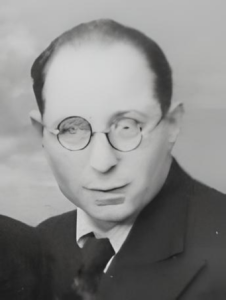
known as Lerman or Brunot
(1904–1987)
Louis Gronowski was born in Włocławek, Poland, into a Jewish family of small-scale grocers who had fallen on hard times. A revolutionary high school student, he helped found the Communist Youth in his region in 1922, was arrested in May 1923, and imprisoned until September 1924. Stripped of his civil rights, he decided in 1926, following the coup d’état by the dictator Pilsudski, to leave Poland. He fled clandestinely to Germany, then to Belgium, where he became active in the political movement. He was deported to France in December 1929 and earned a living as a laborer.
A dynamic and well-educated activist, he was appointed head of the Jewish section of the M.O.I. in 1933, at the recommendation of the PCF. In 1934, he played an active role in the founding of the Yiddish daily newspaper *La Naïe Presse*, of which he would later become editor-in-chief. In 1935, after being diagnosed with tuberculosis, he was sent to the USSR for a few months to receive treatment…
In 1937, he helped organize the International Congress for the Preservation of Yiddish Culture in Paris.
In 1938, he was appointed by the PCF as national director of the M.O.I., which he was tasked with reorganizing underground in August 1940.
In September 1940, along with several progressive Jews, he founded a mutual-aid group called “Solidarité,” which had grown out of the Jewish section. “Solidarité” quickly became a Resistance organization.
By October 1940, the M.O.I. had a strong leadership in Paris. It consisted of a triumvirate: Louis Gronowski in charge of policy, Jacques Kaminski in charge of organization, and Artur London in charge of propaganda.
Gronowski shares control of the FTP-M.O.I. with the FTP’s military committee and must, from now on, “consider himself a member of the PCF Central Committee.” The Party leadership understands the need to unite all its forces. It is aware that the M.O.I. (and the Jewish section in particular) is a pool of experienced and motivated activists.
In November 1941, Louis Gronowski gave Jacques Duclos (leader of the PCF) the manuscript of the widely distributed pamphlet titled *Anti-Semitism, Racism, and the Jewish Question*.
After the war ended, Louis Gronowski returned to Poland, but, driven out once again by anti-Semitism, he came back to France and died in Paris in 1987.
Reference:
Stéphane Courtois, Denis Peschanski, Adam Rayski, 1989, *Le Sang de l’étranger*, Fayard