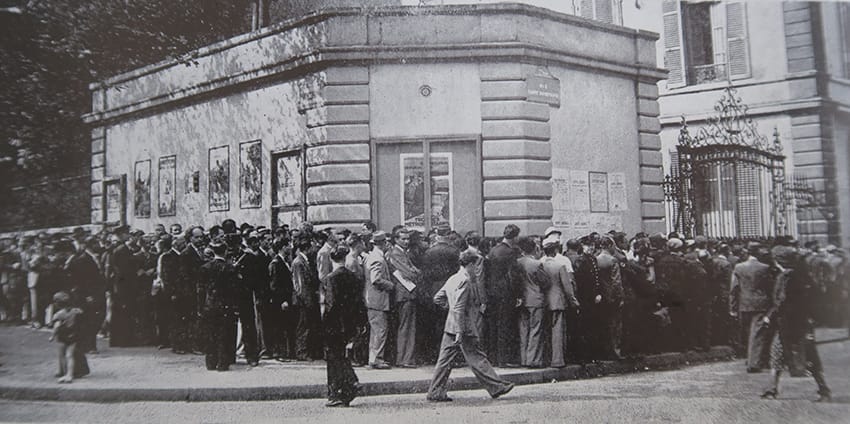
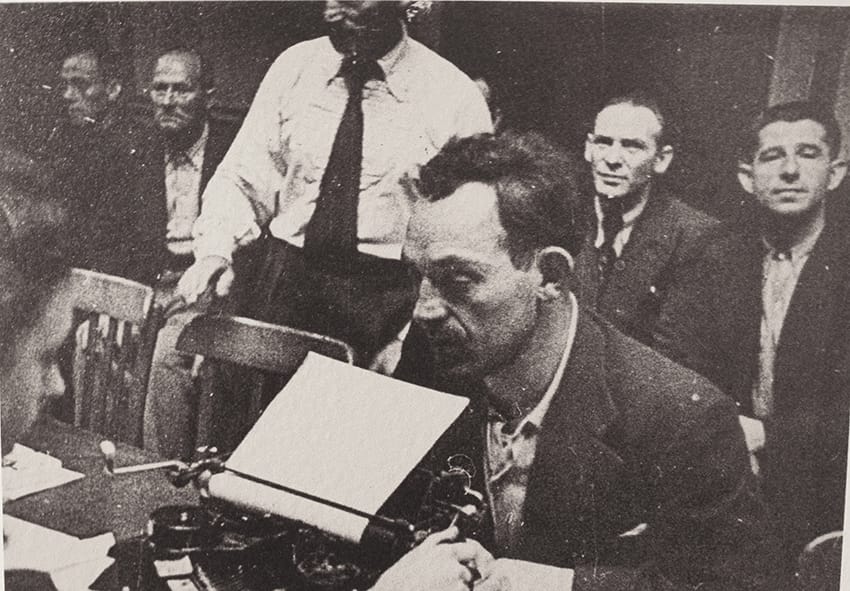
In Paris, they can register at the Ministry of War on Rue Saint-Dominique, at the Reuilly and Vincennes barracks, or—for more than 10,000 of them—at the LICA (International League Against Anti-Semitism) office.
Enlisted foreigners were assigned to special units created beginning in late September 1939, such as the RMVE (Foreign Volunteer Marching Regiments). G. Kenig, for example, an editor at *Naïe Presse*, and Boris Holban, the future military leader of the FTP-M.O.I. in the Paris region, joined the RMVE. Other units welcomed foreigners, such as the REI (Foreign Infantry Regiments), which were joined, for example, by Marceau Vilner, a Resistance fighter and journalist. The Foreign Volunteer Pioneer Marching Battalions and two battalions of the Foreign Legion rounded out these special units. In total, there were five regiments and five battalions.
In addition, Polish citizens—including a number of Polish Jews—were enlisted in the Polish Army in France (such as Adam Rayski, Simon Frid, and Joseph Epstein).
Most of these units fought on the fronts of 1940—in Narvik, Norway; in Belgium; on the Alsace front; and during the Battles of the Somme and the Marne—where they suffered heavy losses.
After returning to civilian life following the defeat, hundreds of Jewish veterans who had served as volunteers were transferred a year later—as foreign Jews—to the camps in the Loiret or Drancy. Their destination: Auschwitz…
As for those taken prisoner by the Germans, they can survive in prisoner-of-war camps in Germany (the Stalags) under the relative protection of the Geneva Convention (which defines the status of prisoners of war).
Reference:
Various Authors, 1971, *The Jewish Volunteer Fighter, 1939–1945*. Abexpress.