On September 1, 1939, Hitler invaded Poland. In response, France and the United Kingdom, which had signed alliance treaties with Poland, declared war on Germany. From the very first days, the French army launched a limited offensive before falling back behind the Maginot Line (a series of fortifications built by France along its eastern borders).
The “Phoney War” refers to the eight-month period between September 3, 1939, and the German offensive on May 10, 1940. It owes its name to the inaction of the French and British armies, which merely stood by and watched as Poland was crushed.
This inaction will have a negative impact on the soldiers’ morale and will allow Germany to consolidate its forces.
There are various reasons for the wait-and-see attitude during the “Phoney War”:
- At the strategic level, fear of new offensive military capabilities and the dominance of concepts inherited from World War I (defensive warfare).
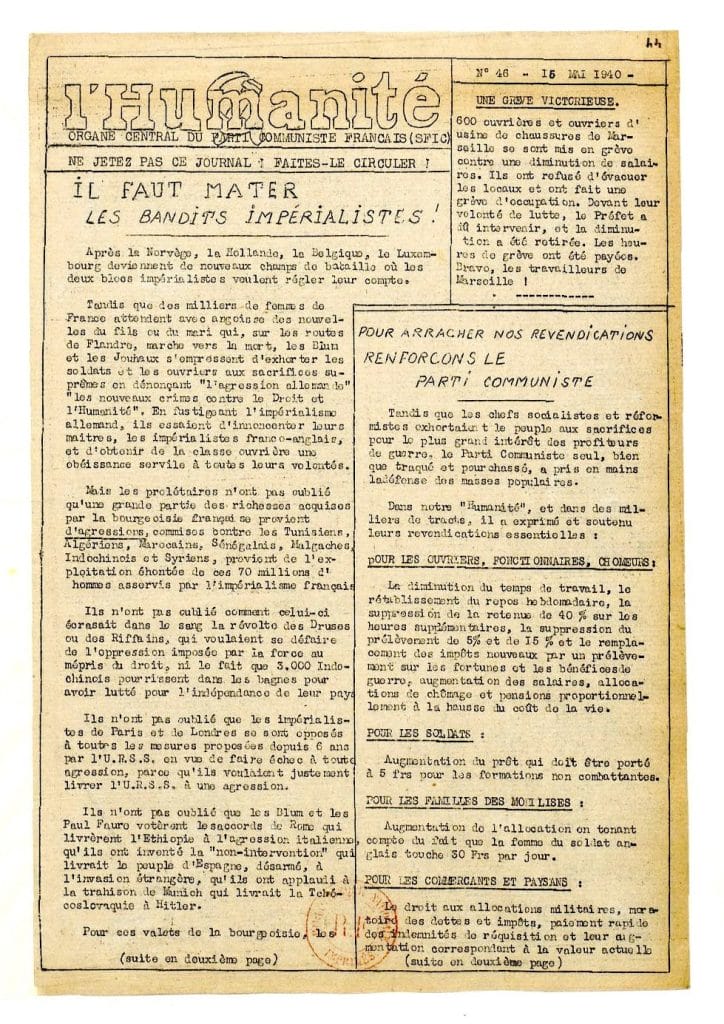
- On the ideological and political front, the persistence of a “Munich-style” pacifist mindset (the democracies’ capitulation in the face of triumphant fascism), anti-Sovietism (support for Finland at war against the USSR), and the anti-communism of certain ruling circles (“Better Hitler than the Popular Front”).
From November 30, 1939, to March 13, 1940, France and the United Kingdom supported Finland, which was at war with the USSR, by sending weapons. The Allies landed in Narvik, Norway, to cut off Germany’s supply of iron ore. This was the Allies’ first military victory against Germany, but the Nazis invaded Denmark and Norway on April 9, forcing the Franco-Polish troops to evacuate Narvik.
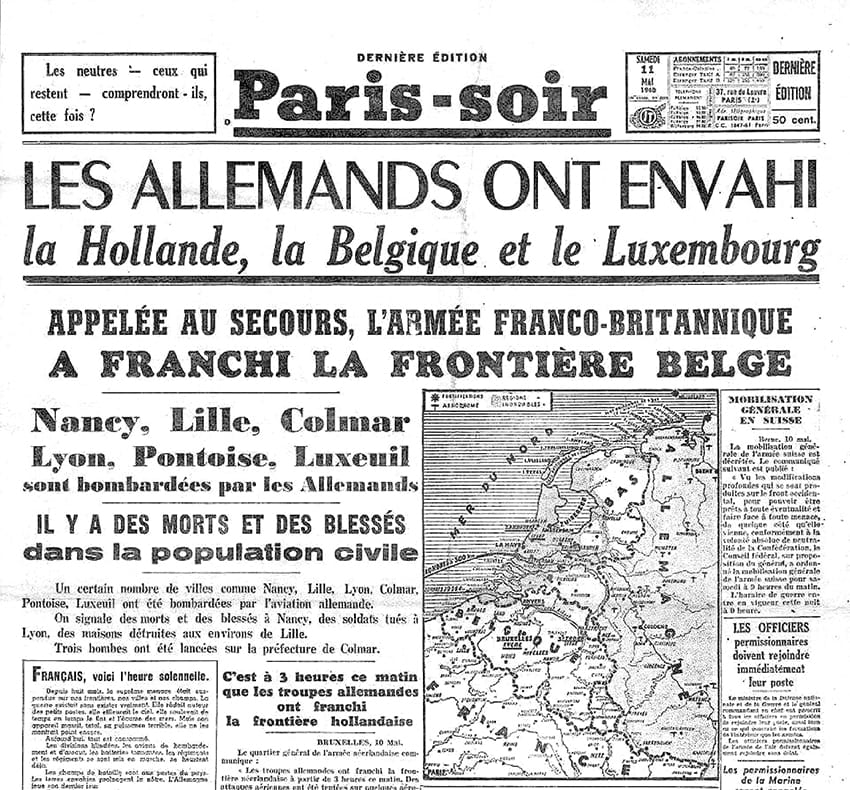
The “Phoney War” ended on May 10, 1940, when the German army (the Wehrmacht) launched a full-scale offensive in the west against the Netherlands, Belgium, Luxembourg, and France.
References:
— Marc Bloch, 1940, 1990 ed., *The Strange Defeat*, Paris, Histoire Folio.
— Roland Dorgelès, 1957, *The Phoney War: 1939–1940*, Paris, Albin Michel.
— Grenier, Fernand (1969), *Diary of the Phoney War: September 1939–July 1940*. Paris: Éditions sociales.