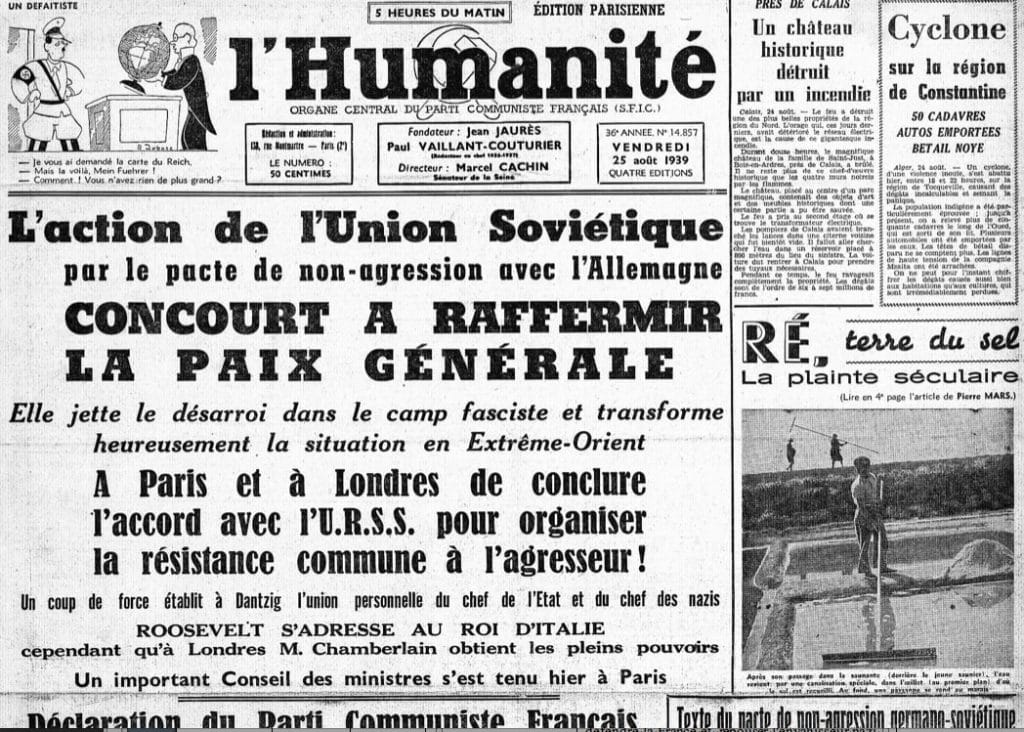
L’Humanité is a daily newspaper founded on April 18, 1904, by Jean Jaurès, with the support of intellectuals such as Lucien Herr and Lucien Lévy-Bruhl. Its goal is to bring together socialist activists and provide a high-quality opinion newspaper.
The editorial staff included prominent politicians such as Aristide Briand, René Viviani, and Léon Blum, as well as writers such as Octave Mirbeau and Anatole France.
After World War II, the socialist movement split over whether to join the Third International (Bolshevik).
The split occurred at the Tours Congress in December 1920: the majority voted to create the French Section of the CI, the Communist International (the future PCF).
Following an overwhelming vote by subscribers and the editorial staff, *L’Humanité* aligned itself with the Communist majority. It thus became “the central organ of the French Communist Party.”
Under the leadership of Marcel Cachin, the newspaper adopted a revolutionary stance and became a tool for mobilizing the working class.
In the 1930s, *L’Humanité* became one of France’s leading daily newspapers, driven by the united front against fascism. It modernized, devoted more space to photographs and leisure activities, and organized the first Fête de L’Humanité in 1930 (which grew into a massive event in 1936).
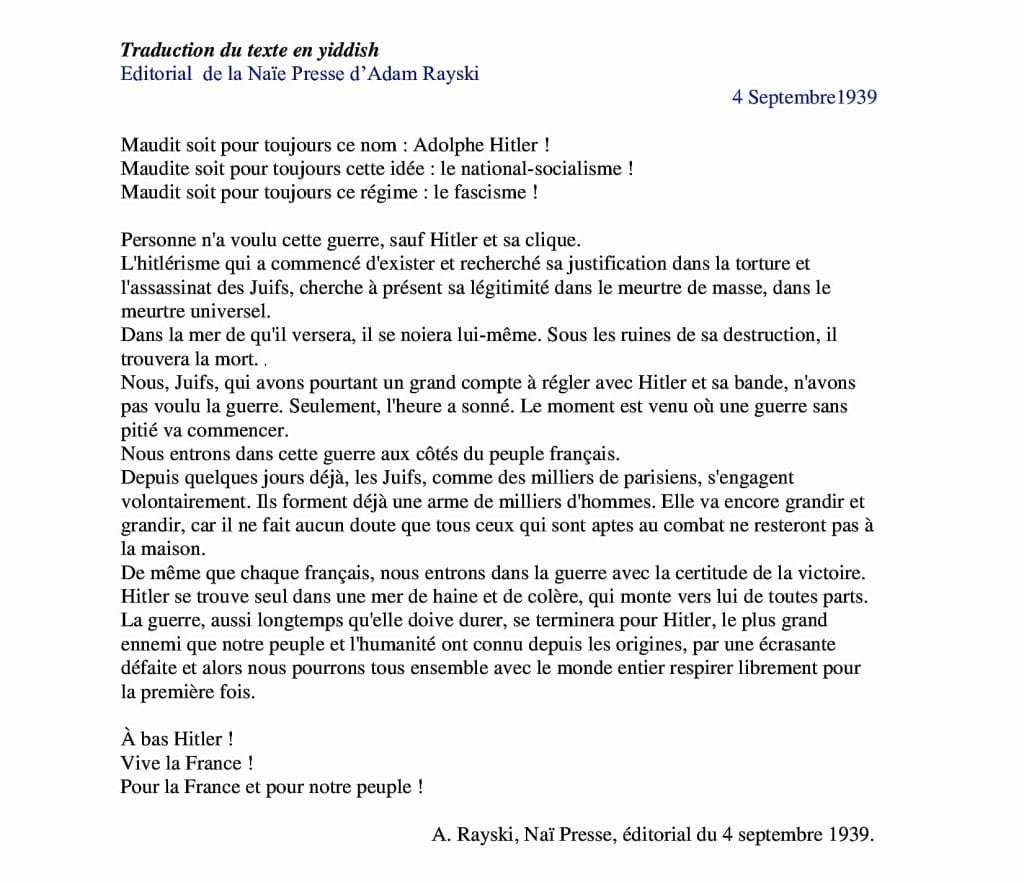
Driven in part by the fight against fascism, the first issue of *Naïe Presse* (*New Press*), a Yiddish-language newspaper published by the Jewish section of the M.O.I., appeared on January 1, 1934.
On August 26, 1939, following the announcement of the German-Soviet Pact and the newspaper’s endorsement of that pact, the Daladier government banned *L’Humanité*. Shortly thereafter, *Naïe Presse* was also banned.
The newspaper*L’Humanité* continues to be published illegally. The IC’s line at the time is to denounce the “imperialist war.”
After Germany’s invasion of the USSR, the newspaper became a pillar of the internal Resistance. Printed clandestinely, it called for sabotage and insurrection against the Nazi occupiers and the Vichy regime. Beginning on September 29, 1940, and throughout the Occupation, *La Naïe Presse* was published clandestinely in Yiddish under the title *Unzer Wort* and in French under the titles *Notre parole*in northern France and *Notre voix* in the south.
Many distributors and journalists at*L’Humanité* paid for this commitment with their lives. *Naïe Presse* (later renamed *Unzer Wort*) also fell victim to Nazi persecution: many of its leaders, editors, printers, and distributors were tortured, executed, or deported.
On August 21, 1944, during the Paris uprising, *L’Humanité* resumed legal publication in the open. In 1945, the newspaper was at the height of its political influence, buoyed by the prestige of the PCF, the “party of the 75,000 executed.”
Naïe Presse reappeared after the war under its original title and reached the Yiddish-speaking Jewish population—whether communist or sympathetic to the cause—who had survived the war and were committed to the ideals of the Resistance. A page in French was soon added to the daily edition.
In 1945, L’Humanité had a circulation of several hundred thousand copies, establishing itself as a key force in the reconstruction of postwar France.
Reference:
Christian Delporte, 2004, *History of the Newspaper *L’Humanité***, Nouveau Monde Éditions.