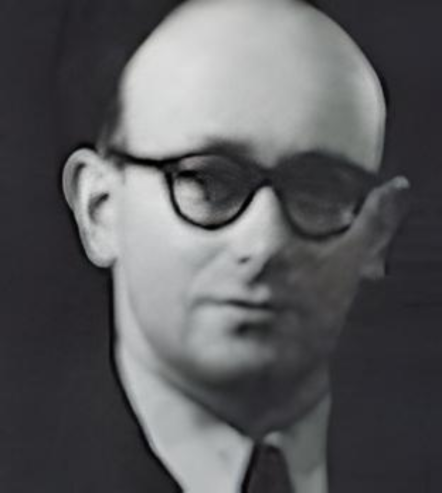
As Hervé
(1907–1978) said
Jacques Kaminski, whose real name was Jankiel Unglik, was born on October 6, 1907, in Poland, into a working-class Jewish family in the village of Klobusk. He had to leave school at the age of thirteen and became a barber’s apprentice.
He joined the Communist Youth at the age of sixteen and emigrated to Belgium and then, in 1930, to France, where he settled.
He is active in the Jewish section of the M.O.I. He serves as secretary of “Jewish Labor” and of the “Friends of La Naïe Presse, ” the progressive Yiddish-language daily newspaper founded in 1934.
During the Spanish Civil War, Kaminski traveled to Spain to work with Jewish fighters to organize political activities (including the work of leadership cadres) and communications for the Botwin Company (through its publications).
Louis Gronowski, the national leader of the M.O.I., appointed him “head of organizational affairs.” Jacques Kaminski would become part of the M.O.I.’s “leadership trio” alongside Louis Gronowski and Artur London.
In September 1940, Jacques Kaminski, Louis Gronowski, and former leaders of the Jewish section of the M.O.I. founded the underground mutual aid organization, “Solidarité,” which would later become the Union of Jews for the Resistance and Mutual Aid (UJRE).
Following the Communists’ creation of the Organisation Spéciale (OS) for armed resistance against the occupying forces in October 1940, Kaminski took charge of organizing the OS-M.O.I. in 1941.
After the various communist guerrilla organizations were unified within the FTPF, Kaminski was tasked with forming the FTP-M.O.I. and entrusted its military leadership to Boris Holban in the spring of 1942.
During the Occupation, he served as a liaison between the national leadership of the PCF and the M.O.I. Resistance fighters. He worked in close collaboration with Gronowski and Holban. The soundness of his judgment and the wisdom of his decisions were unanimously recognized.
In 1947, Kaminski returned to Poland, where he joined the security services. In the early 1950s, he was removed from that post but was subsequently put in charge of relations between the Polish United Workers’ Party (PUWP) and the Communist parties of Western Europe.
Unlike his comrade-in-arms, Louis Gronowski, Jacques Kaminski remained in Poland, where they had both returned after the war “to build socialism there,” and he died in Warsaw on June 12, 1978.
References:
– Louis Gronowski-Brunot, 1980, *Le dernier grand soir*. Editions du Seuil.
– Stéphane Courtois, Denis Peschanski, Adam Rayski, 1994, *Le Sang de l’Etranger* , Fayard
– Photo: Diamant David , *Combatants, Heroes, and Martyrs of the Resistance*, Renouveau, 1984