Following Hitler’s invasion of the USSR, the PCF launched an armed struggle in France as early as October 1941. In early 1942, the French Francs-tireurs and Partisans (FTPF or FTP) became operational, quickly followed by the FTP-MOI. Whether Communists or sympathizers, they played a very active role in the liberation of France.
In October 1941, following the invasion of the USSR, the Soviets intensified their anti-Nazi resistance in Europe. On orders from the Communist International, the French Communist Party (PCF) took charge of organizing an armed struggle in France. Charles Tillon was in charge of this effort. The first recruits, in October 1941, were former members of the Spanish Civil War brigades and Communist activists from the Organisation Spéciale (OS groups) who had escaped the Nazis’ manhunts.
In early 1942, young fighters from the Youth Battalions joined them. By April 1942, the French Francs-tireurs and Partisans (FTPF or FTP) were fully formed. This domestic Resistance force, military in nature, was immediately operational. It was open to non-Communists but remained under the authority of the PCF.
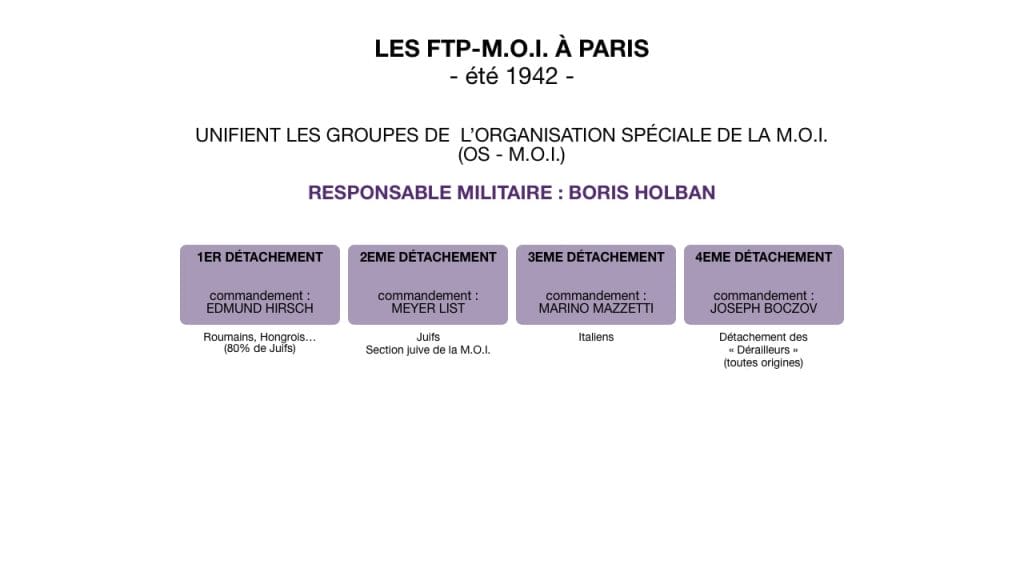
With their very existence threatened and driven by their desire to liberate France from Nazism, Jewish immigrant fighters were led to wage a unique struggle alongside the FTP. At the same time, and very quickly, groups of Francs-tireurs and M.O.I. partisans (the FTP-M.O.I.) were formed in Paris under the military leadership of Boris Holban.
According to PCF guidelines, 10 percent of the militant ranks must be assigned to the FTP; the same rule applies to the FTP-M.O.I.
The FTP initially operated in the occupied northern zone, but they expanded their sphere of activity to the so-called “free” zone as soon as German troops entered the southern zone in late 1942.
The FTP’s newspaper, *France d’abord*, reports on the organization’s armed struggle throughout France.
Starting in 1943, the FTP was merged with the FTP-M.O.I. under the umbrella of the “National Front for the Struggle for the Liberation and Independence of France,” which had been created by the PCF in 1941.
The FTP and FTP-M.O.I., which are highly militarized, engage in urban guerrilla warfare and immediate action.
In the southern region, the FTP and FTP-M.O.I. formed resistance groups.
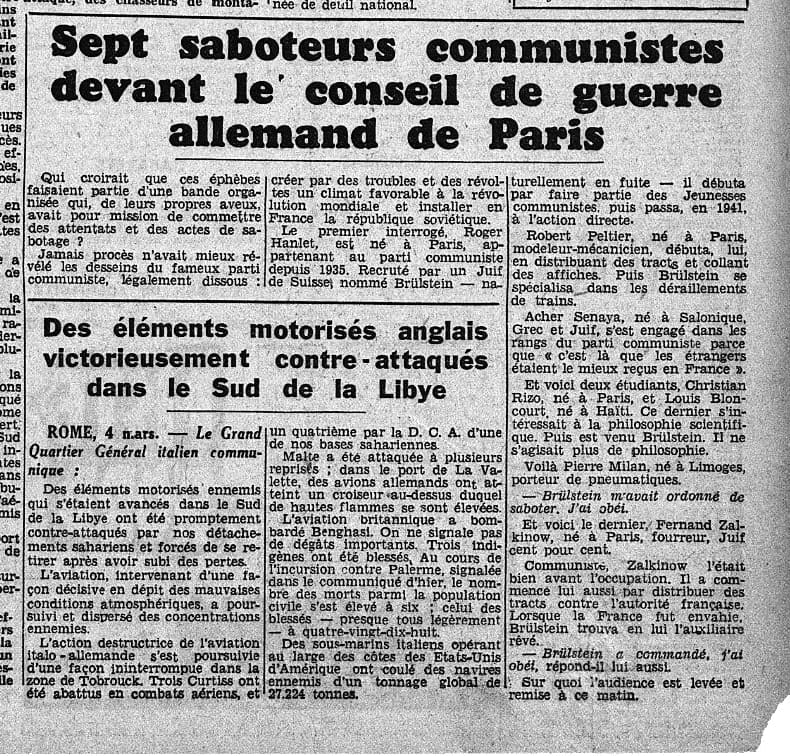
Hunted down by the Gestapo, many members of the FTP (and, in particular, FTP-M.O.I. (FTP-M.O.I.) were tortured and deported, but their activities as part of the internal Resistance—(like those of the MUR or the Gaullist Secret Army)—played a decisive role in the country’s liberation.
In 1944, the FTP and FTP-M.O.I., while retaining their autonomy, were consolidated into the French Forces of the Interior (FFI).
Reference:
Charles Tillon, 1991, *The FTP: Soldiers Without Uniforms*, Éditions Ouest-France.