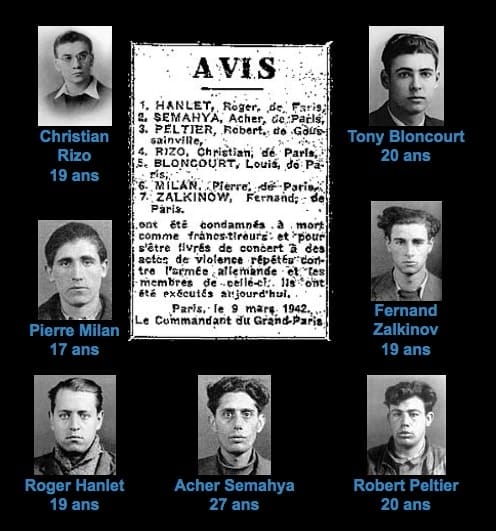
From March to August 1942, the Germans staged three sham trials against young Resistance fighters—members of the Youth Battalions and the Organisation Spéciale—who were engaged in armed struggle against the occupying forces. Almost all of these young people were sentenced to death.
The year 1941 marked a troubling turning point for the German army; on the one hand, it suffered its first military setbacks on the Eastern Front; on the other hand, in France, attacks against its outposts and detachments were on the rise: military trucks were set on fire, soldiers were attacked…Feeling threatened, the Nazis carried out numerous arrests and staged three highly publicized “trials.”
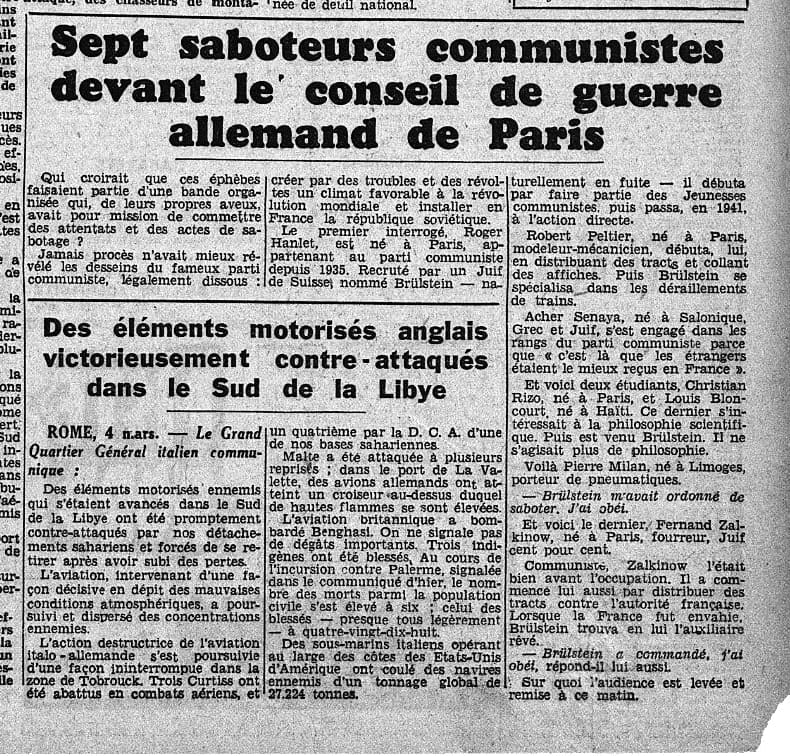
The first trial began on March 4, 1942, at the Palais-Bourbon, a highly symbolic location. Seven young people, six of whom were members of the Youth Battalions, were to stand trial there for having carried out more than “seventeen military operations” in three months.
To give the trial greater publicity, film newsreels, the collaborationist press, and officers from the Nazi high command were in attendance.
After three days of hearings during which Nazi officers assumed the role of judges, the young Resistance fighters were executed by firing squad on March 9, at Mont-Valérien “as francs-tireurs and for having committed acts of violence against the German army and its members.”
The second sham trial began on April 15, 1942, at the Maison de la Chimie. Charges: acts of war and possession of weapons.
Twenty-seven young fighters are involved; the 28th died under torture before the trial began.
Twenty-three of these young Resistance fighters were sentenced to death, two to five and ten years in prison, and the two women, Marie-Thérèse Lefebvre and Simone Schloss, to life imprisonment.
In fact, Simone Schloss, who was a Jew, was guillotined in Germany on July 17, 1942.
The final “trial” was held behind closed doors on August 24 at the Continental Hotel. It targeted primarily Communist Resistance fighters: 33 young people, including 4 women, were tried in a large hall. A portrait of Hitler, framed by swastika flags, was displayed. Eighteen death sentences and 15 sentences of hard labor were handed down.
These are only the most high-profile trials, as it is estimated that more than 3,000 civilians were executed after being convicted by German military courts between June 1940 and April 1944.
References:
— The Letter from Jewish Resistance Fighters and Deportees. March 2000.
— Marcel Ouzoulias, 1968 , *Les Bataillons de la Jeunesse*. Published by Livre Club Diderot.
— Gaël Eisman, 2006, in *Dictionnaire historique de la Résistance*. Ed. Robert Laffont.