“Free France,” founded in London in June 1940 by General de Gaulle, brought together in England military personnel and all volunteers who opposed the armistice signed with Nazi Germany by Marshal Pétain. “Free France,” or the External Resistance, was officially recognized by the Internal Resistance in July 1942.
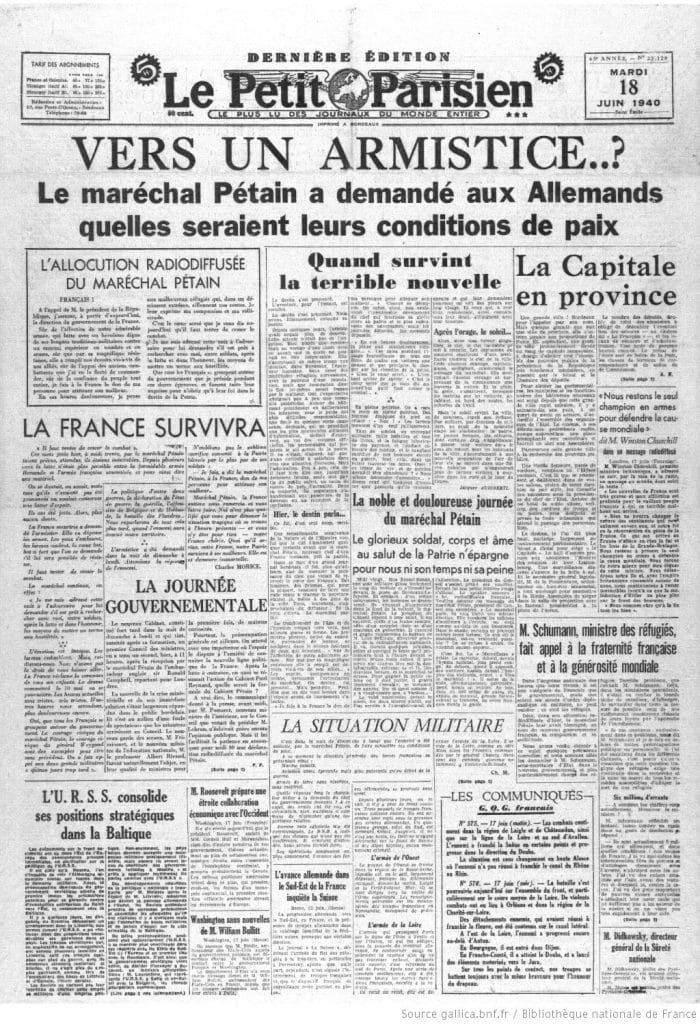
On June 17, Marshal Pétain ordered a ceasefire. On June 18, General de Gaulle, in exile in London, delivered his “Call to the Peuple de France for Resistance” on the British broadcaster BBC and urged volunteers to join him. After the armistice with Nazi Germany was signed on June 22, 1940, Pétain became the head of a collaborationist “French State.”
De Gaulle received support from British Prime Minister Winston Churchill, who was engaged in the war against Germany. In July 1940, the general founded “Free France,” based in London and supported by armed units opposed to the armistice, the Free French Forces (FFL).
De Gaulle worked to secure support throughout the French colonial empire. In September 1941, he established the French National Committee (CNF), which provided political leadership for the military forces.
Under the agreement signed in August 1940 with Churchill, Charles de Gaulle was recognized as the legitimate representative of France and negotiated with the Allies (primarily the United Kingdom and the United States). On July 13, 1942, he established an official government of “Free France”—later renamed “Combatant France”—in London, which was recognized by all domestic Resistance movements.
The term “Free France,” however, would come to be widely accepted in people’s minds and even in official documents.
The soldiers of the “Free French” fought the Nazis, notably alongside the British in England. But the Allies were wary of de Gaulle, whom they considered too ambitious. The general eventually managed to assert himself, however.
The Communist Resistance moved closer to de Gaulle, who founded the French Committee for National Liberation (CFLN) in June 1943. The capital of “Free France,” initially established in Brazzaville, was moved to Algiers, which was then under French administration.
But de Gaulle was committed to uniting the fighting forces. Jean Moulin, the general’s representative in France, worked to unify the domestic Resistance. The National Council of the Resistance (CNR), established—not without difficulty—on May 27, 1943, brought together the country’s democratic factions, from the Communists to the Republican right.
On August 1, 1943, the Free French Forces (FFL) became the French Liberation Army. Deployed around the world, it fought, for example, in the USSR against German troops.
According to the plan of the leader of “Free France,” Gaullist military groups operating within France (“the Secret Army”) and the Communist Resistance (FTP and FTP-M.O.I.) were integrated into the French Forces of the Interior (FFI) on June 1, 1944.
Charles de Gaulle, the leader of the Resistance abroad and recognized as the undisputed head of the unified Resistance, became president of the Provisional Government of the French Republic (GPRF).
References:
— Muracciole, Jean-François, 1996, *History of Free France*, PUF, *Que sais-je?* series.
— Muracciole, Jean-François, 2009 , *The Free French: The Other Resistance*, Paris, Taillandier