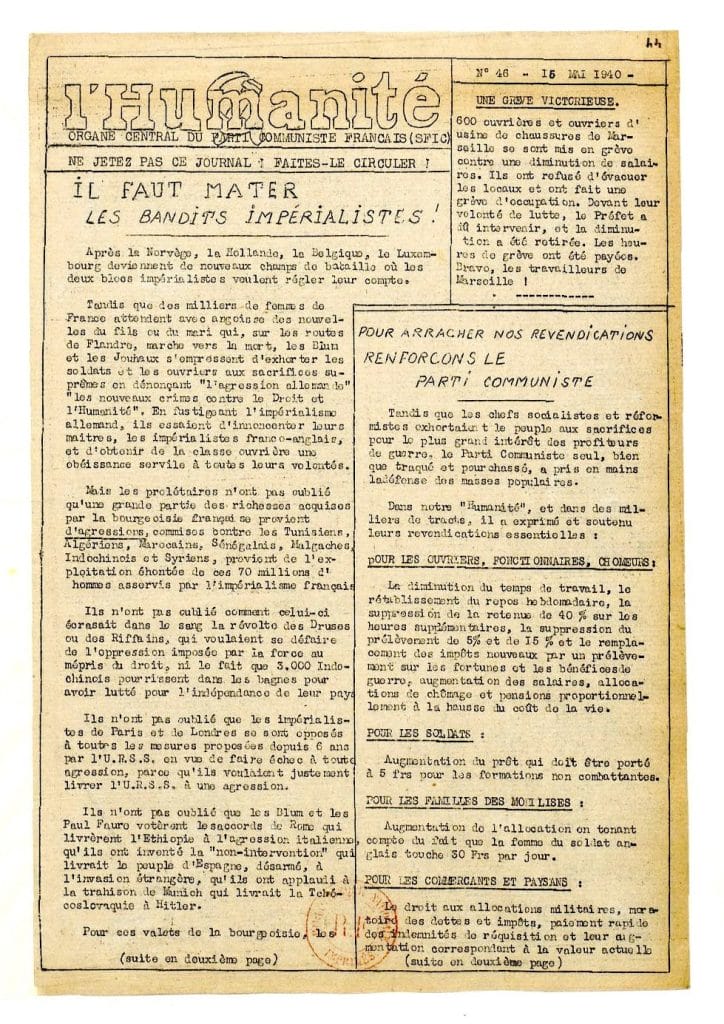
Many foreigners—including activists from the Jewish section of the M.O.I.—then enlisted in the Régiments de Marche des Volontaires Étrangers (RMVE) or in other foreign volunteer units serving France, but the armies remained at a standstill. For eight months, it was the “Phoney War.”
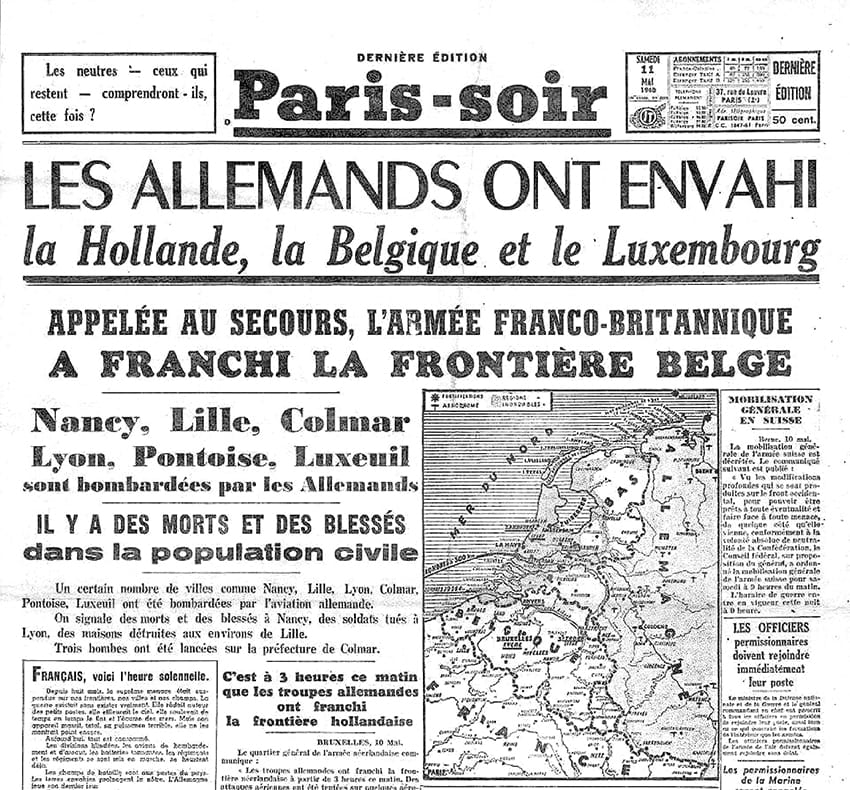
Hitler’s Germany went on the offensive on May 10, 1940, during the “Battle of France.”
Before long, the French army was in full retreat. Defeat is inevitable.
Hundreds of thousands of soldiers were taken prisoner. In the RMVE, a large number of foreigners—including Jews who were immigrants and who were poorly equipped and ill-prepared—were killed or captured.
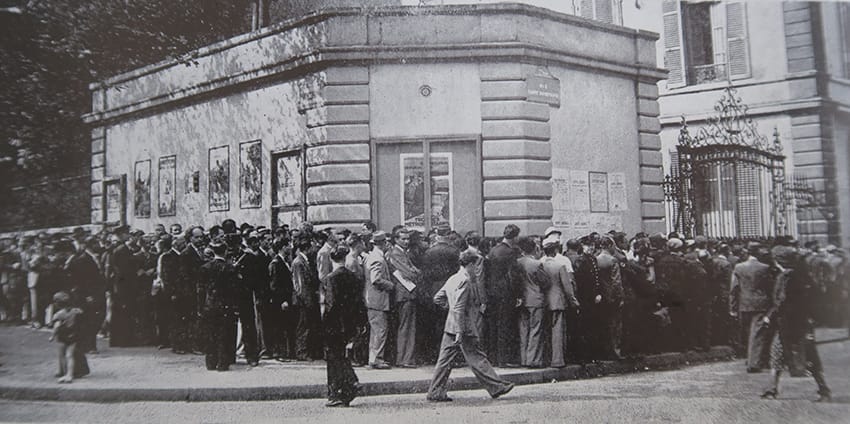
The exodus was massive. It began affecting Parisians as early as June 1940.
Beginning on June 6, 1940, the French army’s lines were breached and the troops were surrounded in the Dunkirk region. More than 300,000 French and British soldiers were evacuated to Great Britain. On June 10, 1940, Fascist Italy, an ally of Germany, entered the war and deployed troops in the Alps.
On June 14, German troops entered Paris, which had been declared an “open city.”
On June 16, Marshal Pétain became President of the Council.
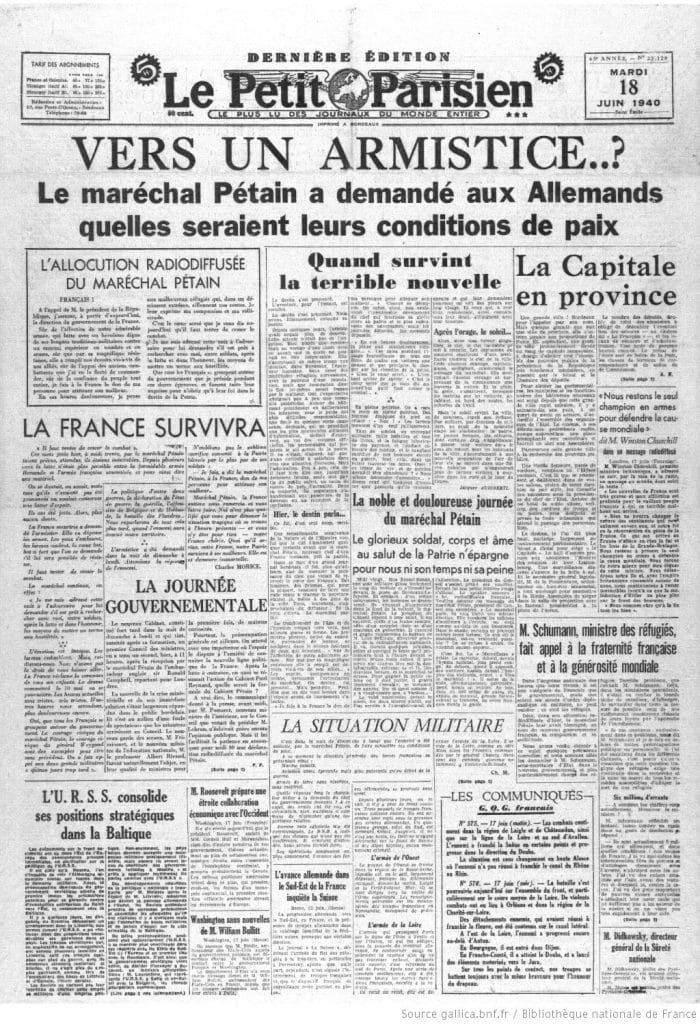
On the 17th, he called on the French to cease fighting and requested an armistice from the Germans.
On June 18, General de Gaulle issued his Call to the Resistance from London.
On June 22, the armistice was signed.
The military refused to accept a surrender that would imply a failure on the part of the French army. Pétain opted for an armistice, thereby placing the blame for the defeat on the political class. A majority of the French people longed for an end to the fighting, but the decision to accept the armistice would lead France into a regime of collaboration with the Nazi occupiers.
References:
— Dominique Lormier, 2020, May–June 1940: The Causes of Defeat—A New Perspective on Political and Military Responsibilities. Published by Alisio
— Marc Bloch, 1940, *The Strange Defeat*. Published by Gallimard
— Philippe Nord, 2017, France 1940: Defending the Republic. Perrin.