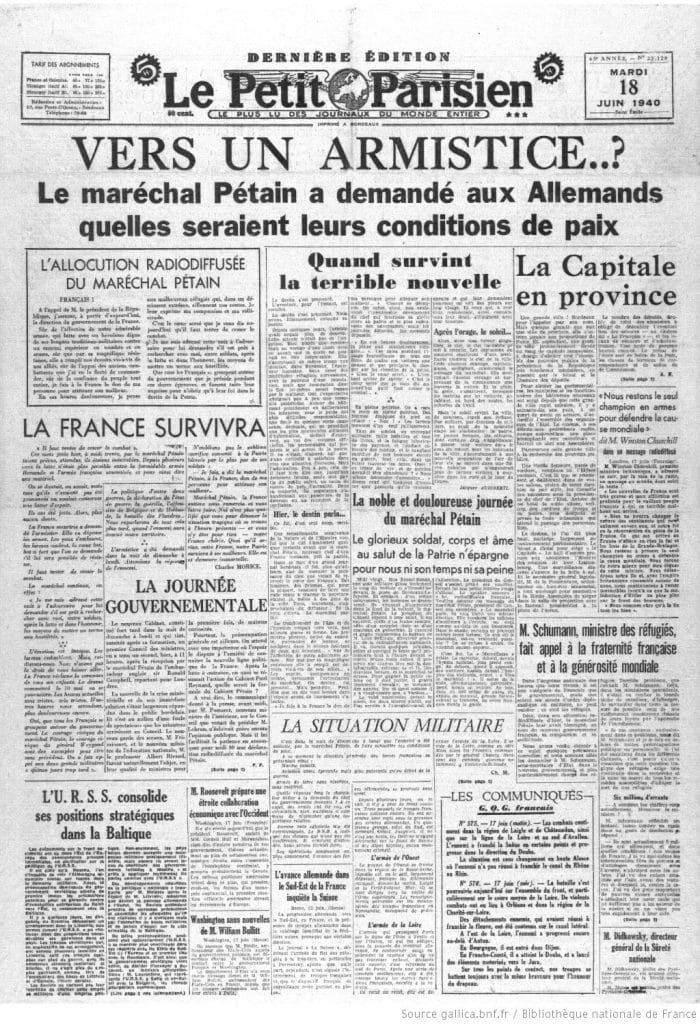
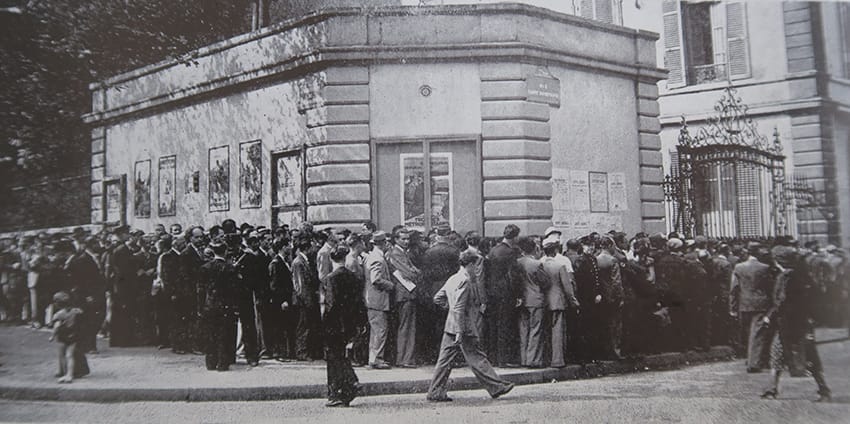
The armistice agreement provides, among other things, for the establishment of two zones.
The occupied zone covers the northern half of the country and the Atlantic coast. The rest of the territory constitutes the “free zone.” The two zones will be separated by a demarcation line. In the northern zone, Germany will exercise “the rights of the occupying power,” which will require the cooperation of the French administration.
In the “free” zone, the French Army will be limited to 100,000 men. The French colonial empire will remain under the authority of the French government. France will hand over to Germany any German or Austrian political refugees present on its territory. Prisoners of war (more than 1.5 million men) will remain in captivity until a peace treaty is signed. France will finance the maintenance of the occupying army, at a cost of 400 million francs per day.
This last point would lead to the economic plundering of the country, widespread food shortages, growing hostility among the French toward Germany, and the emergence of a spirit of Resistance that would continue to grow throughout the conflict. The Jewish section of the M.O.I., vigilant from the very beginning of the Occupation, embarked on a struggle that would not end until the Liberation.
References
— Ferro, Marc, 1987 and 2008, *Pétain*, Paris, Fayard
— Miquel Pierre, 1986 *World War II*, Paris: Fayard, and 1987: Club France Loisirs.