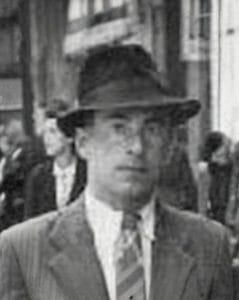
(1914–2008)
Adam Rayski, whose real name was Abraham Rajgrodski, was born in Białystok, Poland, into a Jewish family of small business owners. At the age of 16, following in the footsteps of his uncle, a leader of the Polish Communist Party, he became involved in revolutionary activism, joined the Communist Youth League, and became its leader. Expelled from high school for his political activities, targeted by the police, and threatened with arrest, he left Poland in September 1932 at the age of 18.
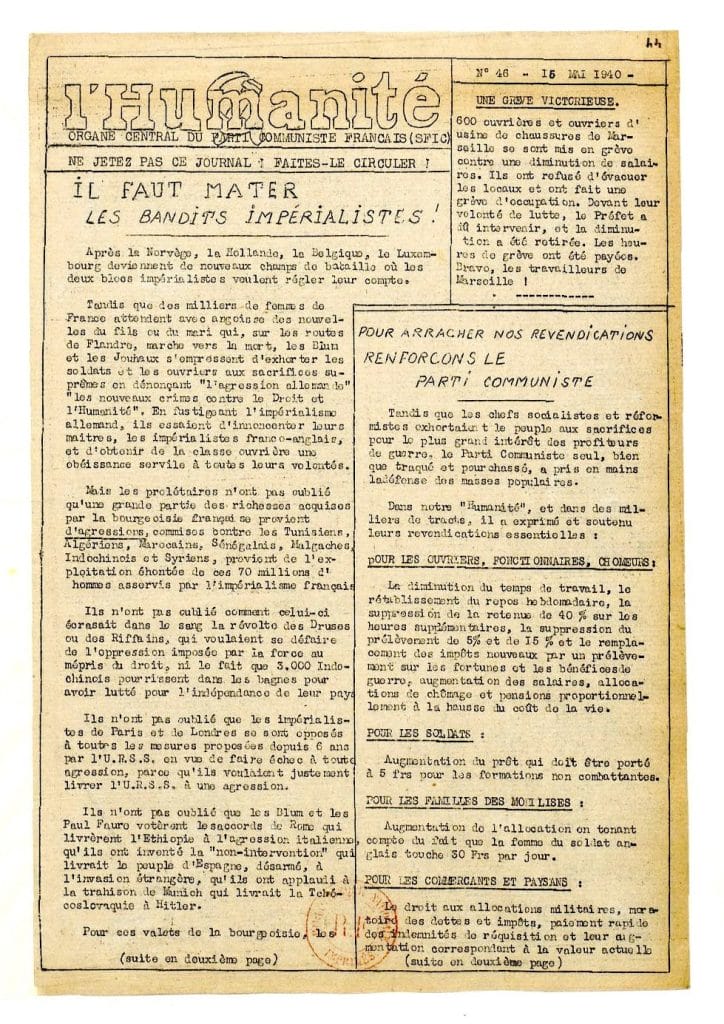
In Paris, he became an apprentice in the clothing industry. He trained as a journalist and took courses at the Institut d’études politiques and the École pratique des hautes études. He was active in the Jewish section of the M.O.I. and began his career at *La* Naïe Presse, the Yiddish-language daily newspaper of the Jewish section; at the same time, he is an intern at L’Humanité.
In the fall of 1938, Louis Gronowski, the national leader of the M.O.I., appointed him to lead *La Naïe Presse* alongside G. Kenig.
In September 1939, the newspaper was banned along with all other communist publications, but it reappeared clandestinely as early as October under the title *Unzer Wort* ( Our Word, and later Our Voice). Rayski remained in his position until he was drafted into the Polish army on May 20, 1940. Taken prisoner, he escaped and returned to Paris on July 14. As a member of the underground leadership of the M.O.I., he devoted himself to rebuilding the Jewish section.
In April 1941, Rayski was sent to the southern zone to organize the escape of foreign communists interned in the Gurs and Vernet camps. Upon his return to Paris, he assumed political leadership of all the media outlets of the Jewish section of the M.O.I. and the Mouvement National contre le Racisme (MNCR). He oversaw the various Resistance organizations: the Women’s Union, youth movements, child rescue groups, and others.
To pay tribute to the Warsaw Ghetto Uprising, he wrote two articles: one for *Notre Voix* and the other for *J’accuse* and *Fraternité*, newspapers published by the MNCR.
He was responsible for selecting fighters for the 2nd Jewish Detachment of the Parisian FTP-M.O.I., which was dismantled by the police in June 1943: many activists from the Jewish section were arrested, tortured, and deported. Rayski, identified by the police, was wanted but managed to escape and made his way to Lyon.
In the winter of 1943–1944, Rayski played a key role in the negotiations that led to the creation of the General Committee for the Defense of the Jews, which became the Representative Council of French Jews (CRIF) in January 1944.
In 1949, he returned to Poland, where he held important positions. Due to the anti-Semitic campaign raging there, he returned to France in 1957.
He then devoted himself to work on history and remembrance.
Adam Rayski died in Paris on March 11, 2008.
References:
— Stéphane Courtois, Denis Peschanski, Adam Rayski, 1989, *Le Sang de l’étranger*, Fayard.
— Rayski Adam, 1985, *Our Lost Illusions*. Balland