On December 7, 1941, with the approval of Emperor Hirohito of Japan, Japanese naval and air forces launched a surprise attack on the U.S. naval base at Pearl Harbor in Hawaii. This act of aggression led to the United States entering World War II.
With the Great Depression of the 1930s and the increasing impoverishment of a large portion of the population, Japanese nationalists, fascists, and military leaders advocated for the conquest of territories to secure raw materials. In 1931, the Japanese army, backed by Emperor Hirohito, invaded Manchuria and then, in 1937, launched an attack on all of China. It set its sights on the Soviet Far East (Siberia and Mongolia). The Soviet counteroffensive crushed these ambitions.
The defeat prompted the Japanese Imperial General Headquarters to turn its attention to the Pacific Islands and Southeast Asia. A Soviet-Japanese Neutrality Pact was signed on April 13, 1941. The Japanese decided to intensify their efforts in China and to conquer French Indochina, the Dutch East Indies, British Malaya, and the U.S.-protected Philippines. Relations with the United States deteriorated completely following the economic sanctions (including the oil embargo) imposed by Washington in July 1941.
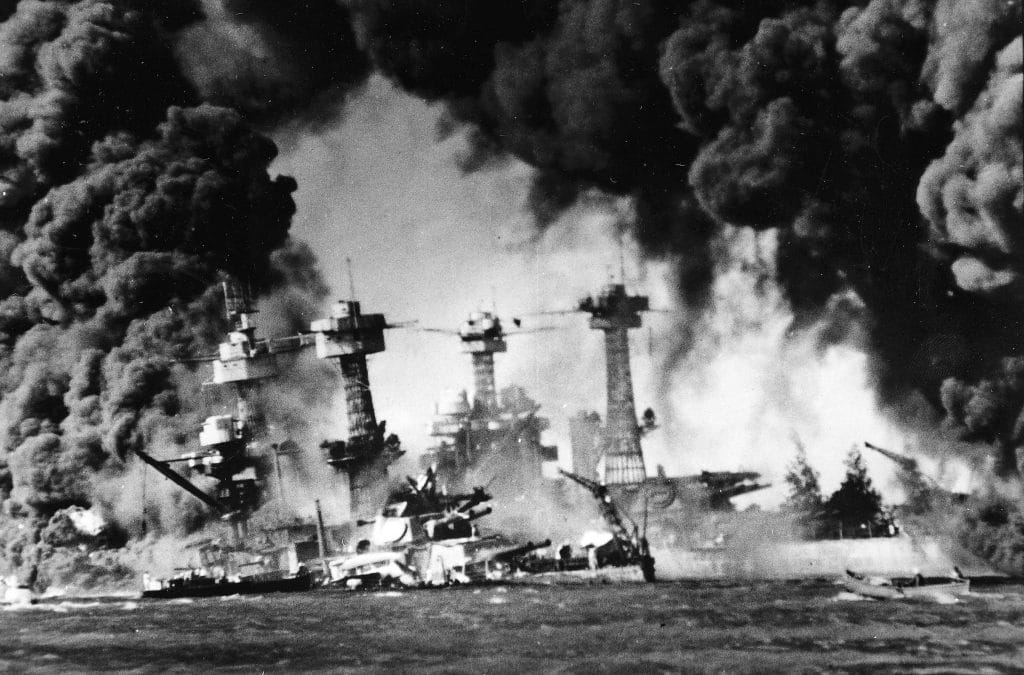
Aware of their industrial inferiority compared to American economic power, the Japanese destroyed the U.S. naval forces concentrated at their Pearl Harbor base in a single strike.
This attack, launched on Sunday, December 7, 1941, against the U.S. Pacific Fleet, took place in two waves of air strikes. U.S. losses were considerable (2,500 dead). Two battleships and 188 aircraft were destroyed, but—crucially—the U.S. aircraft carriers, which were not in Pearl Harbor, were spared. The Japanese attack ended in failure.
American isolationism collapsed, and the next day, the U.S. Congress declared war on Japan. Nazi Germany and Fascist Italy entered the war against the United States on December 11, 1941. At the same time, Japan attacked the Philippines, invaded Hong Kong, and landed its troops in Malaysia.
However, from June 4 to 7, 1942, the United States’ victory over Japan in the Battle of Midway, off the coast of the Midway Islands, put an end to Japanese expansion in the Pacific.
References:
– Francine Herail, Jean Esmein, François Macé, Hiroyuki Ninomiya, and Pierre Souyri, 1990, *History of Japan*, Horvath, Paris.
– Kaspi, André, 1987, “Pearl Harbor: An American Provocation?” *L’Histoire* , No. 101.