The “Munich Agreement” was signed by Germany, France, the United Kingdom, and Italy following the Munich Conference held on September 29–30, 1938. Czechoslovakia and the USSR were not invited.
These agreements allowed Hitler to annex the Sudetenland, a region of Czechoslovakia with a predominantly German population. They marked a setback for the democracies in the face of Nazi expansionism.
In Czechoslovakia, the Sudeten Germans demanded annexation to the German state (the Reich). The crisis erupted in 1938 when Hitler, invoking the right of peoples to self-determination, announced the annexation of the region. The move sparked a conflict with France and the United Kingdom, allies of Czechoslovakia.
The USSR pledged to provide military aid to Czechoslovakia on the condition that France do the same. The Red Army mobilized to intervene, but since it did not share a border with Czechoslovakia, the USSR had to seek Poland’s permission to cross its territory. Poland refuses. France declares mobilization but does not intervene to persuade its Polish ally. Furthermore, the French government has no intention of going to war against Germany without British participation.
At the suggestion of Benito Mussolini, the Italian fascist leader, Hitler agreed to hold a conference in Munich from September 29 to 30, 1938. Participants included Adolf Hitler, Édouard Daladier, head of the French government, Neville Chamberlain, British Prime Minister, and Mussolini. The Czechoslovaks and the Soviets were not invited! The agreements reached stipulated the evacuation of the Sudetenland by the Czechs and its gradual occupation by the German army. This marked the end of Czechoslovakia. By occupying the country, the Germans took control of its high-performing arms and military equipment manufacturers (notably Škoda).
In France, the right and the moderate left (the SFIO and the Radicals) approved the agreements. Only the Communists voted against their ratification. As in the United Kingdom, public opinion focused on the fact that war had been averted and celebrated these illusory “peace agreements.”
Poland benefited from the return of part of Silesia and naively supported Hitler’s government. Excluded from the Munich Conference, the USSR viewed the Munich Agreement as the result of the “policy of appeasement” advocated by Neville Chamberlain to divert the Nazi threat eastward.
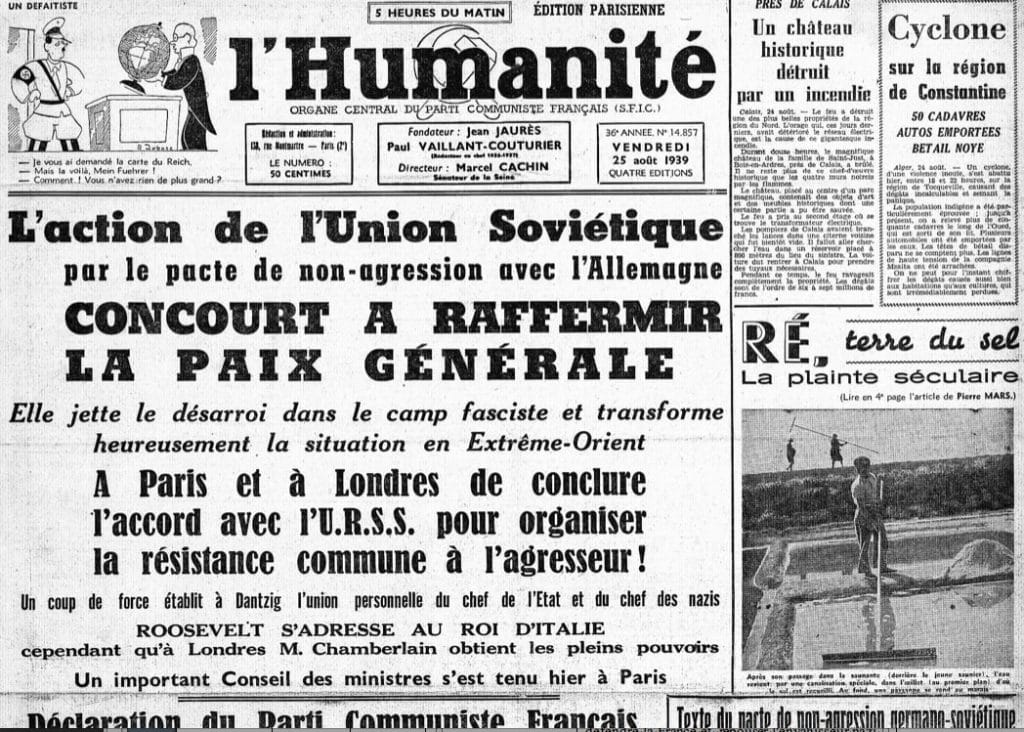
Soviet leader Joseph Stalin, now wary of Great Britain and France, embarked on a new policy that culminated in the German-Soviet Non-Aggression Pact of August 1939, which left many communists— who were naturally anti-Nazi, and activists in the Jewish section of the M.O.I. in particular, into a state of confusion or dismay.
Reference:
Miquel Pierre, 1998, *The Munich Trap*, Éditions Denoël.