The internal Resistance in France, made up of men and women fighting against the Occupying Forces and the Vichy regime, took two forms: civilian and armed. Young communists—including young Jews from the M.O.I.—rose up against the Vichy government as early as the summer of 1940.
In late 1940, organized movements and anti-collaborationist networks began to take shape. They were led primarily by Gaullists and Communists.
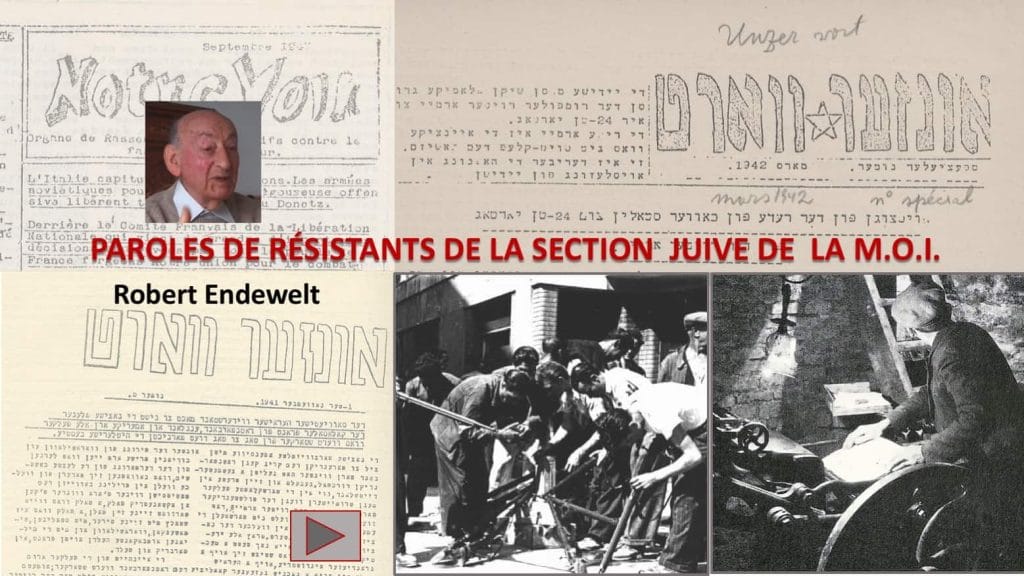
The civil resistance activitiesof the underground resistance fighters were varied: operating clandestine printing presses, distributing leaflets, organizing demonstrations, producing forged documents, finding “hiding places” for fighters and Jews being hunted down, rescuing Jewish children… Liaison agents—often young women on bicycles—carried messages and weapons. The civilian underground Resistance also published an underground press, in French or Yiddish, which was hunted down by the Nazis. All of these actions posed a real danger to the resistance fighters.
Organized members of the Resistance, though very few in number, often rely on support from the general public, whether implicit or explicit.
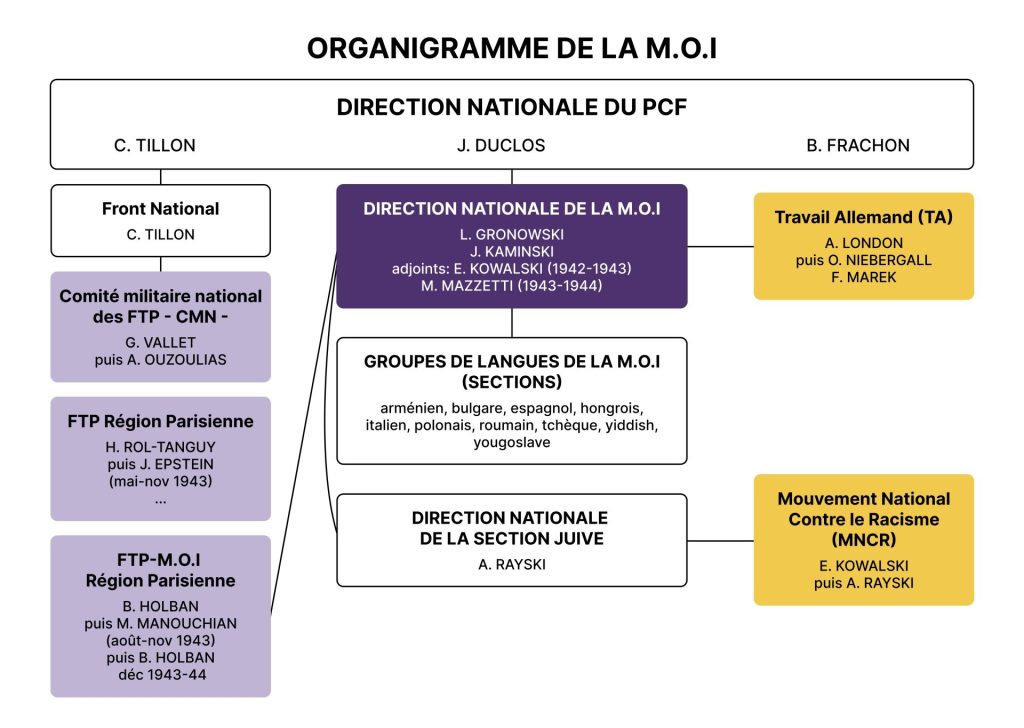
Alongside a civilian domestic Resistance movement, an armed domestic Resistance began to develop in 1941 (including the OS groups, followed by the FTPF and the FTP-MOI). Their actions were varied (attacks on trains carrying enemy supplies, setting fire to weapons depots, grenade attacks on buildings requisitioned by the German army, etc.).
In May 1943, Jean Moulin, General de Gaulle’s representative in France, succeeded in uniting the various domestic Resistance movements, as well as trade unions and political parties—ranging from the Communists to the Republican Right. The CNR was born. The Resistance was organized into two structures.
- One, the military branch, consists of the French Forces of the Interior (FFI). The Gaullist forces, the FTPF, and the FTP-M.O.I. are integrated into the FFI.
- The other organization, a civilian one, brings together the Departmental Liberation Committees (CDL), which are restoring the rule of law. Their role throughout the country is significant.
In May 1944, at the suggestion of the French Communist Party and on the initiative of the CNR, Patriotic Militias were formed in cities and in the maquis. The Resistance fighters were ready for the national uprising and the Liberation.
References:
— Stéphane Courtois, Denis Peschanski, Adam Rayski, 1994, *Le Sang de l’Étranger: Les Immigrés de la M.O.I. dans la Resistance*. Fayard.
— Robert Gildea, 2017, How Did They Become Members of the Resistance? A New History of the Resistance (1940–1945). Published by Les Arènes.