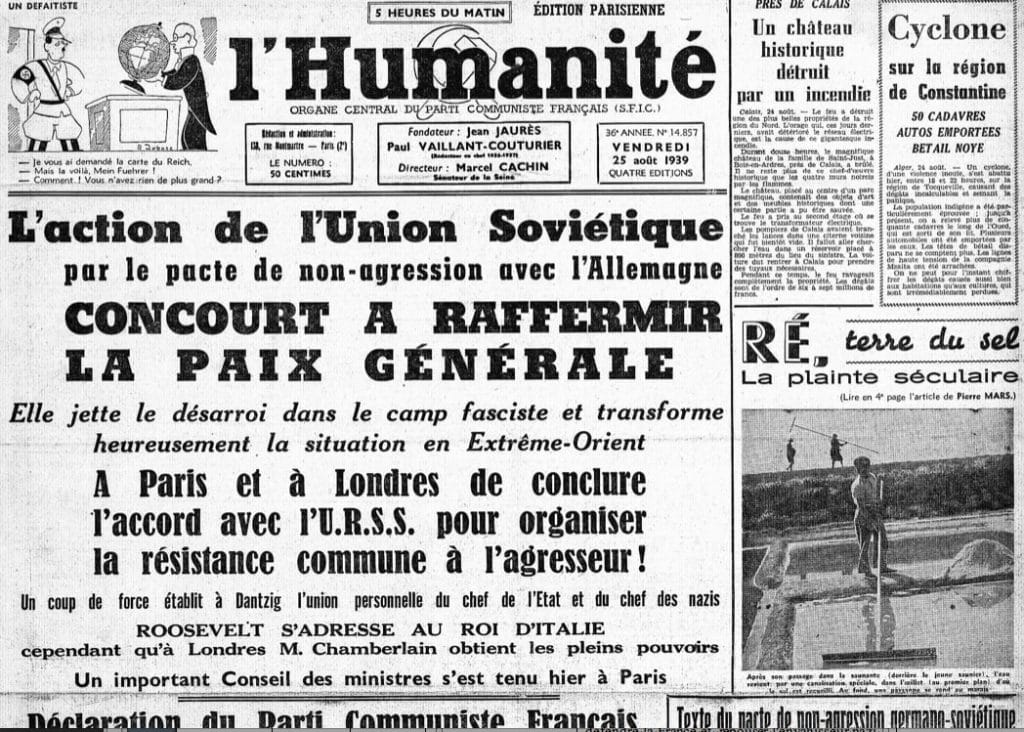
Military and diplomatic non-aggression pact between the USSR and Germany, signed on August 23, 1939. The USSR prioritized the struggle against the “imperialist” powers at the expense of the anti-fascist struggle.
All Communist parties aligned with the regime of the Union of Soviet Socialist Republics (USSR) were united within the Communist International, based in Moscow. On August 23, 1939, Joseph Stalin, General Secretary of the Soviet Communist Party, signed the Non-Aggression Pact with Germany, represented by the Nazi Ribbentrop. Dimitrov and Manuilsky, the leaders of the Communist International, were not informed of this in advance.
It was not until September 7, during a meeting with Stalin, that they learned of the new policy they would have to convey to the various Communist Parties abroad. From that point on, using various means of communication—such as telegrams or the dispatch of emissaries—a new policy had to be implemented.
On behalf of the PCF, André Marty—who was in Moscow at the time—oversaw operations, while Maurice Thorez, another PCF leader, was called upon to leave his regiment and travel to the USSR. He remained there for more than four years.
This new stance, which pits the imperialist powers at war against one another (France and Great Britain against Nazi Germany), met with reluctance, if not outright incomprehension, within the PCF, which, until then, had linked the struggle against fascism to the defense of democratic freedoms.
Reference:
Serge Wolikow, 2010, History of the Communist International, Ed. de l’Atelier.