————————
The son of a baker from Carpentras, Édouard Daladier studied in Lyon, where he attended classes taught by Édouard Herriot. After earning his agrégation in history, he was elected mayor of his hometown in 1912. He fought at Verdun during World War I. He served as a Radical-Socialist deputy for Vaucluse in 1919 and became president of the Radical Party in 1927. He formed his first government on January 30, 1933, just as Hitler was coming to power in Germany.
He was appointed to numerous ministerial posts from 1925 to 1940.
Daladier joined the Popular Front government in 1936. He served as Léon Blum’s Minister of National Defense and War, but the Radicals’ break with the Popular Front was soon complete.
As President of the Council, under the presidency of Albert Lebrun, Daladier signed the “Munich Agreement” with Chamberlain, Hitler, and Mussolini in September 1938. Hitler now had a free hand in the East. The Communists accused Daladier of renouncing his anti-fascist positions from 1936.
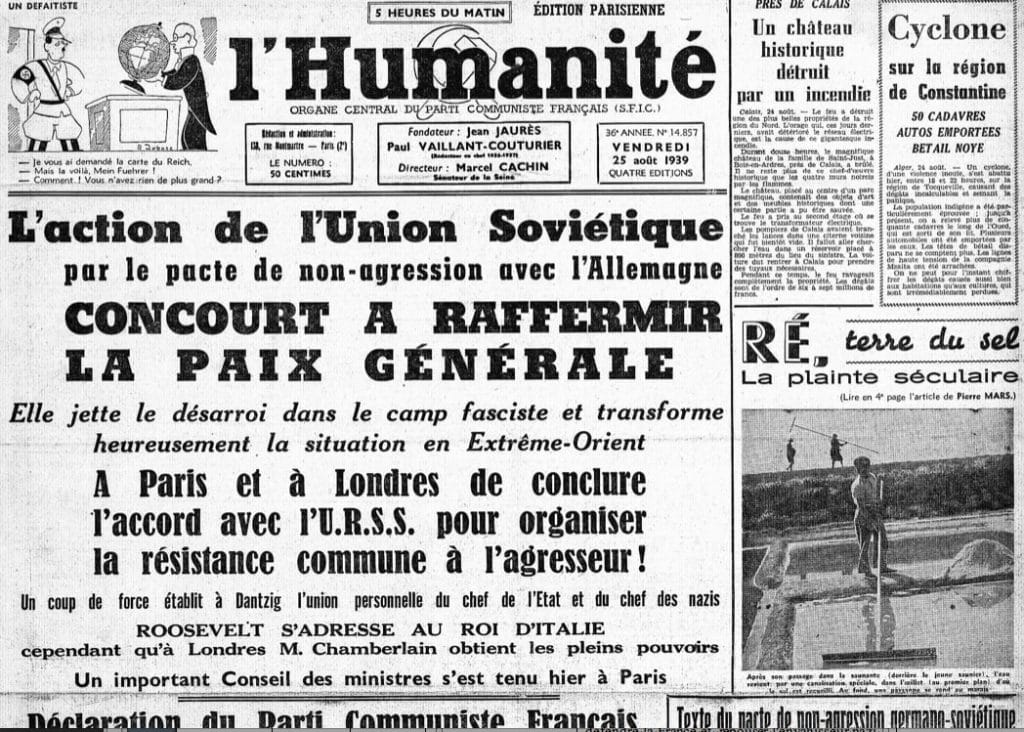
Under the pretext of wanting to reserve jobs for French workers, Daladier issued the decree-law of November 12, 1938, which provided for the internment of “undesirable foreigners.” This decree-law was supplemented by the law of November 18, 1939, which allowed for the internment “of any individual, French or foreign, considered a threat to national defense or public safety.” Communist Jews who had immigrated to the M.O.I. were particularly targeted, as were Spanish Republicans who had taken refuge in France. After the signing of the German-Soviet Pact in August 1939, Daladier ordered the dissolution of the French Communist Party. The PCF was accused by the right and by a portion of the destabilized left of supporting Hitler’s offensive alongside the USSR. Communist members of parliament were prosecuted.
France’s proactive military policy of rearmament, advocated by Daladier, came up against the reality of the “Phoney War.” Held responsible for France’s lack of preparedness for the conflict, he was forced to resign in March 1940. Upon hearing the news of the armistice on June 22, 1940, Daladier left France for North Africa. Arrested in September by the Vichy government, he appeared before the court in February 1942. He was interned in Germany from 1943 to 1945.
Once the war was over, he returned to politics for a time and resumed his seat as a Radical representative from Vaucluse in the Legislative Assembly. In 1957, he served as president of the Rassemblement des gauches républicaines.
He died in Paris on October 10, 1970.
Reference:
Rémond, René, and Bourdin, Janine, 1977, Édouard Daladier, Head of Government (April 1938–September 1939): Proceedings of a Symposium Organized by the National Foundation for Political Science. Paris: Presses de la Fondation nationale des sciences politiques.