Discrimination in university admissions took the form, in the Tsarist Empire, of a quota system limiting the number of Jews admitted to educational institutions (numerus clausus). Similar practices emerged in various Eastern European countries (Poland, Romania, Hungary).
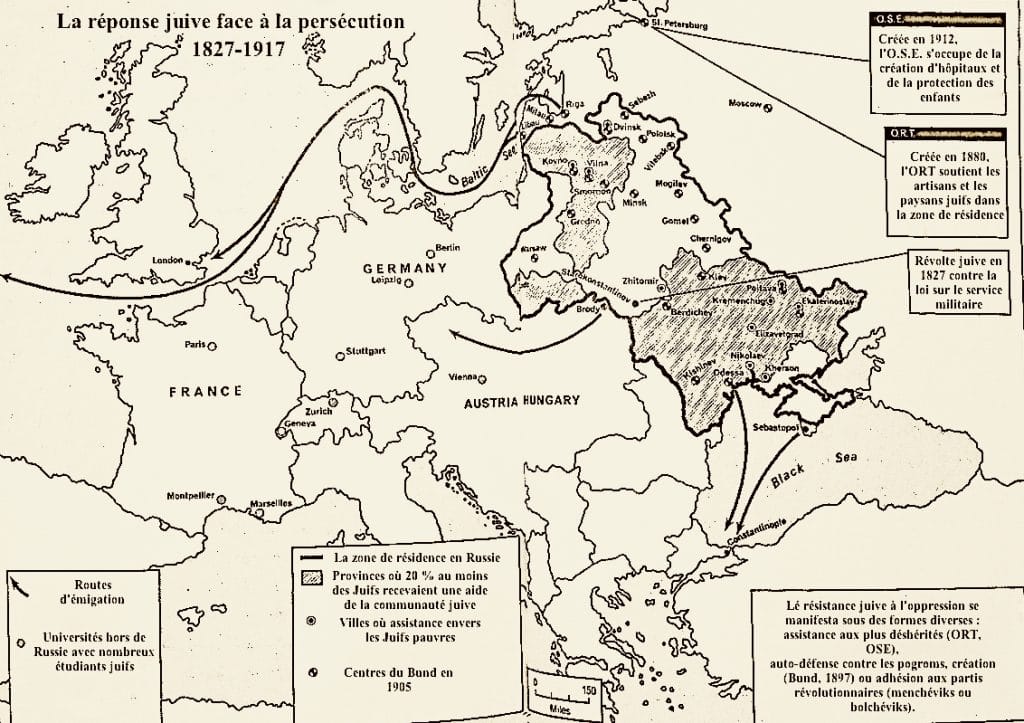
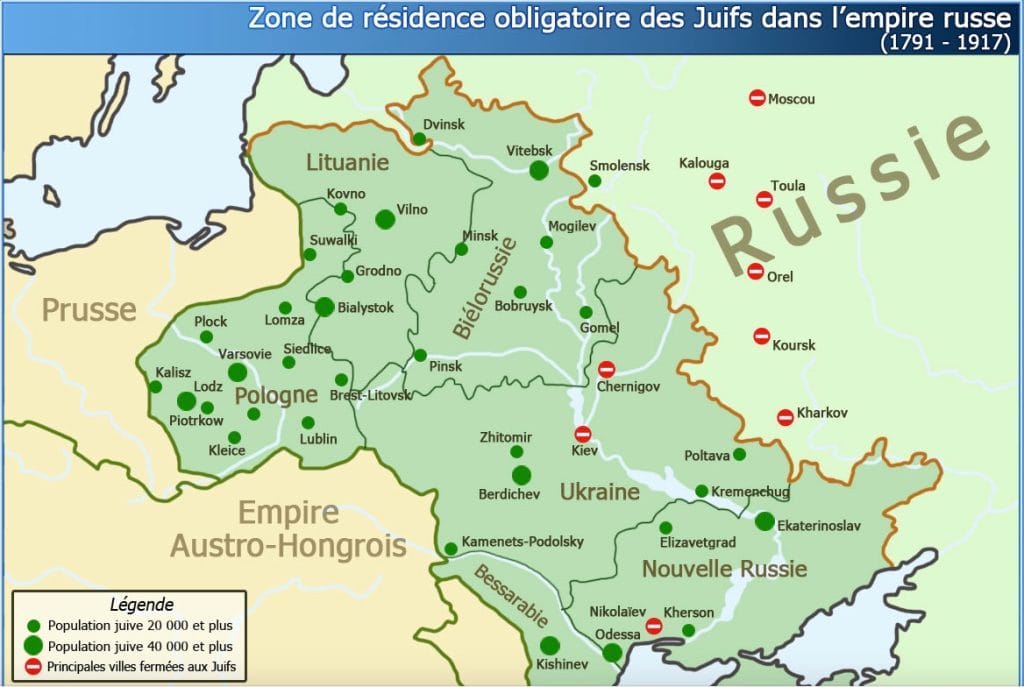
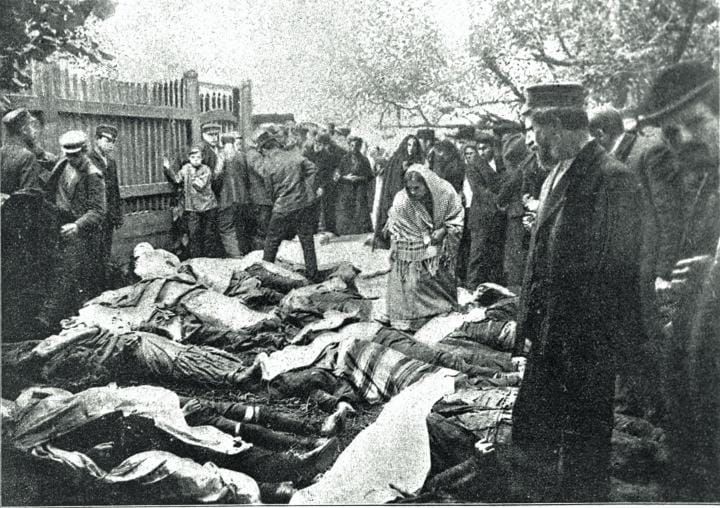
The assassination of Alexander II, which was wrongly blamed on the Jews, triggered a wave of pogroms in 1881. In May 1882, the government passed a series of laws concerning Jews: a ban on building, buying houses, owning, or using land outside the “Pale of Settlement” (the region where all Jews were forced to live).
Another decision was made: to restrict their access to secondary and higher education by introducing a quota on the admission of Jews to educational institutions (high schools and universities) throughout the Empire. Initially, these provisions were not official: first disseminated through a series of secret instructions, they were formalized in 1887 and revised regularly. The quotas varied: 3% in the capitals, 5% in the Kazan and Kharkov regions, and 10% in the “Pale of Settlement.”
In 1889, Jews were barred from becoming lawyers, and the proportion of Jewish doctors allowed to practice in the military could not exceed 5 percent.
The political climate grew harsher after the 1905 revolution, leading in particular to the enactment in 1908 of a law establishing a numerus clausus for Jews. In 1916, this law was extended to high schools and private institutions of higher education.
In the 1920s, most Eastern European countries implemented various forms of academic discrimination against Jews, ranging from designated seating areas (“ghetto benches”) to legal quotas, as well as student violence tolerated by the authorities. This was particularly the case in Hungary, Poland, and Romania.
References:
– Karady, Victor, 1993, ” Anti-Semitism and Educational Strategies in Hungary” (Proceedings of Social Science Research).
– Paul Zawadzki, 2000, “Anti-Semitic Violence at Polish Universities,” in *The Jews and the City*, Presses Universitaires du Midi.
– Iancu Carol, 1978, *The Jews in Romania: 1866–1919 — From Exclusion to Emancipation*, Presses universitaires de Provence.
– Gouzevitch, Irina, and Dimitri Gouževitch, 2002 , “Jews: Students, Scholars, and Engineers from the Russian Empire in France (1860–1940), ” *Archives Juives*, Vol. 35, Les Belles Lettres