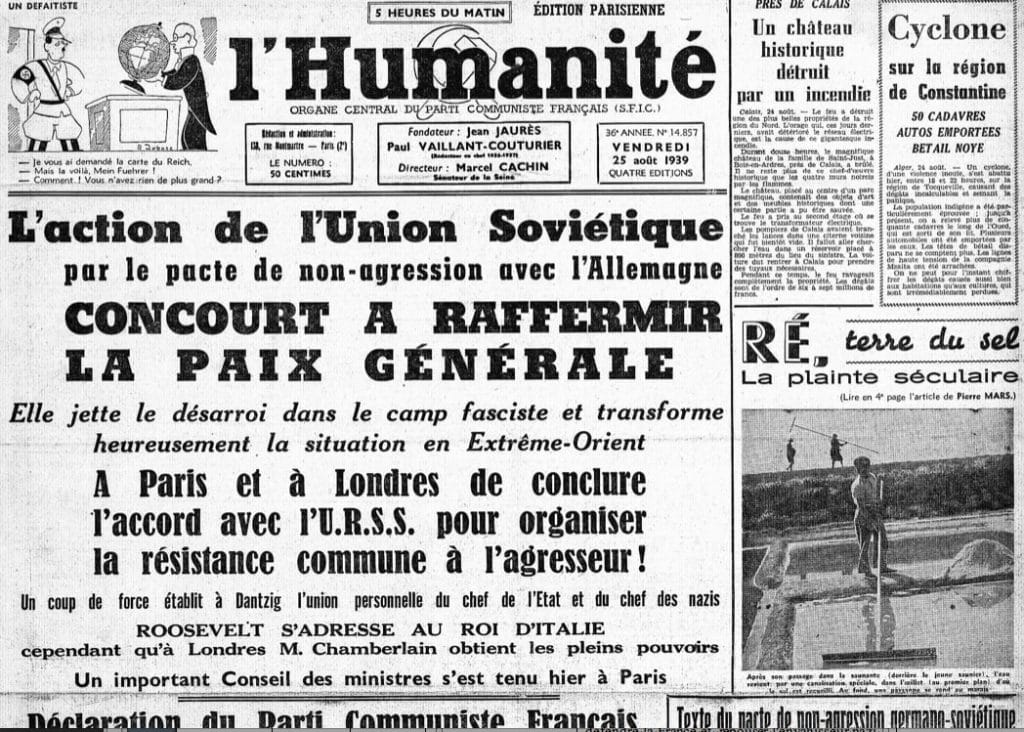
In 1939, the Communist International (CI), known as the Comintern in Russian, had been in existence for twenty years. It saw itself as the World Party of the Revolution. Since its founding in 1919, in the wake of the Russian Revolution, it had evolved significantly. Its leadership structures were centralized in Moscow, although since 1935, the communist parties in each country had enjoyed greater autonomy, particularly in implementing their policies on the ground.
However, while strategic direction remained, in principle, the responsibility of General Secretary Georges Dimitrov, the actual decisions binding on the Communist International were made by the General Secretary of the Communist Party of the Soviet Union (CPSU), Joseph Stalin.At the start of World War II, in late September 1939, the Comintern declared the war to be “imperialist” in nature and announced the end of the anti-fascist front.
After Germany’s invasion of the USSR, the Comintern shifted its line; the conflict was no longer presented as an “imperialist” war that pitted France and the United Kingdom against each other in the face of their common enemy, Germany. The communists intensified their direct struggle against fascism. The Comintern played an important role as French communists joined the Resistance and the armed struggle.
It was dissolved in 1943 to allow each Communist Party to lead the fight against the Nazis in its own territory.
Reference:
Serge Wolikow, 2010, The Communist International (1919–1943): The Comintern, or the Failed Dream of a World Revolutionary Party. Éditions de l’Atelier