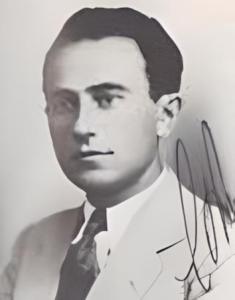
Born Baruch Bruhman Aliases: Roger, Olivier
Baruch Bruhman, known as Boris Holban, was born on April 20, 1908, in a village in Bessarabia (present-day Moldova), which had been the site of numerous pogroms. After the Romanian army carried out the Occupation of the region, Holban pursued scientific studies in Romanian. Later, he became a teacher. Aware of social and ethnic inequalities, particularly those affecting Jews, he joined the clandestine Romanian Communist Party.
Holban was imprisoned several times and sent to a disciplinary regiment. In 1938, he was stripped of his Romanian citizenship because he was a Jew and emigrated to France, where he made contact with Romanian communists. Very soon, he was put in charge of the Committee to Aid Romanian Volunteer Fighters during the Spanish Civil War against General Franco.
In 1939, when war was declared on Germany, he enlisted as a volunteer and was stationed in Barcarès. He left for the front, was taken prisoner by the Germans in June 1940, and managed to escape.
In January 1941, he returned to Paris clandestinely and took part in the first Resistance operations of the OS (Organisation Spéciale), which had been created in the fall of 1940 by the PCF.
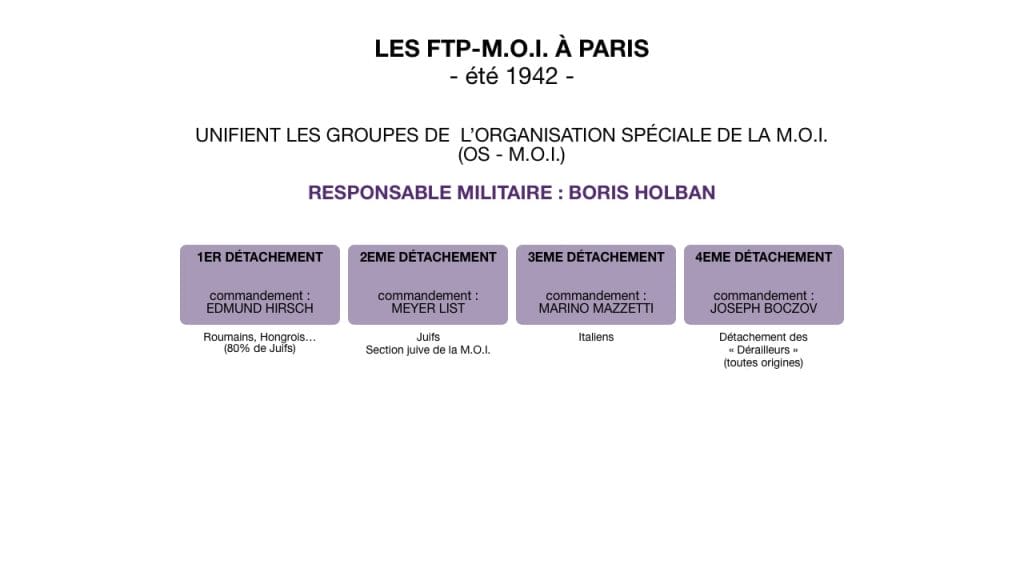
He quickly formed and led the Romanian armed groups of the M.O.I., and then became the head of all the M.O.I. combatant groups.
In late 1941, Holban (also known as Roger or Olivier) was appointed by the PCF to oversee, alongside Jacques Kaminski, the national leader of the M.O.I., the merger of the OS-M.O.I. with the FTP. In 1942, Kaminski entrusted Holban with the military leadership of the FTP-M.O.I. in the northern zone.
Boris Holban disagreed with the M.O.I.’s strategy of stepping up its operations. He considered this approach dangerous and was replaced, between August and November 1943, by Missak Manouchian.
Assigned to the national leadership of the M.O.I., he worked, in particular, to establish the first resistance groups.
In late 1943, following Manouchian’s arrest, Holban was reinstated as military commander of the FTP-M.O.I.
Together with Cristina Boïco, head of the intelligence department, he analyzes the objectives of the operations and ensures that they proceed smoothly.
On September 20, 1944, Boris Holban took command of Battalion 51-22, which was made up of veterans of the Liberation battles, including members of the FTP-M.O.I. Resistance movement.
Discharged from the military in 1946, Boris Holban returned to Romania, but, affected by the anti-Semitic purges, he emigrated permanently to France in 1984.
He died on June 27, 2004.
References:
— Boris Holban, 1994, *After 45 Years of Silence, the Military Leader of the FTP-M.O.I. in Paris Speaks*. *Testament*. Calmann-Lévy.
— Stéphane Courtois, Denis Peschanski, Adam Rayski, 1989, *Le Sang de l’Étranger*. Fayard.