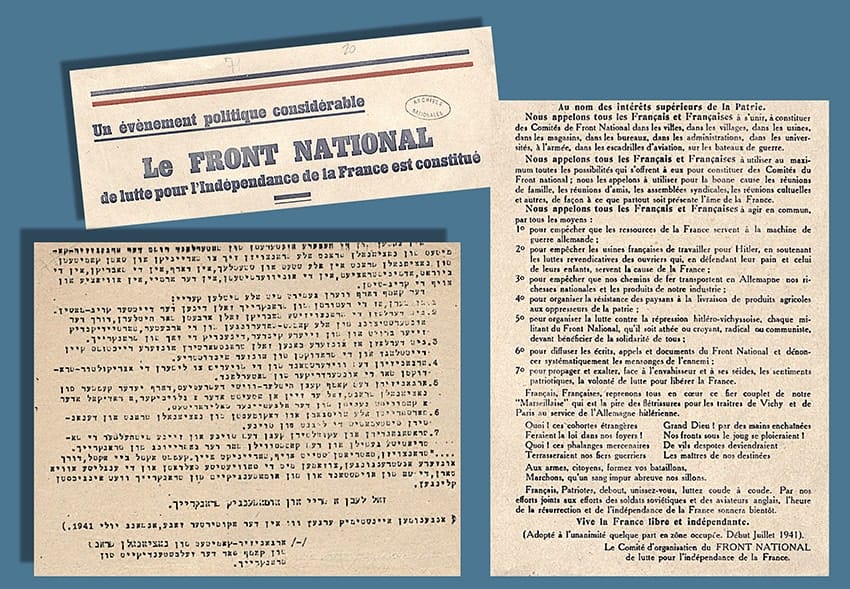
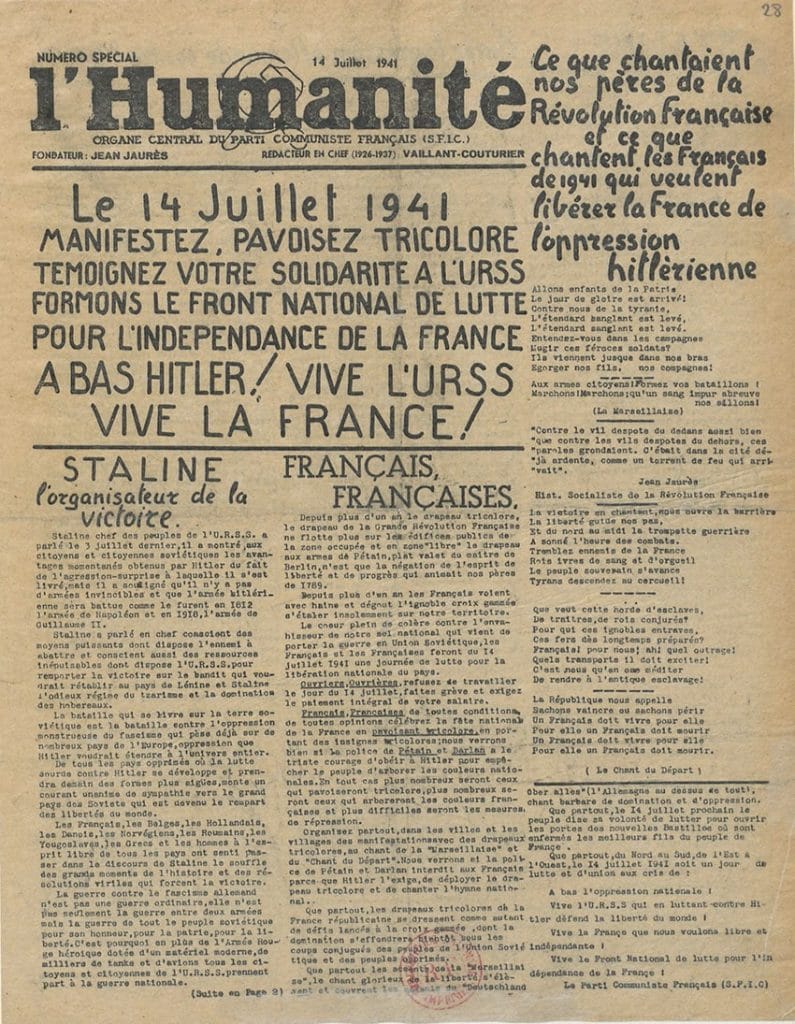
Starting in 1941, the French Communist Party organized the armed struggle against the occupying forces on French soil.
After the Nazis attacked the USSR in 1941, the Communist Party was the first to advocate the use of armed struggle in the Occupied Zone of France.
Unlike Charles de Gaulle, who did not consider attacks against the occupying forces to be appropriate, the PCF believed that one should not wait for a possible Allied landing to strike at the enemy. The goal, according to the PCF, is to fight alongside the USSR—the homeland of socialism that has been attacked—to tie down part of the German forces in the West, and to shatter the image of a peaceful and orderly Occupation.
The attacks are one form of this armed struggle, punctuated by acts of harassment as they await a general uprising. Terrorist attacks are not part of the communist tradition, which emphasizes a “mass struggle.” Many activists are reluctant to follow orders to kill German soldiers.
The first public attack, carried out to set an example, was the execution of Cadet Moser in Paris at the heavily trafficked Barbès-Rochechouart metro station on August 21, 1941. The operation was planned and carried out by Pierre Georges (the future Colonel Fabien) along with Gilbert Brustlein, Fernand Zalkinow, and Albert Gueusquin.
The human cost of the violent crackdown on communist Resistance fighters is accepted. According to Party leaders, it can only fuel hostility toward the Occupiers and increase the number of fighters.
The Barbès attack marked the beginning of the armed struggle. Foreigners, including Jews who had immigrated, joined the cause from the very beginning and took part in the fighting, notably within the FTP-M.O.I., especially during the initial phase, from 1941 to 1943.
Reference:
Stéphane Courtois, Denis Peschanski, Adam Rayski, 1989, *Le sang de l’Étranger*, Paris, Fayard.