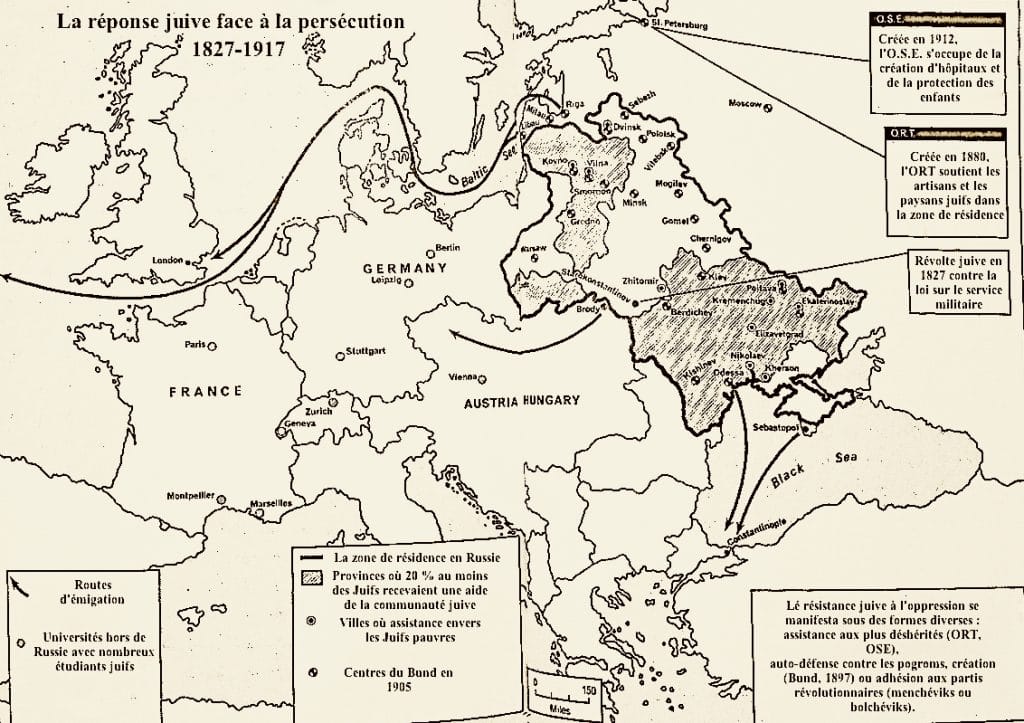
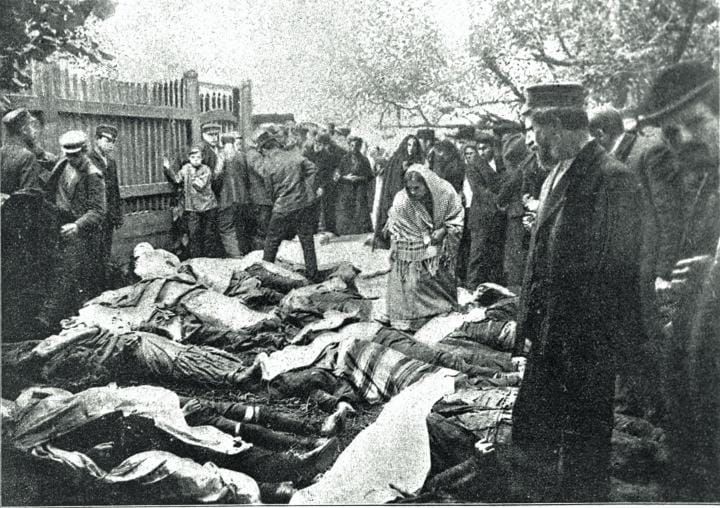
After initially referring to hostility based on religion and later on racial theory, the term “anti-Semitism” now refers to any manifestation of hatred, hostility, and discrimination toward Jews.
Hatred of Jews has existed since ancient times. Medieval antisemitism was Christian and religious in nature. Jews were accused of the death of Jesus (while ignoring the fact that Jesus himself was Jewish) and of ritual crimes. As victims of numerous prohibitions and persecutions, many of them found themselves, out of necessity, confined to trade and moneylending (which was prohibited by both Catholicism and Islam). As a result, particularly among the peasantry—especially in Central and Eastern Europe—Judaism came to be identified with usury.
In the modern era, antisemitism has taken on two new forms. With the development of industrial and financial capitalism, Jews are now denounced as the architects of exploitation, beneficiaries of the “dictatorship of profit,” and seekers of world domination. This fantasy permeates nearly all political movements. On the left, references to the Rothschilds are used to denounce capitalism. On the right, Jews are vilified as the architects of revolutions.
It was also during the mid-19th century and the first half of the 20th century that “biological” anti-Semitism emerged, asserting the “degenerate nature” of the “Jewish race.” These two forms combined to culminate in Nazism, which despised “Judeo-capitalism” and “Judeo-Bolshevism” and was responsible for the Shoah.
In France, the collapse of the Union Générale (1882) marked the beginning of a long period of economic recession. This bank established itself, in contrast to the traditional Jewish and Protestant banks, as the bank of the Catholics. Its bankruptcy ruined thousands of small savers who, unaware of the dubious financial practices of its founder, Émile Bontoux, blamed the Jewish bank (Rothschild) for the collapse. This marked the beginning of a wave of anti-Semitism. Drumont’s book, *La France juive* (1886), and the Dreyfus Affair (1894–1906) were key moments in the spread of conspiracy theories (the Jewish “conspiracy” for world domination).
The Protocols of the Elders of Zion (1901), an anti-Semitic forgery created by the Okhrana (the Tsarist secret police), found a wide audience in the 20th century and continues to fuel conspiracy theories to this day.
Reference:
Léon Poliakov, 1955, *History of Antisemitism*, Éditions du Seuil, Points Histoire series.