On June 10, 1944, a detachment of German soldiers from the Waffen-SS Das Reich Division entered Oradour-sur-Glane, a village in the Limousin region. The day before, General Heinz Lammerding had ordered the hanging of 99 hostages in Tulle, a neighboring town in Corrèze, in retaliation for attacks by resistance fighters attempting to slow the German advance toward Normandy.
In coordination with the Gestapo and the Militia, a program of “brutal action” was decided upon in June 1944 by the German high command. This program put into practice the principle of total war as applied on the Eastern Front, which meant looting, arson, and mass murder. After three preparatory meetings, the decision was made to exterminate the population of Oradour. SS Commander Adolf Diekmann was put in charge of the operation. He had 200 soldiers under his command.
In the early afternoon, the Germans surrounded the village and rounded up the population at the fairgrounds under the pretext of conducting identity checks. Diekmann accused the residents of hiding weapons and demanded that those responsible turn themselves in. He asked the mayor to designate hostages. The mayor refused. The SS then divided the population into two groups: women and children on one side, and men on the other.
The men are locked in barns, held at gunpoint by automatic weapons. The SS machine-gun them, cover the bodies with bales of straw, and set them on fire. Women and children are locked inside the church. The building is set on fire using chemical weapons and explosives.
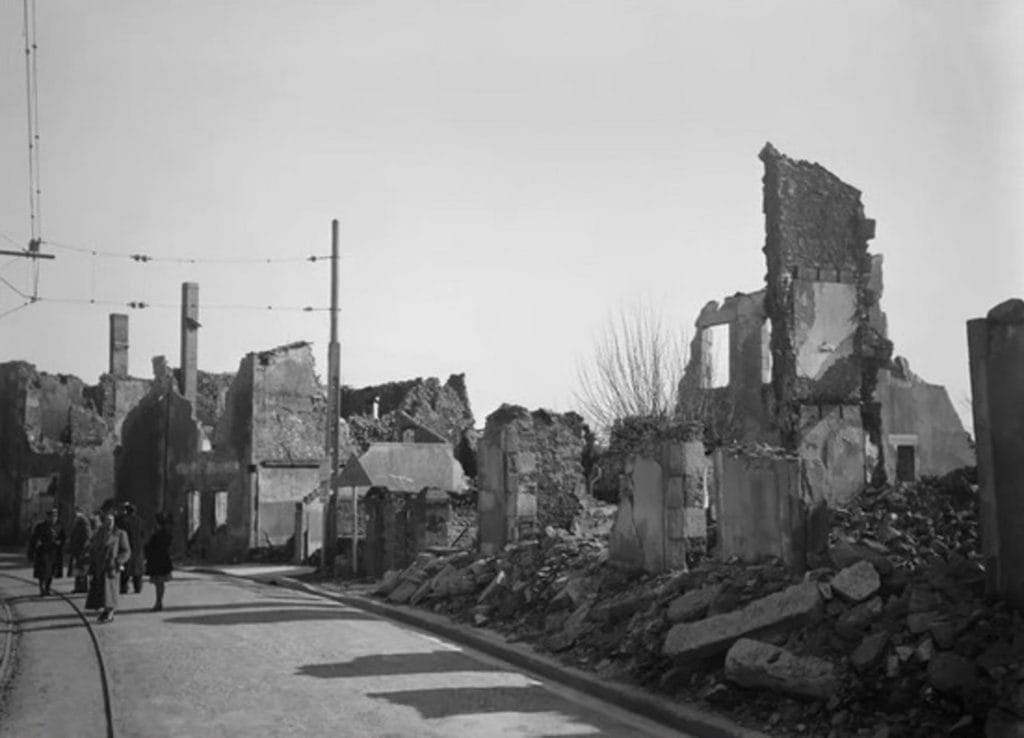
Detachments of SS soldiers looted and set fire to the village, killing the few residents who had barricaded themselves in their homes.
In the days that followed, an SS unit buried the bodies in mass graves to cover up the evidence and make identification impossible.
This massacre claimed 642 lives, including 245 women, 207 children, and 190 men. Of those killed, 117 were from other regions of France and had taken refuge in Oradour-sur-Glane.
It was the most serious war crime committed by the Germans against the civilian population in France.
References:
— Leroux, Bruno, in: F. Marcot (ed.), *Historical Dictionary of the Resistance* (2006): Éditions Robert Laffont.
— Le Maitron Online: entry by Dominique Tantin