The Special Sections, special courts, were established in August 1941 at the request of the German authorities to punish, by the death penalty, acts of Resistance committed by underground communist and anarchist activists, This request stemmed directly from the Vichy government’s desire to crush the Communists in particular.
Following the execution of two young communist protesters on August 19, 1941, Resistance fighter Pierre Georges shot and killed a German officer in retaliation on August 21. The Special Sections, created at that time by the Germans and widely supported by the Vichy government, were tasked with combating communist and anarchist Resistance fighters.
These special divisions sat within the courts of appeal (in the occupied zone) and the military or maritime courts (in the unoccupied zone, known as the “free zone,” until November 1942).
The Vichy regime quickly expanded the jurisdiction of the Special Sections, which gradually came to cover all “terrorist” acts and were augmented by “expanded special sections” that included police officers and gendarmes.
The Special Sections handed down a total of 45 death sentences, 33 of which were in absentia, and some were even retroactive…
In Paris, three Communist Resistance fighters (Emile Bastard, André Brechet, and Abraham Trzebrucki) were the first to be sentenced to death. They were guillotined on August 28, 1941.
In February 1942, the Special Section of the Toulouse Military Court tried 21 German and Austrian communist resistance fighters.
Nine death sentences were handed down the following year.
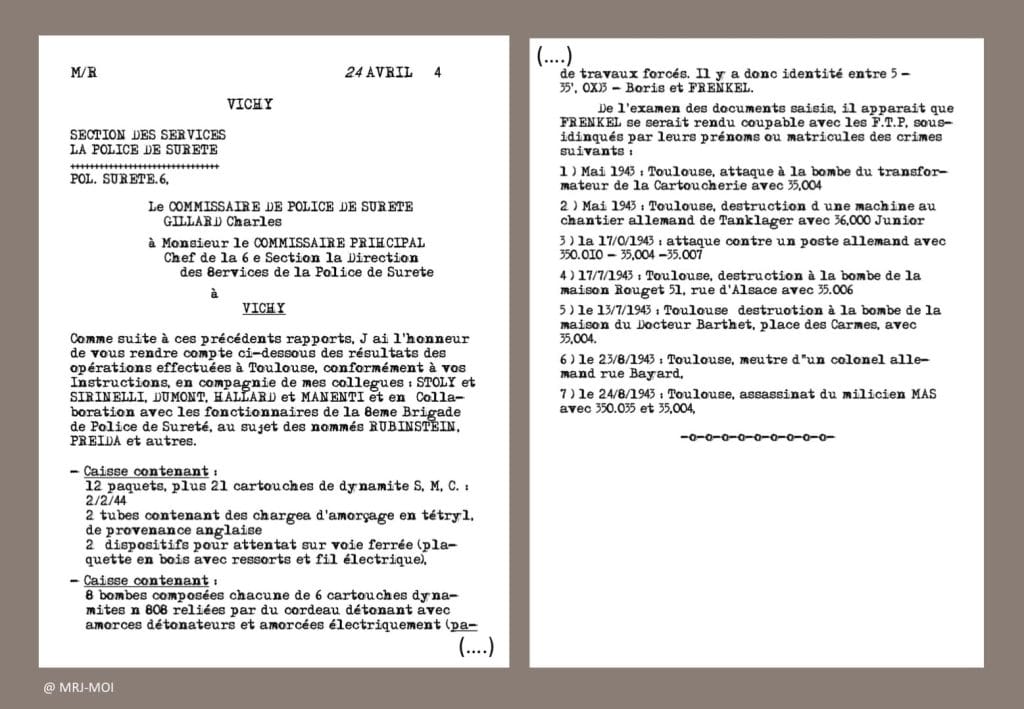
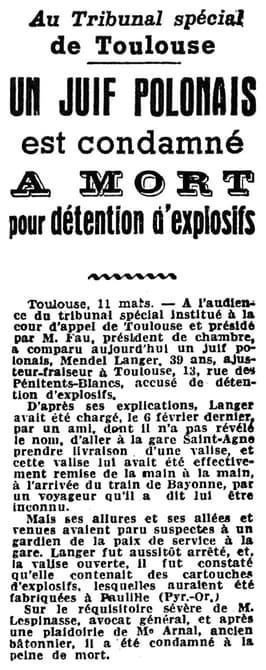
Thus, on March 21, 1943, Mendel Langer, known as Marcel Langer, a former officer in the International Brigades in Spain and commander of the FTP-M.O.I. in the 35th Toulouse Brigade, was sentenced to death by Prosecutor General Pierre Lespinasse, who declared: “You are a Jew, a foreigner, and a communist—three reasons for me to demand your head.” Langer was guillotined on July 23, 1943.
In retaliation, Prosecutor Lespinasse was executed by a member of the FTP-M.O.I. resistance group from the 35th Brigade on October 10, 1943.
Similarly, in December 1943, Faure Tinguely, a judge of the Special Sections, was killed by a group of FTP-M.O.I. fighters from the Carmagnole Battalion in Lyon in retaliation for the beheading of the resistance fighter Simon Frid.
Intimidation is working. No judge is seeking the death penalty for a resistance fighter anymore, but the violence of the security forces has intensified.
This situation prompted Vichy to strip the judiciary of its authority. From then on, 200 courts-martial were tasked with meting out ruthless and swift justice against all armed units of the Resistance (FTP, FTP-M.O.I., maquis).
The number of people held by the Special Sections, however, was constantly increasing, as the Germans continually drew from the pool of political prisoners (arrested under French law) to “use” them as hostages or to deport them.
Reference:
French Association for the History of Justice, 2001, Justice in the Dark Years: 1940–1944. Paris : Éditions La Documentation Française.