Radio Londres was the name given, during World War II, to French-language broadcasts that were hostile to the Vichy government. They were broadcast from June 19, 1940, to October 25, 1944, from the studio of the French section of the British Broadcasting Corporation (BBC) in London. They were one of the manifestations of the external Resistance.
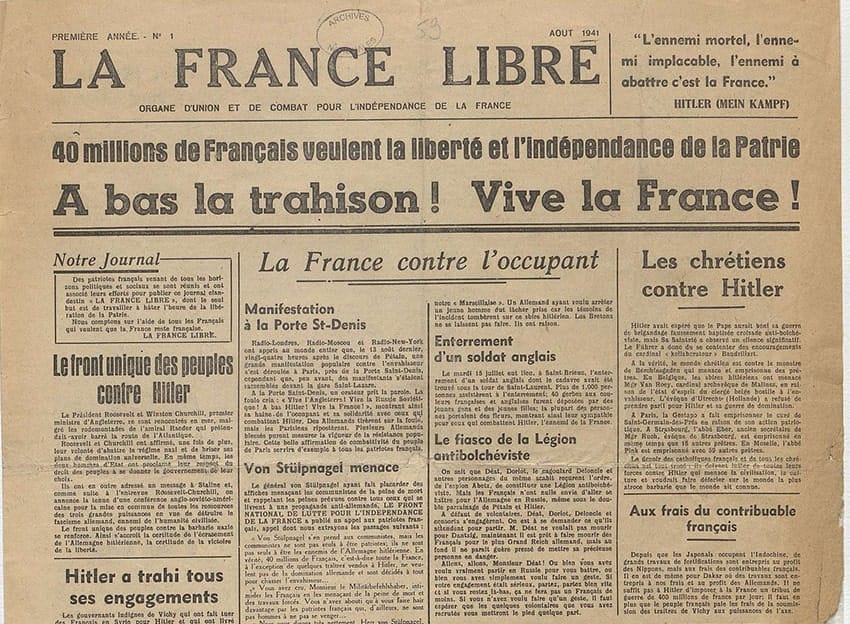
For the first time in history, radio emerged as a crucial weapon. Following General de Gaulle’s appeal on June 18, 1940, Radio London played a major role, maintaining a continuous link between the French people under Nazi Occupation and the Allies who were continuing the war. Radio London became the voice of Free France.
At midday and in the evening, programs on the English-language BBC radio station are introduced by a musical excerpt from Beethoven’s Ninth Symphony, followed by the announcer’s voice: “This is London; the French are speaking to the French.”
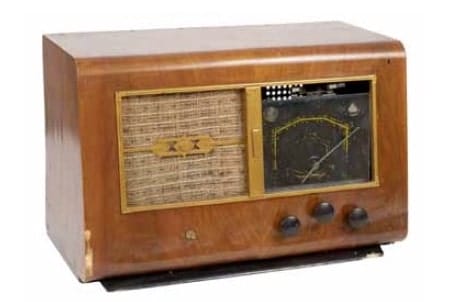
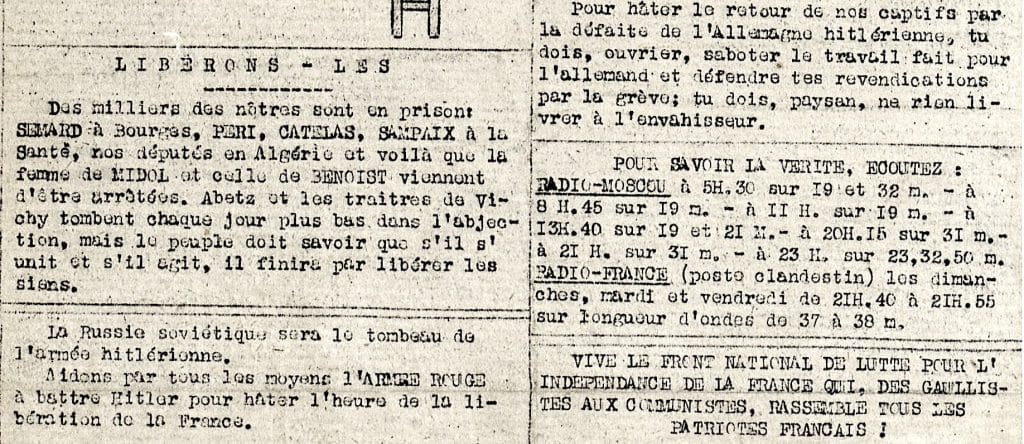
Despite radio jamming, strict surveillance by the police and informants, and the confiscation of radios (Jews were stripped of their radios as early as 1941 by a German decree), 70% of the French population was listening to the BBC in the summer of 1944.
Radio London was also used to broadcast coded messages to members of the Resistance, such as those providing information about airdrops (“The cook keeps her kitchen clean,” “The carrots are cooked”…) or those announcing landings (“The long sobs of autumn’s violins… ,” followed by “wound my heart with a monotonous languor,” or “The first snag costs two hundred francs”), which only the intended recipients could decipher.
The comedian Pierre Dac, a Jewish member of the Resistance from Alsace, was one of the leading figures at Radio London. Among his targets, he took aim—with biting irony—at Philippe Henriot, the voice of Vichy propaganda.
Reference:
Aurélie Luneau, 2005, Radio London 1940–1944: The Voices of Freedom. Librairie académique Perrin.