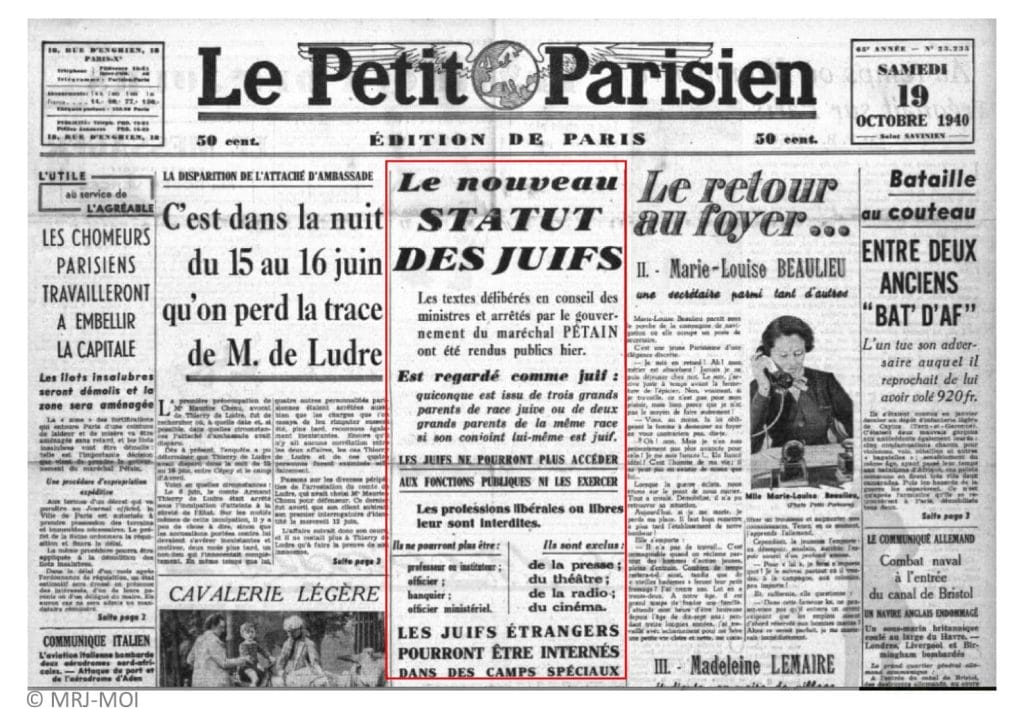
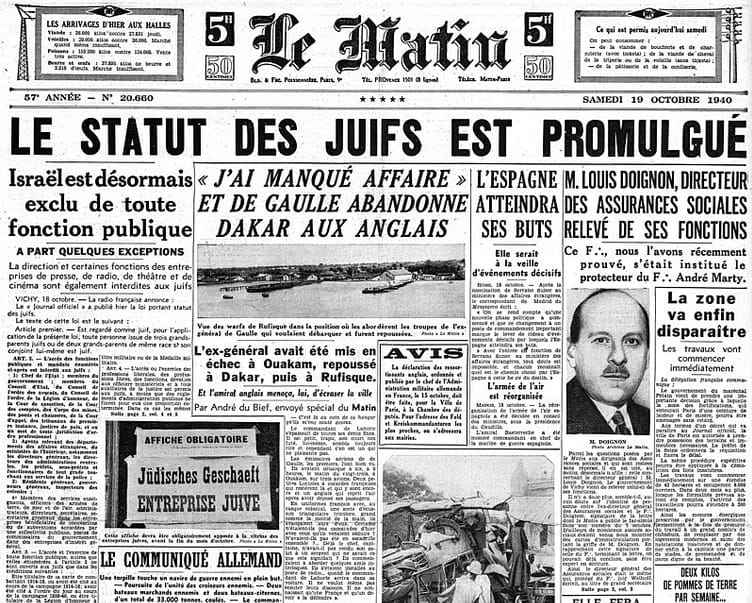
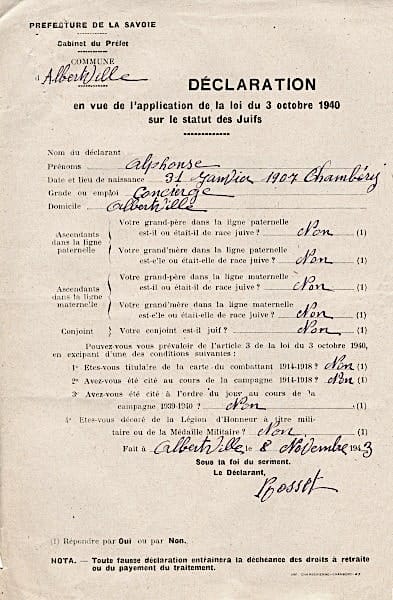
The law of October 3, 1940, “on the status of Jews,” defined the concept of the “Jewish race” as understood by the collaborationist Vichy regime and enacted the first discriminatory measures against Jews.
From 1940 to 1944, 143 laws and regulations (most of which were enacted before the end of November 1942) targeted Jews. The German ordinance of September 27, 1940, paved the way for the French law of October 3, 1940, which historians refer to as the “first statute for Jews” and consider the starting point of state-sponsored antisemitism.
This law was an initiative of the Vichy government and was modeled after the German Nuremberg Laws of 1935.
This status made Jews a separate category—second-class citizens, ostracized from society—and introduced the concept of the “Jewish race ” According to Article 1, “A person is considered a Jew—regardless of religious affiliation—if they have at least three grandparents of the Jewish race, or only two if their spouse also has two grandparents of the Jewish race. A grandparent who belonged to the Jewish religion is considered to be of the Jewish race.”
Article 2 concerns access to and the exercise of public office and positions of authority. Regardless of titles, positions, or departments, most of these roles are off-limits to Jews. Furthermore, Jews are barred from professions that influence public opinion. Finally, this article establishes a quota limiting access to and the practice of the liberal professions.
On October 4, an amendment to the law targeted “foreign nationals of the Jewish race.” From that point on, by mere decision of the prefect of the department where they resided, they could be immediately interned in special camps at Pithiviers, Beaune-la-Rolande, and Drancy.
Reference:
Diamant, David, 1971, *The Jews in the French Resistance, 1940–1944*. Le Pavillon, Roger Maria Éditeur.