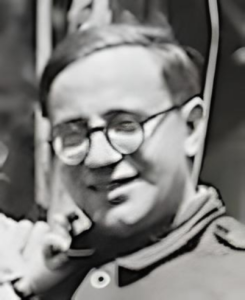
Joseph Minc was born on March 14, 1908, in Brest-Litovsk, in the Russian Empire. His mother came from a family of rabbis. His father had attended rabbinical school. Joseph’s initial calling was religion.
After World War I, it successively held Polish and then Russian citizenship, depending on the conflicts between the two countries.
He attended Hebrew school and then, in 1922, left for Warsaw to continue his studies at a rabbinical school. He returned to Brest-Litovsk to study to become a dental technician and “bid farewell to God.”
In 1924, he joined the underground Communist Party of Poland and held leadership roles in the areas of political propaganda, labor activism, and Jewish organizations.
He passed the baccalaureate but was unable to enroll in dental school because of the numerus clausus imposed on Jews.
He went into exile in France, first to Bordeaux in 1931, then to Paris in 1937, where he earned his dental degree.
In 1939, when war was declared, although he was a foreigner, he volunteered for the French army, but in 1940 he was recruited as a dentist in a Polish army formed in France.
In the summer of 1940, he was taken prisoner in Montbéliard, then released as a “member of the medical services,” and returned to Paris.
He joined the underground Jewish organization M.O.I. “Solidarity” and participated in the Committee for Aid to Women and Children.
In 1942, refusing to wear the yellow star, he went into hiding and joined the Mouvement National contre le Racisme; under the pseudonym Mine or Dacqmine, he helped rescue children.
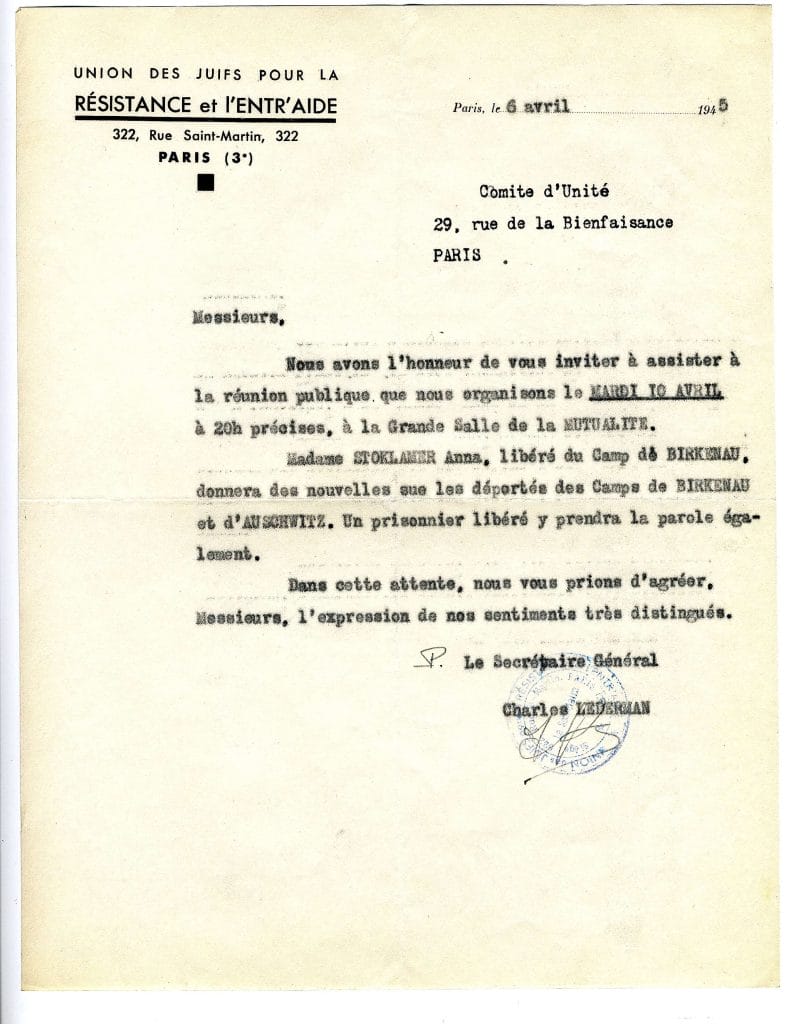
From the very beginning of the UJRE (Union of Jews for Resistance and Mutual Aid) in May 1943, he became involved in the Children’s Commission, which was tasked with hiding Jewish children to save them from deportation. Minc and his comrades found safe havens and oversaw the placement of the children.
After the Liberation, he joined a Jewish Unity Committee that included representatives from all factions. The committee’s mission was to help Jews who were emerging from hiding to find housing, obtain clothing, and learn about their rights.
Joseph Minc helped supply the canteens and search for hidden Jews.
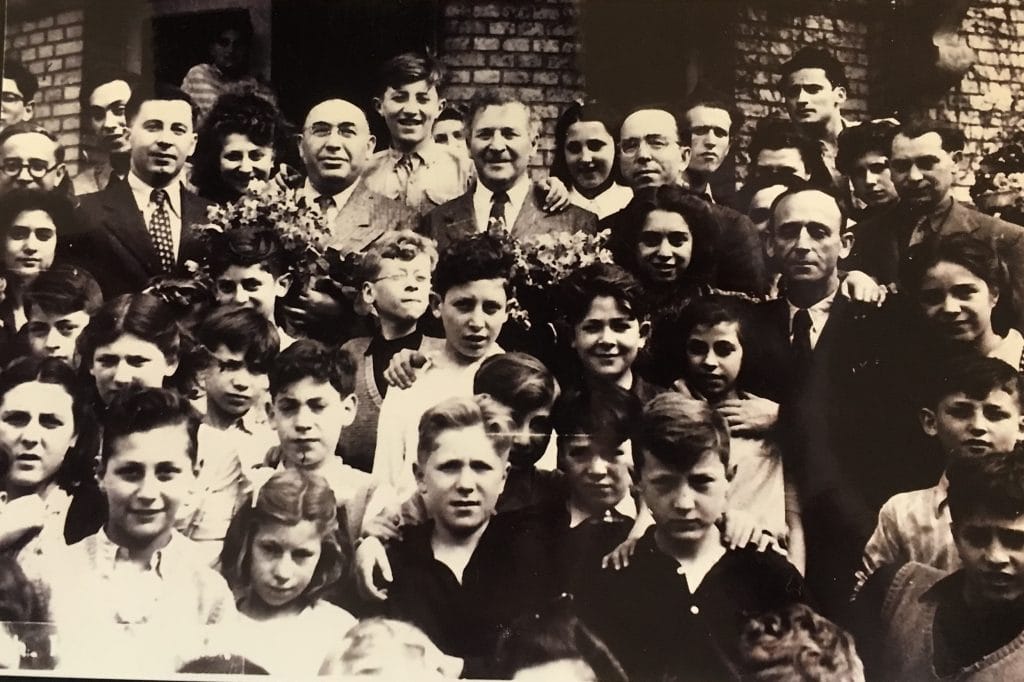
In early 1945, the UJRE’s Children’s Commission became the CCE (Commission Centrale de l’Enfance of the UJRE). Joseph Minc served as its first secretary-general until 1946.
In just a few months, from February to October 1945, the CCE established six orphanages, featuring innovative educational approaches, to care for approximately 350 orphans.
Starting in the summer of 1945, summer camps were organized for all Jewish children, including those who were not orphans.
Joseph Minc left the CCE in June 1946. In 1950, he became secretary of the UGEVRE (the Federal Union of Foreign-Born Volunteer Resistance Fighters), a position he held until 1968.
He died in Paris on January 8, 2011.
References:
— Minc Joseph, 2001, The Extraordinary Story of My Ordinary Life. Published by Bookpole
— AACCE, 2009, *The Jewish Resistance in France, 1940–1945*. Published by AACCE
— Serge Wolikow, Isabelle Lassignardie, 2015, Growing Up After the Shoah. Ed de l’Atelier