Several FTP-M.O.I. groups were formed in the southern zone, but some were particularly active. In Lyon, in the summer of 1942, a few former members of the Spanish Civil War brigades and activists from the Communist Youth League came together. All were foreign Jews. They formed the “Carmagnole” detachment.
In addition to “Carmagnole,” a second detachment was formed, known as “Simon-Frid,” named after a fighter who was guillotined in December 1943; however, this detachment would never reach full strength.
In Grenoble, the “Liberté” detachment (30 men) was formed in the spring of 1943.
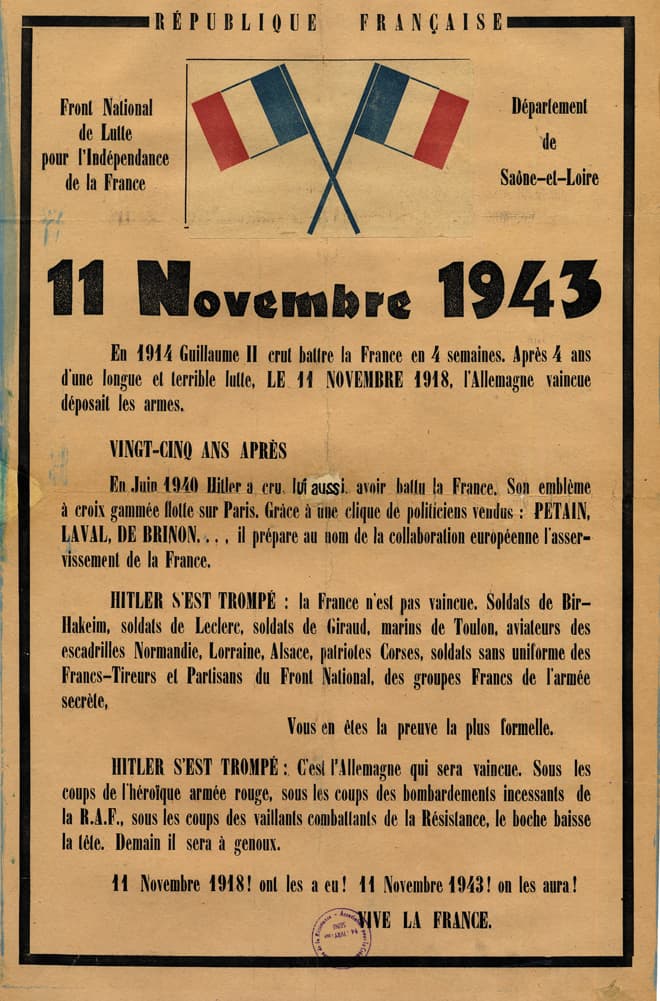
There were numerous acts of resistance in the Lyon and Grenoble regions against the occupying forces and the Vichy regime.
Following the D-Day landings, the “Carmagnole” and “Liberté” detachments each formed a maquis; each group comprised more than a hundred fighters and included Italians, Polish miners, and young French people fleeing the STO.
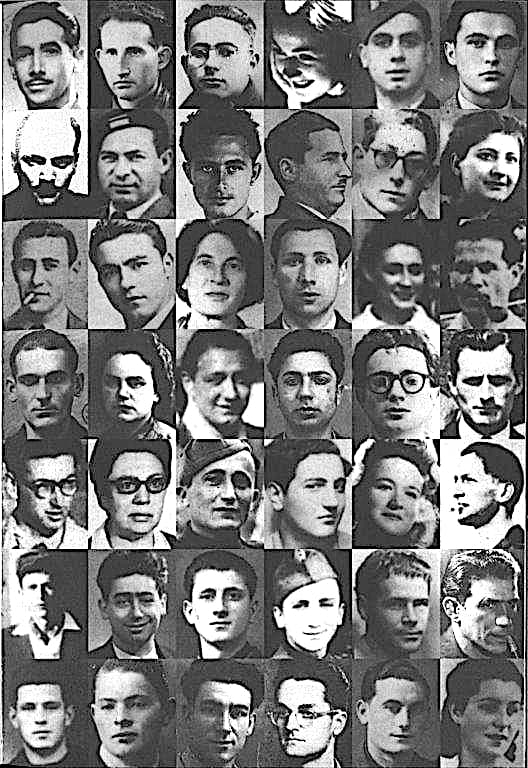
The list of “The Hundred Dead of Carmagnole” and “Liberté” from 1942 to 1944 reveals that the organization relied primarily on Jewish immigrants from Eastern Europe.
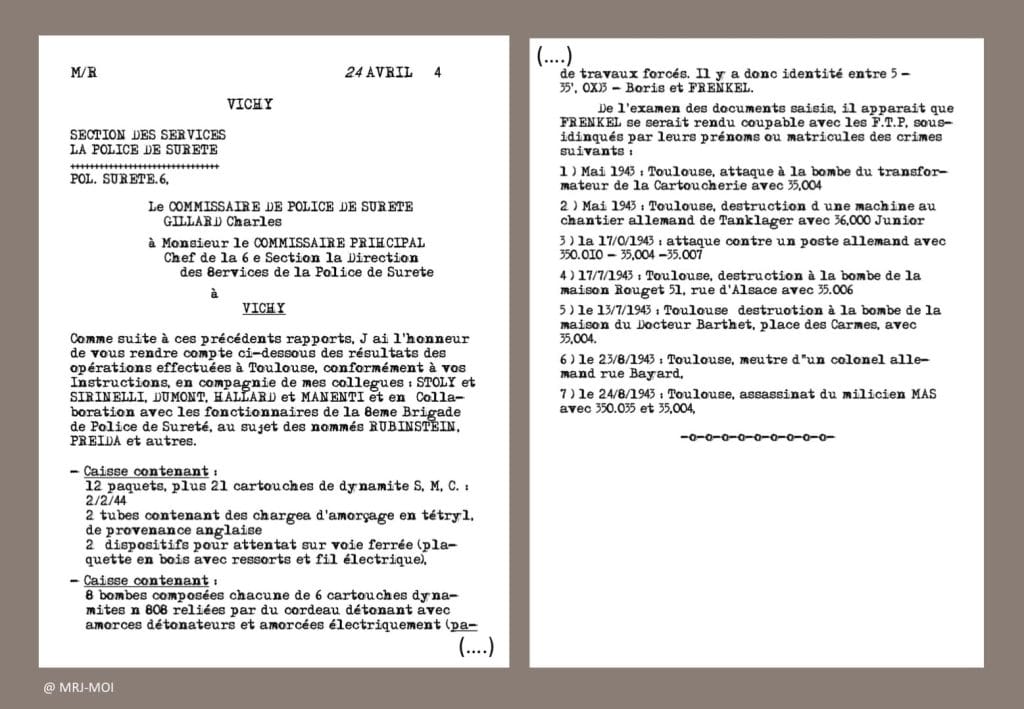
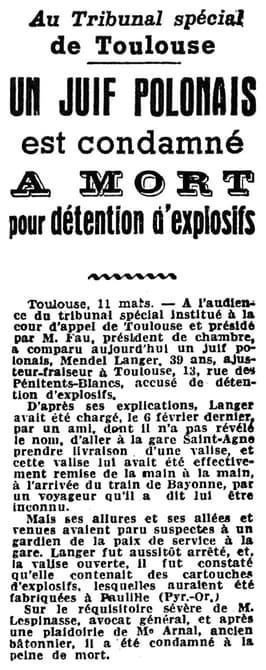
In Toulouse, the 35th Brigade, known as the “Marcel Langer Brigade,” is named after its commander, a Polish Jew and former member of the Brigades, who was assassinated by the Vichy regime. It is a mixed unit, composed of 60 members, mainly Jews from Eastern Europe.
The women, who are deeply involved, carry the weapons, track down targets, and make the bombs.
The “Brigade’s” record is impressive: sabotage of railroads, factories, and German supply depots; attacks on German convoys; and the execution of collaborating magistrates and militiamen… The fighters succeeded in creating a climate of constant insecurity for the enemy.
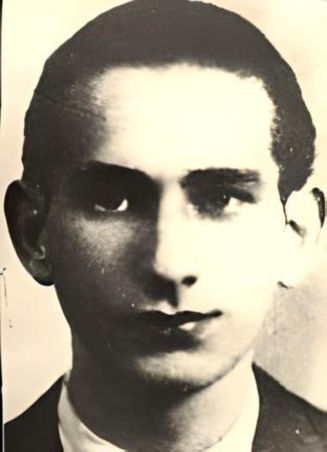
In Marseille, the Marat detachment—which later became the Maurice Korzec Company, named after its young Jewish commander, who was murdered by the Nazis at the age of 19—was also very active. On November 11, 1942, as German troops entered Marseille, a bomb destroyed a German truck right in the city center. Numerous other attacks would follow.
Generally speaking, despite their small numbers, the FTP-M.O.I. Resistance fighters—both in Paris and in the South—were highly effective in their fight against Nazism and for freedom. They all took part in the battles for the Liberation.
References:
— Collin, Claude, in: F. Marcot (ed.), 2006, *Historical Dictionary of the Resistance*: Robert Laffont.
— Ravine, Jacques (1973) *The Organized Jewish Resistance in France, 1940–1944*: Julliard