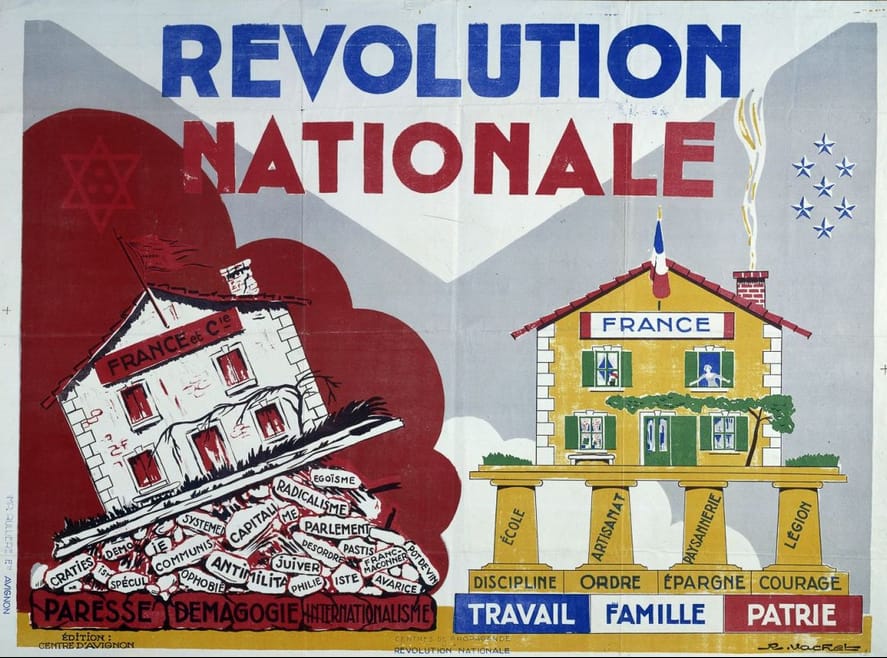
Far-right leagues emerged during the interwar period amid the rise of nationalism and dictatorships.
Hatred of the Republic, the cult of the nation, xenophobia, and anti-Semitism are their main slogans. Founded in 1936 by Jacques Doriot, the French Popular Party (PPF) was, under the Vichy regime, the only mass fascist organization with a popular base.
The spirit of Action française, a nationalist intellectual movement of the early 20th century, formed the ideological foundation of the far-right leagues between the two world wars. Anti-republicanism, national primacy, xenophobia, and anti-Semitism are all hallmarks that emerged in the wake of the Dreyfus Affair.
After 1918, the economic crisis led big business to support dictatorial regimes, foremost among them Hitler’s Germany. At the same time, far-right leagues—funded by big business and foreign countries such as Mussolini’s Italy—were active.
Their demonstration in Paris on February 6, 1934—which went beyond a mere rejection of the Republic—was inspired by fascism. Pétain was then head of the Ministry of War. These leagues, united under the Cagoule—a clandestine far-right paramilitary organization—were instrumental in the establishment of the Vichy regime. Many Cagoule members held government posts, and the French State Militia was formed from members of the military wing of the Cagoule.
As early as 1936, Jacques Doriot, a former Communist deputy and a symbol of the disintegration of part of the left, offered a political response to the movement: he founded the only mass fascist organization with a popular base under Vichy, the French Popular Party (PPF), which had 300,000 members. Since Pétain did not grant the PPF and its leader the role they had hoped for, Doriot then turned to extreme collaboration with the creation of the Legion of French Volunteers Against Bolshevism (LVF).
References:
— *Géohistoire* Journal, 2017, No. 32, “The Far Right in France, 1870–1984.”
— Annie Lacroix-Riz, 2006, *The Choice of Defeat*, Armand Colin.