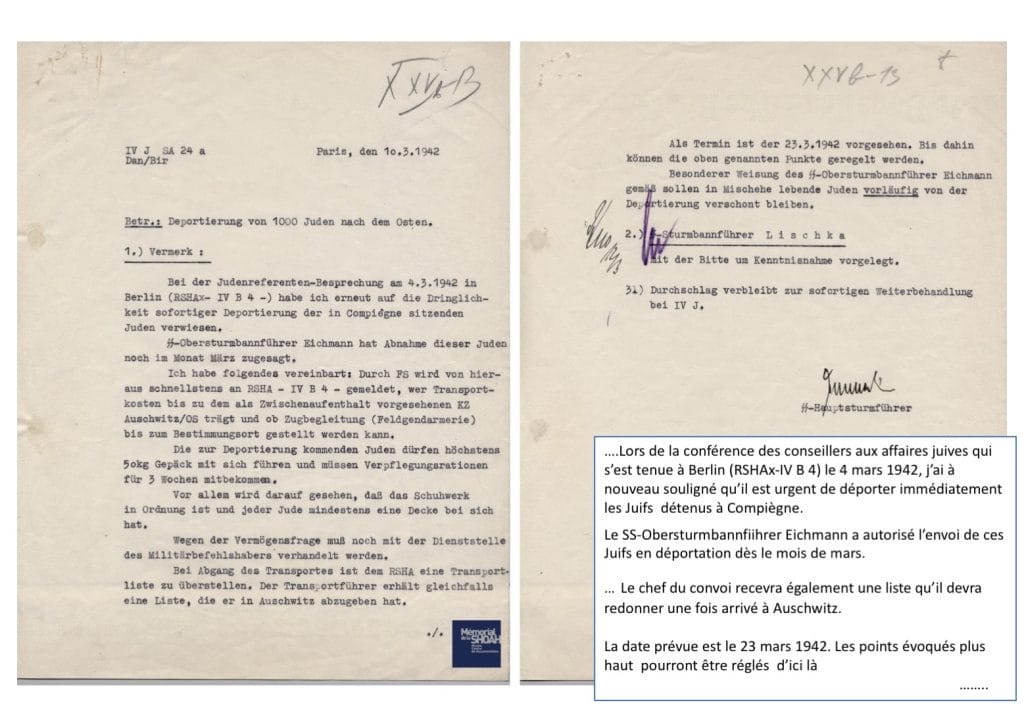
From 1942 to 1944, some 75 train convoys deported 75,000 Jews—including 11,400 children—from France to extermination camps. Most of these trains were numbered by the authorities at the time.
Most of these 75 train convoys carrying deportees departed from the Drancy transit camp in the Paris region (55 convoys), but also from camps in the Loiret department (Pithiviers and Beaune-la-Rolande), the Compiègne-Royallieu camp, Angers, and Lyon.
- Convoys Nos. 41, 43, 54, and 56 do not exist, and convoy No. 64 departed before convoy No. 63 due to administrative errors. The last two convoys (Nos. 78 and 79) were not assigned numbers.
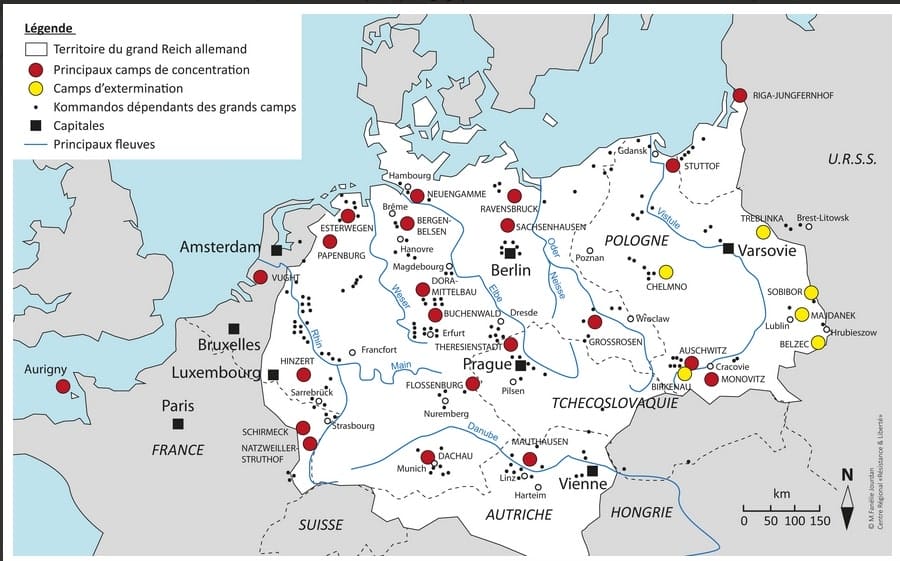
- Convoys Nos. 50–51 were sent to the Sobibor and Majdanek extermination camps, convoys No. 52 through 53 to Sobibor, convoy No. 73 to Kaunas (Lithuania) and Reval (now Tallinn, Estonia), and convoy No. 79 to Buchenwald.
The conditions for the deportees on these trains are appalling. Children, the elderly, women, and men are crammed together, without food or water, in cattle cars. Many of the deportees die during the journey.
Virtually all of the Jews from France who were deported passed through Drancy on the orders of the Nazis and their French collaborators. In total, approximately 63,000 Jews, divided into some 60 convoys, left the Bourget-Drancy station and then the Bobigny station, bound primarily for Auschwitz-Birkenau.
The deportees from Nord and Pas-de-Calais—about 1,000 people, including 202 children—were sent to the camps via Belgium.
Even though the Nazis knew their defeat was imminent, they did not ease up on their pressure.
The last convoy left Drancy on August 17, 1944. The deportees were marched on foot to the Bobigny train station by the Nazi Aloïs Brunner, the camp’s last commander, who fled France… along with the convoy.
The Drancy transit camp, liberated on August 20, 1944, by the Resistance, remains a symbol of anti-Semitic persecution in France.
Nearly 3 million of the 6 million victims of the Shoah were murdered in mass killings in Eastern Europe or died in the ghettos created by the Nazis.
The convoys bound for the gas chambers bear witness to the acceleration of the extermination through the industrialization of the process of destruction.
A cattle car, preserved in its original condition and on display at the Cité de la Muette in Drancy (the site of the camp), symbolizes all the convoys of deportees.
References:
— Yad Vashem website (www.yadvashem.org)
— Serge Klarsfeld, Memorial to the Deportation of French Jews, Association of the Sons and Daughters of Jewish Deportees from France (FFDJF)
— Fontaine Thomas, 2009, *The Impossible Forgetting: Deportation to the Nazi Camps*. Tallandier.
— Jean-Luc Pinol, 2019, *Convois: The Deportation of Jews from France*, Paris, Éditions du Détour.