The OSE was founded in 1912 in Saint Petersburg by Jews to assist disadvantaged Jewish communities. After relocating to Berlin and then to France in 1933 to escape Nazism, the OSE established shelters during the German Occupation to take in persecuted Jewish children and organized rescue networks.
In 1912, Jews founded the Society for the Health Protection of the Jewish Population (OZE in Russian) in Saint Petersburg. In 1923, the OSE established itself in Berlin under the honorary presidency of Albert Einstein. In 1933, the organization fled Nazism and sought refuge in Paris, where it became the Œuvre de Secours aux Enfants (OSE). It specialized in pediatric medicine and medical-social services for families.
After the outbreak of World War II, the OSE came to the aid of a destitute Jewish population. It provided shelter to 300 children taken in since 1939, whose parents had been interned first as enemy nationals and then, after 1940, as foreign Jews.
With the help of “volunteer residents” in the internment camps and several French, American, and Swiss charitable organizations, the OSE succeeded in getting the children out of the camps at Gurs and Rivesaltes, where appalling conditions prevailed. It achieved this by circumventing Vichy regulations, which allowed for exceptions for children under the age of 15.
To accommodate them, the OSE opened about 15 homes and specialized institutions in France. 1,600 children stayed there during the war.
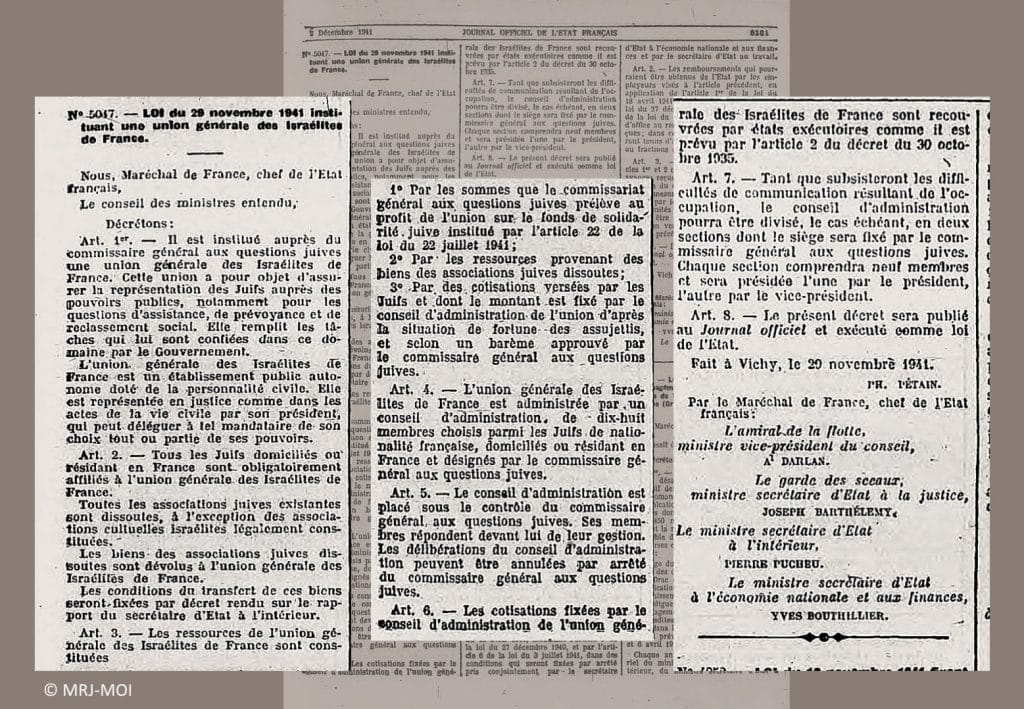
In early 1942, the OSE was forcibly incorporated into the UGIF, along with all other Jewish organizations (except for those in the Jewish section of the M.O.I., which had gone underground).
The OSE then shifted from providing assistance to engaging in humanitarian Resistance, particularly after the roundups of August 1942, when the first children taken in were those who had been rescued from the Vénissieux camp. The danger made it necessary to scatter the children. Georges Garel organized a clandestine network for children, the Garel Network, which would save 1,500 Jews.
In 1944, medical and social assistance to families was the OSE’s sole legal front; the rest of its activities—such as producing false documents, caring for foster children, and organizing smuggling routes to Switzerland—were now entirely clandestine.
Along with other resistance fighters, Charles Lederman, director of the OSE in Lyon and one of the leaders of the Jewish section of the M.O.I., worked closely with the UJRE, the Amelot Committee, the Éclaireurs Israélites de France, the André network, and the MNCR to rescue Jewish children.
References:
— Loinger, Georges, 2010, *Jewish Resistance During the Occupation*. Published by Albin Michel.
— Renée Poznanski, 2006, *Historical Dictionary of the Resistance*. Robert Laffont, ed.