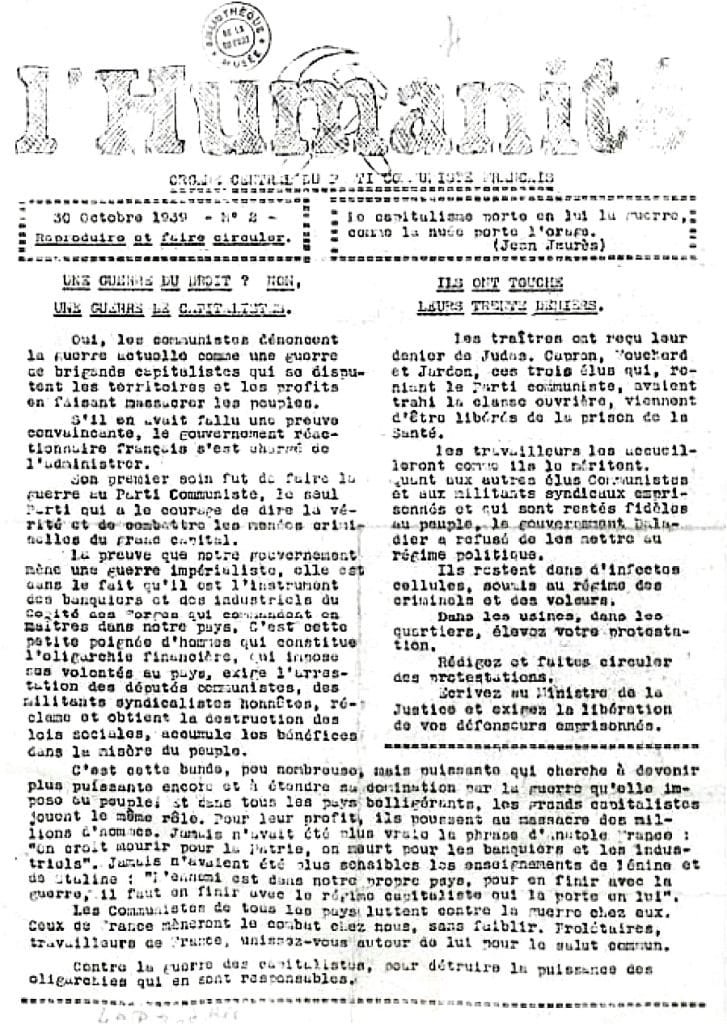
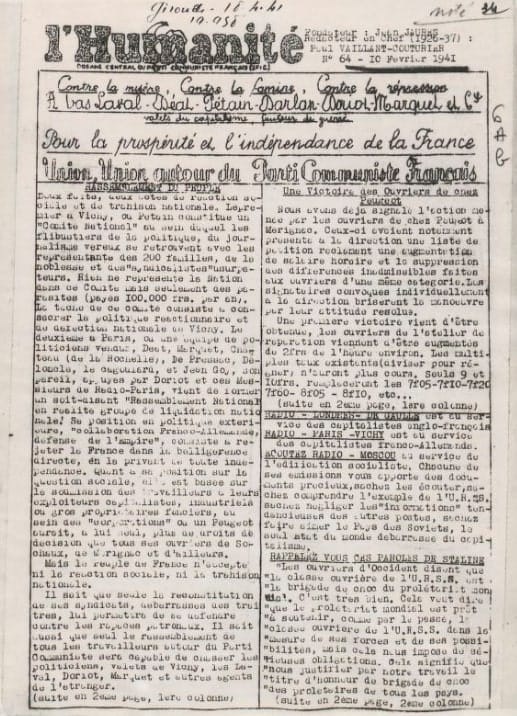
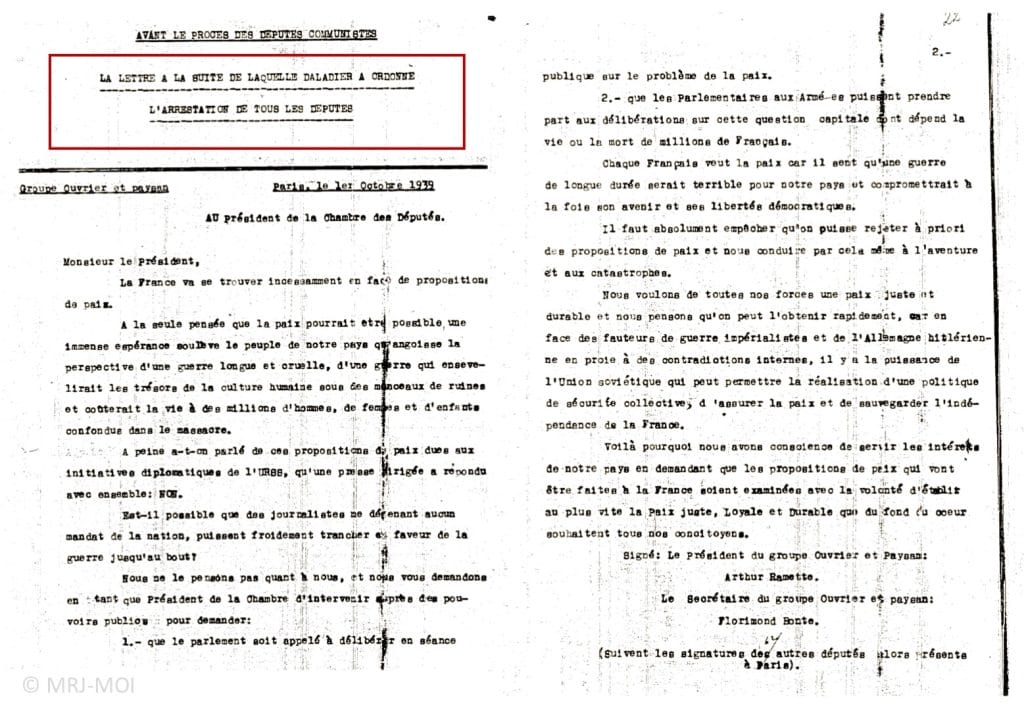
On August 26, 1939, the Daladier government banned the publication of *L’Humanité*, which had endorsed the German-Soviet Pact, a non-aggression treaty between Germany and the USSR. Similarly, most communist newspapers were banned. Thus, on October 2, the police notified Gaston Barrois, the editor-in-chief, of the decision to ban *Naïe Presse*, a Yiddish-language daily.
More than a month elapsed between the banning of *L’Humanité* (August 26, 1939) and that of *Naïe Presse*. The newspaper continued to be published, which allowed Adam Rayski to write an editorial on September 4 in which he proclaimed, in defiance of the Communist International: “We Jews have a score to settle with Hitler… the hour has come; the merciless war begins.” It was necessary to inform, alert, convince, and foster the spirit of the Resistance.
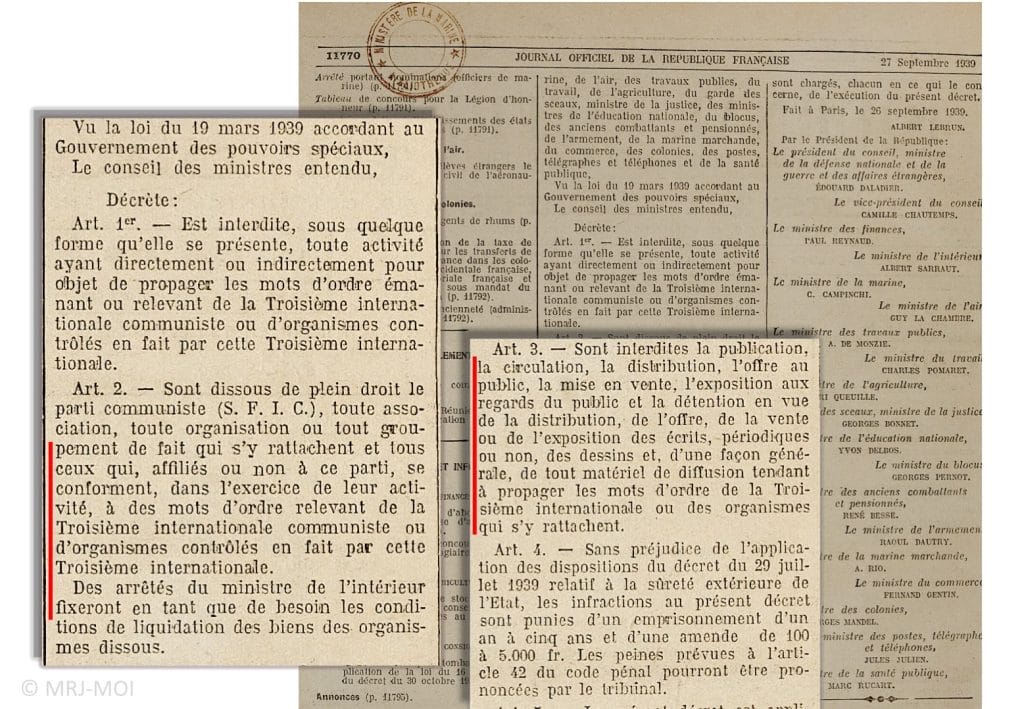
Pursuant to the decree dissolving the Communist Party of September 26, 1939, *Naïe Presse*, a progressive daily newspaper published in Yiddish, was banned from publication, circulation, distribution, and sale. On October 2, 1939, the police notified Gaston Barrois, the publication’s editor-in-chief, of the decision.
In September 1940, the Jewish section of the M.O.I. was reestablished. *Naïe Presse* reappeared on September 29, 1940, as an underground publication. Between 1940 and 1944, 90 issues were published both in Yiddish, under the title *Unser Wort* (or *Unzer Vort*), and in French, under the titles *Notre Parole* (in the northern zone) and *Notre Voix* (in the southern zone).
These newspapers publish safety guidelines, describe life in the camps in France, the deportations, the executions, the extermination, the armed struggle of the Peuple de France, the last letters from the partisans, and the epic story of the Warsaw Ghetto Uprising.
Several staff members of *Naïe Presse* perished during the Occupation, including its editor-in-chief, Mounié Nadler, who was executed by firing squad on August 11, 1942, at Mont-Valérien.
Reference:
Cukier, Simon; Decèze, Dominique; Diamant, David; Grojnowski, Michel, 1987, Revolutionary Jews. Messidor/Éditions sociales